
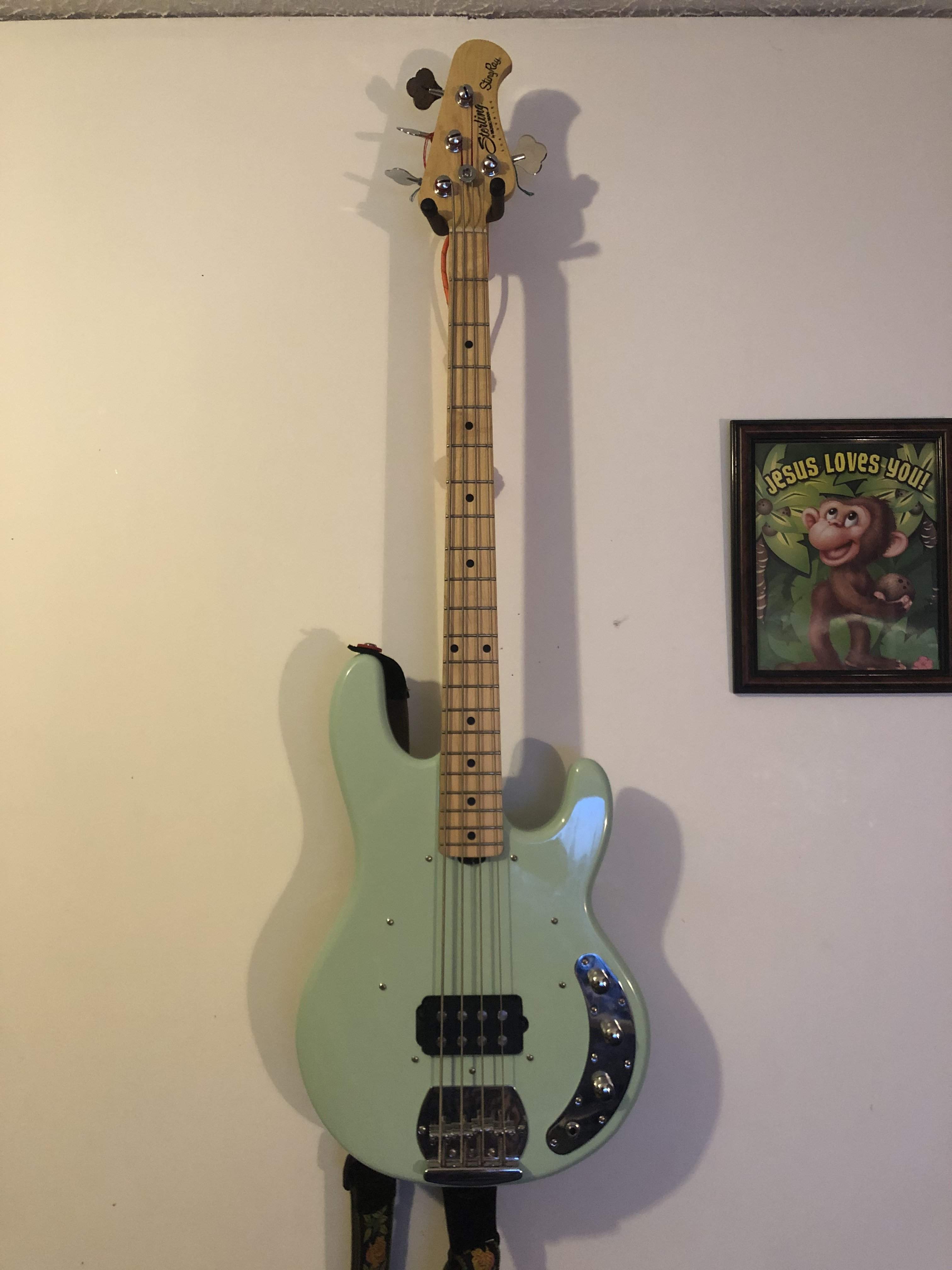
Hey! I’ve been wanting to mess with my string action for awhile but wasn’t sure how low or high I wanted to go. For my sterling stingray what would be a good string height for a nice slap sound but very little to no fret buzz (here’s a picture of my bass if it helps any)

Enjoy the benefits of a premium membership!
Upgrade Account
-
TalkBass has been independent since 1998. Add your voice.
Create a free account to reply to discussions, view embedded media, and browse with fewer display ads.
Join free Log in
Want zero display ads or expanded classifieds tools? Compare plans.
You are using an out of date browser. It may not display this or other websites correctly.
You should upgrade or use an alternative browser.
You should upgrade or use an alternative browser.
Low action?
- Thread starter Hisler
- Start date
More options
Who Replied?

String action is a very subjective thing.
It really depends on your personal technique.
How hard you play. Where you pluck the strings. Close to the bridge? Over the rear pickup?
Over the front pickup? Near the neck? How clean and consistent is your fretting Hand, Etc..
Speaking for myself, I try to get the action as low and comfortable as possible with (my) attack without too much fret buzz.
I like to lower the strings until they buzz then back them off a tiny bit until they stop.
Then I can measure the string height to get an actual number to know where I’m at and then
Get all strings in the ballpark of consistency.
I try to keep all my instruments as similar as possible for uniform feel.
If I can get mine at 1/16 of an inch at the 17th fret (on a fender), I consider that (for me) pretty low action.
Some basses can be set up with ridiculously low action without fret buzz from the factory. My status and Warwick basses were that way.
also don’t Discount the importance of nut height as it relates to playability.
Many production line basses come from the factory with nut action that is too high and that can cause the bass to play more difficult in the lower positions.
I can almost guarantee that the factory nut height on a SBMM Ray can be made lower.
the neck relief also plays a big part in how the bass feels.
I tend to recommend setting up your bass for your style. If it feels right, it probably is.
It really depends on your personal technique.
How hard you play. Where you pluck the strings. Close to the bridge? Over the rear pickup?
Over the front pickup? Near the neck? How clean and consistent is your fretting Hand, Etc..
Speaking for myself, I try to get the action as low and comfortable as possible with (my) attack without too much fret buzz.
I like to lower the strings until they buzz then back them off a tiny bit until they stop.
Then I can measure the string height to get an actual number to know where I’m at and then
Get all strings in the ballpark of consistency.
I try to keep all my instruments as similar as possible for uniform feel.
If I can get mine at 1/16 of an inch at the 17th fret (on a fender), I consider that (for me) pretty low action.
Some basses can be set up with ridiculously low action without fret buzz from the factory. My status and Warwick basses were that way.
also don’t Discount the importance of nut height as it relates to playability.
Many production line basses come from the factory with nut action that is too high and that can cause the bass to play more difficult in the lower positions.
I can almost guarantee that the factory nut height on a SBMM Ray can be made lower.
the neck relief also plays a big part in how the bass feels.
I tend to recommend setting up your bass for your style. If it feels right, it probably is.


Like Lesfunk said, string height (action) is pretty subjective. What might be comfortable for you may be too high or too low for someone else.
If you're comfortable with doing your own setups, I'd simply experiment and determine what feels best to you while allowing the bass to sound the way you want it to. A lot of it depends on the style of music you're playing and whether you play with a lighter touch (low action friendly) or really dig in (higher action required). Will you be playing only fingerstyle or will you be using a pick or slapping? The tension of your strings also a factor. Generally strings with higher tension can be played with lower action without fret buzz.
There's no pat answer to your question. Sure, each manufacturer has its recommended specs, but those are just more or less a reference point to start with. You may find the best action for you may deviate somewhat from the published specs. There really aren't any hard and fast rules.
I'm sure you'll get it figured out. Good luck.
If you're comfortable with doing your own setups, I'd simply experiment and determine what feels best to you while allowing the bass to sound the way you want it to. A lot of it depends on the style of music you're playing and whether you play with a lighter touch (low action friendly) or really dig in (higher action required). Will you be playing only fingerstyle or will you be using a pick or slapping? The tension of your strings also a factor. Generally strings with higher tension can be played with lower action without fret buzz.
There's no pat answer to your question. Sure, each manufacturer has its recommended specs, but those are just more or less a reference point to start with. You may find the best action for you may deviate somewhat from the published specs. There really aren't any hard and fast rules.
I'm sure you'll get it figured out. Good luck.

I typically set it so it doesn’t buzz the way I normally play, if I hit it harder I get a little rattle.
interestingly when I do it by feel and then measure I always get the same reading: .010” relief and 2/32” on the G, 5/64” on the E. For the B string it’s 3/32” all measured at the last fret.
I can get it a little lower but it limits my dynamic range.
interestingly when I do it by feel and then measure I always get the same reading: .010” relief and 2/32” on the G, 5/64” on the E. For the B string it’s 3/32” all measured at the last fret.
I can get it a little lower but it limits my dynamic range.
+1String action is a very subjective thing.
It really depends on your personal technique.
How hard you play. Where you pluck the strings. Close to the bridge? Over the rear pickup?
Over the front pickup? Near the neck? How clean and consistent is your fretting Hand, Etc..
Speaking for myself, I try to get the action as low and comfortable as possible with (my) attack without too much fret buzz.
I like to lower the strings until they buzz then back them off a tiny bit until they stop.
Then I can measure the string height to get an actual number to know where I’m at and then
Get all strings in the ballpark of consistency.
I try to keep all my instruments as similar as possible for uniform feel.
If I can get mine at 1/16 of an inch at the 17th fret (on a fender), I consider that (for me) pretty low action.
Some basses can be set up with ridiculously low action without fret buzz from the factory. My status and Warwick basses were that way.
also don’t Discount the importance of nut height as it relates to playability.
Many production line basses come from the factory with nut action that is too high and that can cause the bass to play more difficult in the lower positions.
I can almost guarantee that the factory nut height on a SBMM Ray can be made lower.
the neck relief also plays a big part in how the bass feels.
I tend to recommend setting up your bass for your style. If it feels right, it probably is.
Link Removed
Link Removed

I typically set it so it doesn’t buzz the way I normally play, if I hit it harder I get a little rattle.
interestingly when I do it by feel and then measure I always get the same reading: .010” relief and 2/32” on the G, 5/64” on the E. For the B string it’s 3/32” all measured at the last fret.
I can get it a little lower but it limits my dynamic range.
I feel like a wee bass toddler asking this, but how much rattle do you tolerate? I recently picked up a new bass that has SUPER low action, and it feels like a different instrument altogether from my thuddy jazz bass with what I now realize must be relatively high action.
i find that I have to play the new bass SUPER softly to avoid the rattle, but if I dig in just a little bit I can get a (nice?) snap to the notes. At the same time, I ask myself 'is this what it's supposed to be like?'

I like to set the action with the bass plugged into an amp. Sometimes there will be a buzz or rattle unplugged that doesn't come through the amp. The action on my P-bass doesn't sound good at all acoustically but none of the noise can be heard through an amp.
Rick B.
Rick B.

Action height is a personal thing, super low action (shredder low) makes fretting easy, increases likelihood of fret buzz and reduces dynamic range. High action makes fretting harder, reduces likelihood of fret buzz and increases dynamic range.
The best way to know what you like is experience, experiment with different heights, there is no "right".
I personally do not like a low action, as it imposes too much limitations on dynamics and techniques for me.
I play generally with a light touch as that allows me the option of a wide range of dynamics, I don't play in only one position as there are different tones available by plucking along different points of a strings length.
I also do not restrict myself to only one or two plucking techniques, I use standard two finger plucking as well as classical guitar plucking, strumming, slapping, double thumb, faux pick, actual pick, old school thumb and occasionally tapping. It just depends on what I am playing and how I want a phrase to sound.
I offset the higher action by using lighter gauge strings that are as even tensioned as possible.
The best way to know what you like is experience, experiment with different heights, there is no "right".
I personally do not like a low action, as it imposes too much limitations on dynamics and techniques for me.
I play generally with a light touch as that allows me the option of a wide range of dynamics, I don't play in only one position as there are different tones available by plucking along different points of a strings length.
I also do not restrict myself to only one or two plucking techniques, I use standard two finger plucking as well as classical guitar plucking, strumming, slapping, double thumb, faux pick, actual pick, old school thumb and occasionally tapping. It just depends on what I am playing and how I want a phrase to sound.
I offset the higher action by using lighter gauge strings that are as even tensioned as possible.
I feel like a wee bass toddler asking this, but how much rattle do you tolerate? I recently picked up a new bass that has SUPER low action, and it feels like a different instrument altogether from my thuddy jazz bass with what I now realize must be relatively high action.
i find that I have to play the new bass SUPER softly to avoid the rattle, but if I dig in just a little bit I can get a (nice?) snap to the notes. At the same time, I ask myself 'is this what it's supposed to be like?'
That's a great question. Depending on how I play I can induce some fret rattle, like you if I dig in I get a little raspiness on the front of the note and that's fine, you don't really hear the rattle through the amp, not much anyway.
Some people prefer no rattle at all and they set the bass with higher action which produces some nice clean notes but it's harder to play. Because in the early days of playing in clubs our sets were very long, sometimes it was one six hour set I decided to lower the action and play softer and that has stayed with me.
I find on a Jazz Bass if I set the action too low it doesn't speak very well above the 12th fret, the notes rattle and choke out but that is with ridiculously low action. Strings also play a part here, lighter sets need a lighter touch or higher action, heavier sets depending on construction can tolerate lower action and a harder touch.
So largely it depends on what you play, how you play and what you're expecting sound wise and that is different for everyone. With properly levelled frets you can set the action quite low but it doesn't stay that way for long as when you play frets wear unevenly, this means more visits to your local luthier to keep them level and eventually refret.
Even that depends on your touch, your hands tend to be sympathetic so if you pluck hard you tend to fret hard and of course this introduces more wear on the frets. That's why some people get a couple of years out of a fretless board and others get decades out of it before it needs levelling.


