• TalkBass has been independent since 1998. Add your voice.
    Create a free account to reply to discussions, view embedded media, and browse with fewer display ads.
    Join freeLog in
    Want zero display ads or expanded classifieds tools? Compare plans.

Double Bass Lowering string height of a double bass

Nov 2, 2020
101
172
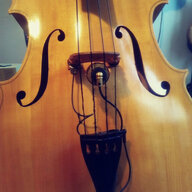
I've been deterred from playing my double bass because I feel the string height is too high. It feels harder to play compared to other double basses I've tried and the string height adjuster is all the way down.

How would I go about lowering the string height?

upp1rjwmxs9prphqgezi.jpg
 
  • Like
Reactions: lowendrachel
This is probably heresy, but I made a jig and used my table saw to remove 3/16” from the top half of my bridge at the joint where the adjusters live. The top was still perfect and the feet sat nicely on the face of the bass. But I have good tools and do this kind of stuff all the time.
image.jpg
 
Last edited:
  • Like
Reactions: getrhythm
This is probably heresy....]

Hey 9 thumbs,

Not heresy at all! Taking wood out of the middle portion of the bridge (e.g., just above or below the adjusters) is often the easiest way to adjust a bridge. The same applies if your bridge is too short and you want to make it taller (except that you'd be adding in wooden shims rather than taking out wood).

The other options are to recut and reshape the feet where they touch the top (a ridiculous amount of work) or to recut the very top of the bridge (the "crown"). Recutting the top isn't as hard as reshaping the feet, but neither of these are necessary if you work on the middle of the bridge feet.

Ntang, if you're pretty handy, have tools, and want to understand your bass's functioning a lot better, you might be able to do it yourself. Otherwise, it's an easy job for a luthier.
 
...

Ntang, if you're pretty handy, have tools, and want to understand your bass's functioning a lot better, you might be able to do it yourself. Otherwise, it's an easy job for a luthier.

My concern about advising @ntang to start hacking up his bridge is that we don't know anything about this bass or what else might be going on with it. Those strings do look too high to me, but we can't see the nut, which may also be a factor. It's not a great photo, but we can't know the condition of the fingerboard, which might suddenly matter if the strings do come into a proper range of height at both ends of it.

Looking at your profile and posting history @ntang I'll speculate that you are naturally a BG player. You posted in October that you had not played this bass in 2 years and were considering selling it. Those were your only two DB posts, so I apologize if I'm making bad assumptions. But, if you would like to learn this instrument, a professional set up will make the process much more enjoyable and increase your likelihood of success. If you want to sell it, DIY modifications are going to be a huge red flag to potential buyers, whereas a recent setup and assessment from a DB luthier (not a guitar luthier) will increase the value.
 
My concern about advising @ntang to start hacking up his bridge is that we don't know anything about this bass or what else might be going on with it. Those strings do look too high to me, but we can't see the nut, which may also be a factor. It's not a great photo, but we can't know the condition of the fingerboard, which might suddenly matter if the strings do come into a proper range of height at both ends of it.

Looking at your profile and posting history @ntang I'll speculate that you are naturally a BG player. You posted in October that you had not played this bass in 2 years and were considering selling it. Those were your only two DB posts, so I apologize if I'm making bad assumptions. But, if you would like to learn this instrument, a professional set up will make the process much more enjoyable and increase your likelihood of success. If you want to sell it, DIY modifications are going to be a huge red flag to potential buyers, whereas a recent setup and assessment from a DB luthier (not a guitar luthier) will increase the value.

Thanks for the informative response! I'll try to get some better pictures of the bass. You are right in the assumption that I am selling it. I just don't have the time to play it anymore since I'm more of a bassist and guitarist. But I feel if I can get it to play the way I feel is comfortable I might start devoting more time to it as I used to play a lot a few years ago. I would never do any DIY mods, I'll have probably have it looked at by a DB luthier.
 
  • Like
Reactions: scott sinner
This is probably heresy, but I made a jig and used my table saw to remove 3/16” from the top half of my bridge at the joint where the adjusters live. The top was still perfect and the feet sat nicely on the face of the bass. But I have good tools and do this kind of stuff all the time.
View attachment 4621273

A+ effort for self reliance & creativity.

I also often use my tablesaw to "guillotine" the middle section of the bridge....any excuse to justify that $5000 Sawstop!
 
I also do alot of woodworking - curious, what do you use to hold the bridge in place when trimming it?

I have a hold down jig with Destaco clamps, but I'll also use guitar builder's binding tape. It is strong AF, but I can also saw right through it with no issues. Usually there is a spacer, but for this one the bass was a bit funky. (Also no Sawstop in the photo here. I have a 1946 Unisaw bolted right next to it) I still use a sander like Greg mentioned to fine tune them, but for the initial cut this is fast. Basically- use whatever tools you have on hand and are comfortable with. I'm positive I could do it just as well with a Swiss Army knife; it would just take longer....

B38.JPG


I've shown it before, but here is my massive tablesaw setup for the tool nerds:

Condino tablesaw 1.JPG


Condino tablesaw  2.JPG


Condino tablesaw 3.JPG
 
  • Like
Reactions: strigidae
I can’t watch this.....

I know a whole lot more people who've died or been seriously %$#@'d up by automobiles, but we all still keep driving everyday....;)

The Sawstop is a wonderful piece of technology. I use it for myself & it is the only saw I let the students and apprentices use. Yes, I've seen it set off two times, both from moisture content in glue that had not dried. When it blows, I send the cartridge back to SS, they evaluate the data, & usually send me a new one and a fresh blade. The damage to the main saw carcass is zero- it is designed to withstand the forces. It destroys a brake cartridge and I do not re use the old blade. It takes about three minutes to change out and have operational again.

This is my second one in 20 years. 'Cost about as much as a nice old Juzek, but is worth every penny. As a business expense it works out to something like $2.35 per week amortized over 20 years....
 
Last edited: