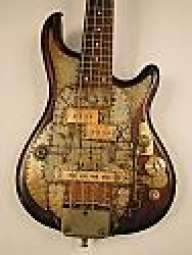
The adjustable bridge on my Christopher bass (w/ solid top) is so tall, even at its lowest setting, my string action is painfully high. My teacher suggests I take it to be shortened, perhaps as much as 1/4 inch, but I can't make it to a luthier in the big city for several weeks. So, I'd like to try it myself.
I want the bridge to be low enough that the adjusting wheels have a little bit of range, so I'd take it a little lower than I need, and adjust upwards.
I'm aware of two approaches:
1) carve down the feet. I've read where I can carefully saw off a little less than I need, then strap some sandpaper over the top where the bridge stands and drag the feet back & forth across it (matching the angle to fit the top).
2) leaving the bridge in place, deepen the string grooves (one at a time, checking the action), then sand down the edge to fit the groove depths.
1) leaves the feet thinner, and risks a fallen soundpost, while 2) fattens the edge where the strings cross.
Suggestions (including DON"T DO IT!) would be appreciated.
Rees
I want the bridge to be low enough that the adjusting wheels have a little bit of range, so I'd take it a little lower than I need, and adjust upwards.
I'm aware of two approaches:
1) carve down the feet. I've read where I can carefully saw off a little less than I need, then strap some sandpaper over the top where the bridge stands and drag the feet back & forth across it (matching the angle to fit the top).
2) leaving the bridge in place, deepen the string grooves (one at a time, checking the action), then sand down the edge to fit the groove depths.
1) leaves the feet thinner, and risks a fallen soundpost, while 2) fattens the edge where the strings cross.
Suggestions (including DON"T DO IT!) would be appreciated.
Rees