• TalkBass has been independent since 1998. Add your voice.
    Create a free account to reply to discussions, view embedded media, and browse with fewer display ads.
    Join freeLog in
    Want zero display ads or expanded classifieds tools? Compare plans.

Double Bass lowest playable pitch - detuned C extension

Hi everyone,

I'm wondering whether someone could answer a couple of questions i have regarding the very lowest possible range (ie. for a bass with a C-extension). It's for an orchestral piece I'm writing and involves slow tutti sectional writing (ie. not solo bass) The sort of things i'm planning are:

1) Detuning the bottom C to a low A (ie. tuning: lowA A D G) - Long sustained arco at a range of dynamics pppp to f on this open string
2) A sustained octave A with the two bottom open strings (would the difference in tension
(I want the orchestra as a whole to sound like a huge cathedral organ)
3) Low A pizz at a quiet volume
4) A long sustained note starting at Low C where the string is detuned gradually (also lowering the dynamic) until it no longer 'speaks' leaving just the sound of the bow on the slack string - at what roughly what pitch is this likely to happen

I'm wondering if anyone could advise me on the feasibility of any of these ideas.

Thanks
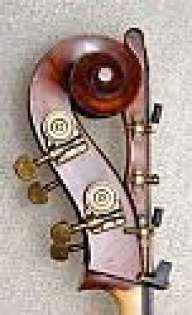
 
1) Detuning to low A would make hassle of transposing fingerings. Unpractical if you want to use the string for anything else than open A.
2) sustained octave is probably fine.
3) Detuned strings might be wonky about pizzicatos
4) Possible, but if the said string is detuned to A, then the note cannot start at C. No idea of when the sound stops - but it's going to end in the string smacking the fingerboard at a few Hz.
 
It's been done. If you ask that players begin the piece with normal tuning and then gradually de-tune to an A, you should know that it will be VERY out of tune. Not just the low string, but the entire instrument will go severely out of adjustment. So don't do that unless you're just looking for noise and sound effects.

However, if you had one or two bassists begin the piece with their instruments already tuned precisely for a low A scordatura, you could achieve most of what you want. Rather than de-tuning, they could simply glissando from a concert C to the open A and you'd have the same effect without the extra hassle.

Any other material in the piece should probably avoid the low string. It will be very floppy and difficult to play with a good sound. Perhaps it would be best to have a Bass I and Bass II part, with the Bass II in scordatura and tacet for any lower material not utilizing the sub-C range.
 
1) Detuning to low A would make hassle of transposing fingerings.
True, although on a five-string it would be quite easy. It's precisely the same fingering system as the "other" A string. With a C extension, you'd basically have to learn a fingering system for a D-flat string. A B-extension would make it a D-string, which wouldn't be so bad at all.

Given the variety of fifth-string/extension options, it wouldn't be worth the trouble of providing a transposed part with fingering suggestions.
 
It's been done. If you ask that players begin the piece with normal tuning and then gradually de-tune to an A, you should know that it will be VERY out of tune. Not just the low string, but the entire instrument will go severely out of adjustment. So don't do that unless you're just looking for noise and sound effects.

However, if you had one or two bassists begin the piece with their instruments already tuned precisely for a low A scordatura, you could achieve most of what you want. Rather than de-tuning, they could simply glissando from a concert C to the open A and you'd have the same effect without the extra hassle.

Any other material in the piece should probably avoid the low string. It will be very floppy and difficult to play with a good sound. Perhaps it would be best to have a Bass I and Bass II part, with the Bass II in scordatura and tacet for any lower material not utilizing the sub-C range.

Best response here.
 
That's what Crumb did - divide the bass section.

The low A will have a tendency to go sharp as bow pressure is applied to the loose string but I don't most people will notice.

I think it's definitely doable. But do realize there are huge variations in sound - not just in double bass timbre but also the execution of the extension. Many Jackstadt basses have a low B extension.
I've played a Pollman with a C extension - that bass was very nasal but very clear.
 
I think Thomas Ades has called for a low 'A' - I'm thinking of the violin concerto, which I saw two years ago here in Boston. The BSO solved the problem by having Dennis Roy play with his 5-string, which has an extension (see: Invalid Link Removed). It looked like they miked him - or at least, there was a mike in the bass section for *some* reason. It was a reduced orchestra, and I'll bet the rest of the section did not bother retuning.
 
It would work, but as Paul says it will need to be tuned well and settled. Getting it back up to C in the same piece could be rough. You will need two different bassist doing it.
I can tune down to D with good accuracy during a concert, I can get the G up to A pretty good, too. I can also get the low E down really low, then back up to E.

These are all things I do in my own music, so they are specific skills I have worked on.
You just aren't going to get orchestra musicians to develop a whole skill set like that!
So: separate the parts between basses.
 
Why going through the hassle of detuning?
Who says you can't play lower than the lowest open string?

Invalid Link Removed

(I can't see the point doing this on a violin, but for the bass this should be interesting. Anyone tried this?)
 
Why going through the hassle of detuning?
Who says you can't play lower than the lowest open string?

Invalid Link Removed

(I can't see the point doing this on a violin, but for the bass this should be interesting. Anyone tried this?)

Sure. Mark Dresser did most of the research for bass. It works, but it has a more gritty tone and can be unstable - though awesome.
 
I just tried it on my Pfretzchner. It basically works up to mf for sustained notes and pizz, although I wouldn't want to have do do anything quick with the string so slack, which makes articulation very slow, not to mention having to figure out where the notes are. Also, yes, you definitely lose a lot of volume, so you'd want at least half the section doing it. This has been done before. Not such a big deal as long as you don't put in any Don Juan:hyper: type licks
 
The improvisor in me wants to say we should be able to do it with a normal set up, though you are correct.
In going to back to some sub-harmonic studies, (at low C on the A string) one thing you find is that bow turns are difficult. I found that if I start at the frog and turn the bow midway instead of going all the way to the tip you can get a cleaner (still noisy) long tone.
 
I agree, we should be able to do it with normal setup. but the less tension on the bow hair idea is from an interview by this violin player.. I forgot her name.. she has a cd "life below g" or a similar title.
I´ve found it helps to get a feeling how to do it.. not so much downward pressure needed, just a little more than weight alone I´ve found.

bow turns are very difficult.
also long, stable tones are hard as are short fast passages : )

funny enough I´ve found it easier to start around a quarter of the bow from the tip than at the frog.. upstrokes easier than downstrokes.
but I think this technique reveals bowing inaccuracies - change of angle, speed, pressure, contact point - all ways to end the subharmonic at an unwanted moment.
this is also mark dressers point - even if you don´t use subharmonics in your music, it´s usefull to practice them to get a good bowing technique. "guts" dvd recommended.
 
Here's what I have done in the past. Take your biggest available bass and put it in low 4ths tuning, BEAD. You now have a dedicated sub-contra, and if the player's ever handled a five-stringer before, you're home free. Detuning a bass in this tuning even further gives a lot more stability.

Alternatively, take the biggest bass and tune it in high fourths tuning ADGC (but an octave down). Again, the fourths interval is preserved, and if your player has ever played in this tuning for jazz work, and many have, he or she will only need to remember that the bass now sounds two octaves lower than written.

You'll have to detune a low B string for the low A. Results are variable, BUT! if you assign one bass to double the dedicated sub-contra one octave higher, the results can be amazing. Big, phat, chunky bass. Pizzicato is not much good down in this range unless it is doubled. Obviously, rapid passages should also be avoided if you do not wish to become a statistic. ;)

You can hear some of the results I've gotten with the New Family Orchestra at http://youtube.com/user/octavivo. Low-res YouTube videos do not have the best audio, but if you can listen through a good set of headphones, you'll get the idea. BTW, the big bass in the orchestra clips will handle a low G, but so far no string available has worked well enough.