• TalkBass has been independent since 1998. Add your voice.
    Create a free account to reply to discussions, view embedded media, and browse with fewer display ads.
    Join freeLog in
    Want zero display ads or expanded classifieds tools? Compare plans.

Double Bass Luthier CSI December 2020: Epiphone tailpiece bonus issue

james condino

Spruce dork
Commercial User
Sep 30, 2007
5,443
13,478
asheville, nc
www.condino.com
The old 1940s US made Epiphone basses have a strong following among a select group of people. They tend to have smaller body sizes with a nice voice and they probably have the best shape and size neck from any of the domestic manufacturers of that era- plenty of mass with a great feel in hand, a good profile, and a big confident scroll. From a technician's viewpoint, it is also nice that even though they used a dovetail joint, it was bigger that their contemporaries and much more sturdy. I see plenty of broken Epiphone necks, but it is rare to see a failed dovetail.

Most Epiphone & Gibson history nerds generally agree that Gibson purchased Epiphone for two reasons:

1) to buyout their guitar competition
2) for the bass production equipment

There are plenty of less than official stories that the Epiphone employees were not happy with the sale of the company, so they burned and destroyed the bass production tooling, hence they have never been made since.

There is an old thread in the archives from about ten years ago where a couple of the original body molds showed up on EPAY. To date, I don't know where they ended up and I have not seen anything produced on them.

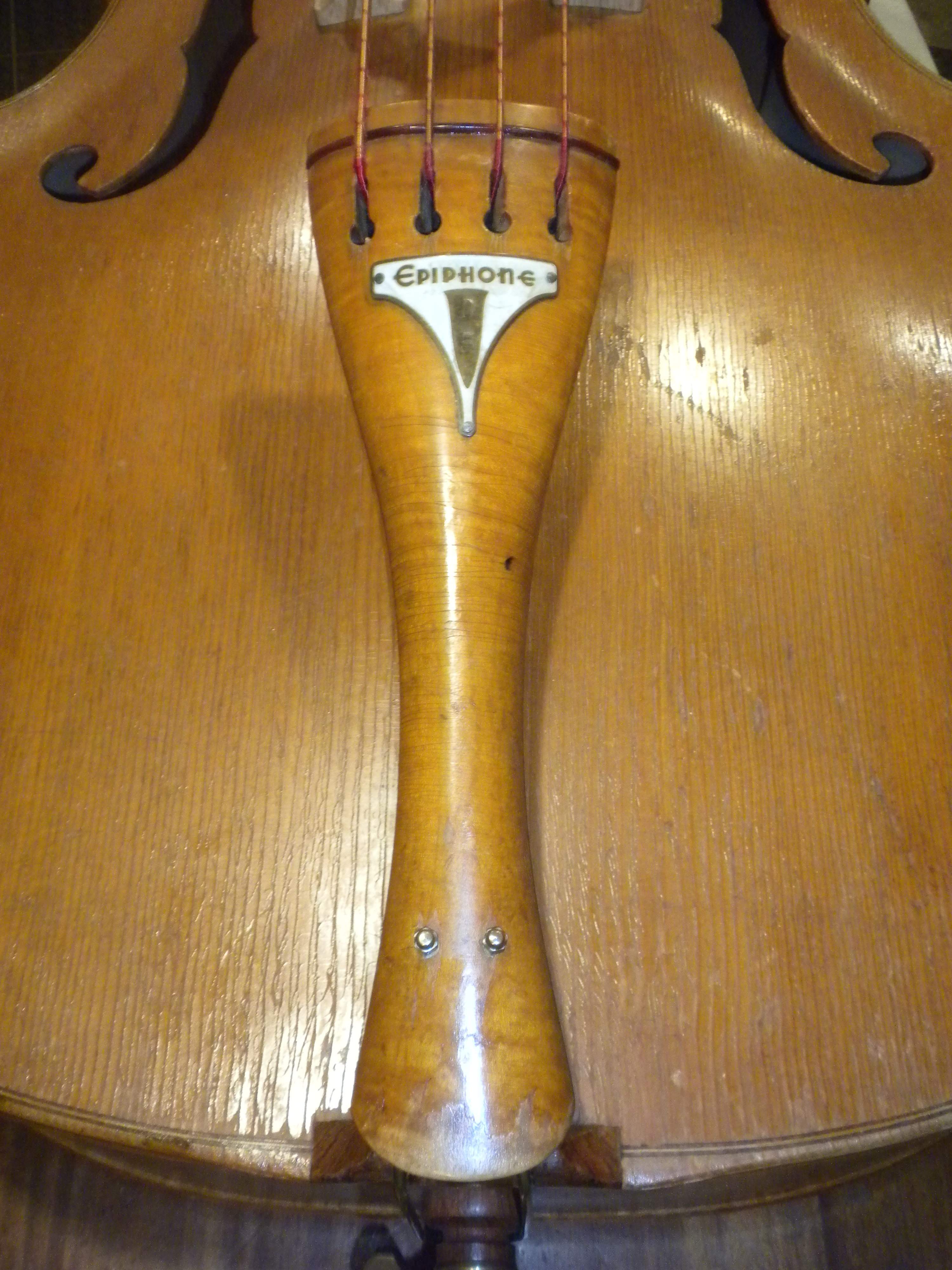
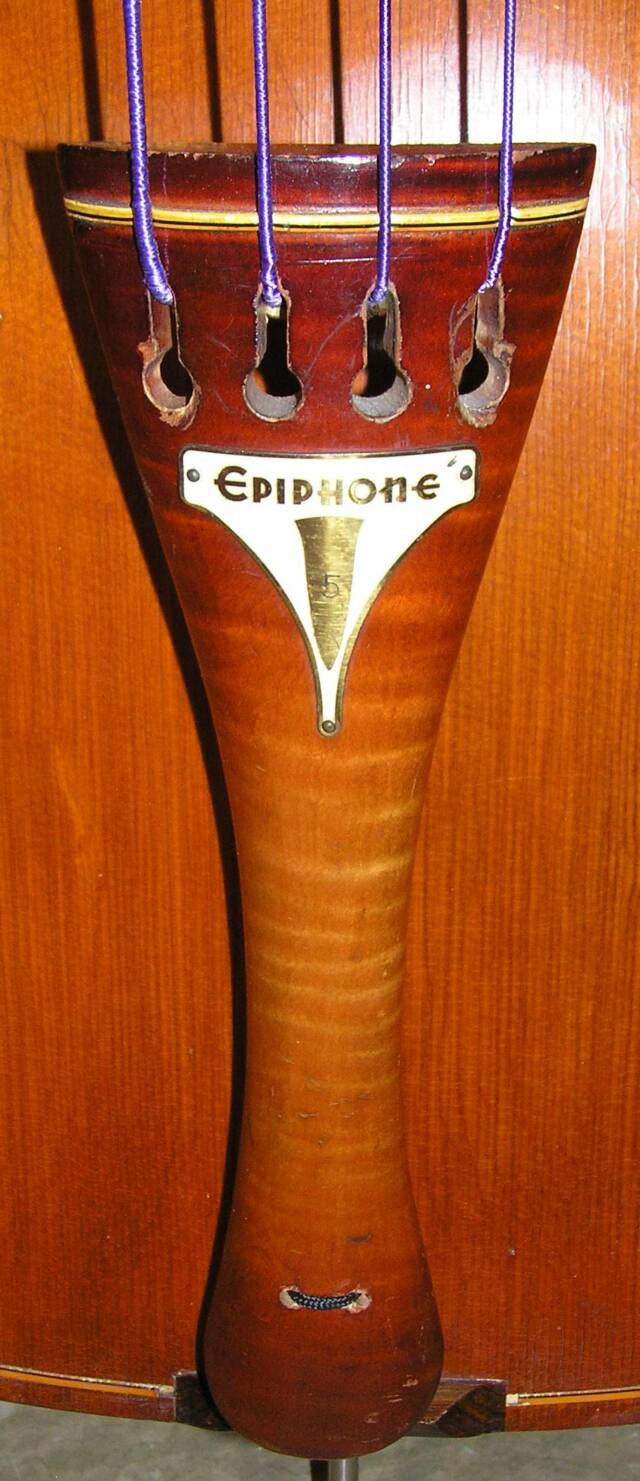
One of my favorite style features of the old Epiphone basses was the tailpiece. It was not any structural or tonal masterpiece; they just have a period vintage vibe that reflects a lot of that early rock-n-roll era that looks distinctly vintage Americana.

Most were curly or birdseye maple & they had big brass badges that matched the guitar headstocks. Many of them had a matching sunburst finish to compliment the finish of the bass; something I often do on the instruments and fittings that I make.

Here are a couple of examples:
B105.jpg
DSCN8270.JPG
Epi_B-2_badge_op_640x594.jpg


Wendy's website over at bassmonkey.net goes into great detail on the old Epiphones.
 
Last edited:
Regardless of what you may think of them, when I do insurance writeups and estimates, I generally downgrade the street value of an instrument approximately $300-350 if the original tailpiece is missing. Insurance guys like the details and vintage folks are ornery about everything original and period correct. That is a reasonably accurate number from the viewpoint of an insurance company: what will it take for me to locate an original within 30 days somewhere in the US and actually get the current owners to part with it; not how much can I bottom feed it for if I spend 6000 hours searching the internet for the next three years.

There is only one problem: the production was so small for Epiphones that they are almost impossible to find.

A while back, I had someone visit the shop who REALLY liked old Epiphones; she owned a couple of them. (It was not Wendy or one of my other customers that have been featured here in the past.) One bass was missing the original tailpiece and it bothered her. A nice bonus for me was that she had a perfect example on her other bass and was fine leaving it at the shop for a while.

We'll call it the blonde one in the middle; time for a bit of creative fun....
 
Last edited:
Something I learned while working at one of the world's great art museums, right down the street from Ed's old office:

Expert forgeries start with an original example or with something that is well documented in the public record and is currently missing....

I pulled the blonde tailpiece and use it to make an exact pattern, with all of the original's asymmetry. This is more challenging than you might expect for someone who has built hundreds of new instruments because we tend to sweat the little details and try to improve on them; asymmetry drives us nuts & factory builds tend to be on a much higher production schedule, so they will blast thing through the process and 'git 'er dun. Small shops will obsess and waste tremendous amounts of time over details that may never be seen for another 50 years until a future repair person takes the top off, but we sleep better knowing we went the extra distance.....

I used the router table with a pattern bit + bearing to clone the outer profile. This was the master copy I used to make a couple of tailpieces. Technically they were 2nd generation copies because I didn't want to push my luck with that fragile original.

DSCN1456.JPG


A few more details:
DSCN1457.JPG
DSCN1460.JPG
DSCN1461.JPG
 
Last edited:
At the time I did this project, I could not find a source for an original tailpiece. They were stamped out of sheet metal embossed, and sprayed with a very durable, likely baked on enamel paint. I contacted several die cast metal shops about a reproduction run and the price was several thousand dollars for an initial batch with no guarantees.

The vintage guitar guys regularly trade one very similar to this, but they go for about $250 each for just the badge. (I believe that there is a Chinese made reproduction made today).

Our friend John Hay, aka 360guy, has also come up with a great solution and makes these:

john hay repro epi tailpiece badge.jpeg


I had none, so there was a bit of problem solving....
 
Last edited:
I've seen two main methods for attaching the badges over the 40 or so that I've seen:

1) small brass screws
2) small brass brad nails

This one had steel nails, driven in a bit hard & eventually caused the nitrocellulose finish to crack. You can also see the sloppy overspray on the what I'll call the tailpiece saddle where the strings rest on their way to the bridge:

DSCN8277.JPG
 
Lookin' around, I kept running into guitar guys that would call the missing badge an Epiphone "bikini" badge...that got me thinking about a solution. I've seen plenty of reproduction tailpieces and plenty of mediocre reproduction bikini badges, but....I've never seen anyone forge the absence of one; a faux bikini line. There was my missing solution. I had seen a few that had a long life of gigging that bent or broke the badge. The exposed part was all clean underneath but showed a distinct tan line.

Shaping the maple was pretty basic- a few hand rasps to rough it out and then clean it all up with sandpaper. Many of the original tailpieces that I've seen show a common tooling mark. On the bottom flat surface, there are a couple of thin small ridges; evidence that the planer or jointer blade had a couple of dings in the blade. After the final surfacing, I took one of my old scrapers and bashed it with a hammer in a couple of spots; perfect. The next pass left a smooth surface with an obvious ridge.

B110.JPG
B111.JPG


Drill a few holes and then I used a small handheld rasp for the keyhole.
I handcut a the channel with a simple saw and made the saddle out of a scrap of ebony with and exacto knife and a little bit of sandpaper.

Epiphone only sprayed nitro finish on the topside, but left the bottom unfinished, but with a wash coat of yellow aniline dye coloring.

B112.JPG


I handrubbed a thick varnish for the basic finish. Then I made a simple mask out of sheet metal patterned off the original badge. That was nailed in position, "relic'd", and then removed leaving the tan line..

B108.JPG
B107.JPG


The finishing touch was to go in the parts drawer and pull out one of the old rigid style original tailwires and mismatched patina acorn nuts. I would put a flexible wire cable for the working unit, but period correct parts seemed fitting for the handoff.

B113.JPG


'Basic project, but the spice is in the details and it is nice to work on something that does not take several months and is measured in the 100s of hours.

B109.JPG


There are a couple of more recent ones now out in the trenches with a matching sunburst that are better left anonymous.
 
Last edited:
well done!

I played a few epiphones at a shop in western Massachusetts and didn't bond with any of them. I wish I could describe how they felt to play. "Foreign" is the only word that comes to mind. The guy also had an old American standard that i did bond with but was about 1k short of the price tag.
 
They all have pros and cons. I'm a large enough person that I most often reach for my American Standard. I've played plenty of basses that other folks bonded with tremendously while I though they were crazy to pay $25,000 or more for, just as my choices don't work for them.

We are all very lucky to have a lot of different options to be able to pick the one that works best for our individual needs and style. Arnold once said to me, "Anyone who plays the bass is a friend of mine."