That sounds like a disturbing concert experience.
It's performance art, attendees are encouraged to bring ear protection, Eye protection, wear full Kevlar body suits as well as face shields.

TalkBass has been independent since 1998. Add your voice.
Create a free account to reply to discussions, view embedded media, and browse with fewer display ads.
Join free Log in
Want zero display ads or expanded classifieds tools? Compare plans.
That sounds like a disturbing concert experience.


Well if you can't be famous, might as well be infamous!

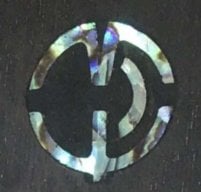

Since many readers of this thread are beginners like me, it may be useful to document how I fared with the moon-shaped control cover plate.
Filing the thing to shape was a mixed experience. On the outside (the convex curve) filing went well. But the inside (the concave curve) was very difficult to file, though I tried many round and half-round files. This is probably due to the fact that you have to hold the file perpendicular to the edge, as opposed to the convex side where you can file parallel to the edge.
In the end, I made a new cover. I wanted to do a better job at sawing the concave curve so I wouldn't need to do so much filing.
Also, I hadn't drilled any holes in the cover. This is easier to do in a bigger plate, before cutting the piece out. So that's another reason for making a new one.
This time I had fewer flying shards because I kept them mostly under a push stick. To illustrate this, here you can see I'm about to cut off a shard:
View attachment 5125593
But instead of doing it like that, I held this push stick (made of multiplex) on top of the shard while cutting:
View attachment 5125595
Here it is in my old heavy vise. The vise has serrated jaws, so I made smooth inserts from multiplex. By the way, this photo shows the nice gold-ish colour rather well:
View attachment 5125598
The cover now looks like this:
View attachment 5125596
Two holes for kill switches, one hole for the jack, and three for screwing it down.
It is far from perfect, but that doesn't bother me. It is rough and unique, and very me. Most things I've made are like that.
I plan to bevel it, with files. I hope that goes well.
View attachment 5125597
I don't quite understand why you are having trouble filing the perimeter curves. To me, I would probably spend 15 minutes filing the concave and convex curves of that part to shape. I would clamp the plate in a vise with wood blocks, like you are doing. I'd file the jagged parts off and bring the shape to the lines with a fairly large coarse half-round file. In US series, a 10" Bastard Half Round file. In Swiss Pattern, a #00 Series. Then I'd go over it with a 8" Smooth Half-Round file to smooth it out and remove the marks from the Bastard file.
Well, part of that was simply inexperience. Not knowing how a file I've only ever used on wood will work on brass . Not knowing what result to expect from, say, ten seconds of filing. And so on.I don't quite understand why you are having trouble filing the perimeter curves.
Well, part of that was simply inexperience. Not knowing how a file I've only ever used on wood will work on brass . Not knowing what result to expect from, say, ten seconds of filing. And so on.
So I returned to it the next day, and things went better. I'm still a beginner but I'm a bit less of one than I was yesterday.
View attachment 5126684
Still somewhat rough here and there but that doesn't bother me. And I am especially proud of those holes.
So there it is: a piece of self made hardware for my new bass!
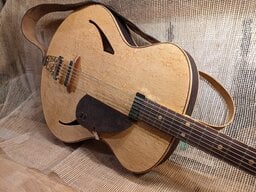
You may be OK with it now, but you will be looking at it forever. As your metal working skills improve, you may regret not having take the time to do a better job smoothing out the curves and adding the bevel the Bruce suggests....
Still somewhat rough here and there but that doesn't bother me. And I am especially proud of those holes.
So there it is: a piece of self made hardware for my new bass!
I do understand what you're saying, and I agree with you in principle. And I haven't yet fully dismissed the option of taking the time now to do a better job.You may be OK with it now, but you will be looking at it forever. As your metal working skills improve, you may regret not having taken the time to do a better job smoothing out the curves and adding the bevel the Bruce suggests.
I do understand what you're saying, and I agree with you in principle. And I haven't yet fully dismissed the option of taking the time now to do a better job.
All the same, I don't want to linger on this too much, for several reasons, including the fact I'm building a bass that I want to play in the foreseeable future. And if in a few months or years I find that my skills have improved, no one will stop me from loosening three screws, taking the control cover off the bass, and do that better job.
And then there's this, and it may be the hardest thing to explain: I need to take into account how my learning curves work. I've been reading this thread, picking up a lot of new information, asking questions. I've bought some new tools. I've drilled the six holes in this cover plate, using the Spot Drilling technique as explained, and they came out basically flawless. All this amounts to a lot of info and skills, which I acquired in a short time.
Now I can feel I'm reaching a saturation point, where I cannot process and apply any more info on the subject. As a result, I may easily become careless and botch up my good work. I'm speaking from experience, it has happened to me many times in many areas.
So yes, I agree with you that I will derive more satisfaction from doing a better job, which is why I need to make sure I tackle that better job only when I'm ready for it.
I was going to ask if he had half-rounds, to me that would make the interior curve easier than the exterior, even if the file radius and the desired curve didn't match exactly.... you'd have a bit more contact but still have control of the shaping...

Good advice for everything.I think you need to clamp a piece of the scrap cutoff in your vise, and spend a little quality time going at it with a file. Practice taking off material pushing hard, filing down lumps, making a smooth curved surface, etc. Get a feel for how to file metal on some scrap. Practice until you feel comfortable. Then finish up your part.
Good advice for everything.
One can learn from reading and seeing and hearing, but you don’t really know it until you have done it wrong a few times before getting it in your hands.
I seem to end up with a steep learning curve with every new tool or process.
My wife wonders why I keep piles of scraps in the garage, but I know. It’s my mistakes pile. Past mistakes or future ones waiting to be made.
Funny you say that. I'm planning on trying out my dad's old router* for the first time later this week, and already have a note to scare up some scrapwood to practice on. I've got a barrel of pallet wood handy but don't want to use it in case of stray nails.Absolutely. When I'm testing out a new machine or tool, I'll always try it out on scrap wood or metal first. Even when I'm doing a complicated router setup on an instrument part, I'll often do a test run on some scrap, just to make sure that all the settings are right. That's an important part of Craftsmanship: Finding the mistakes before they happen.
Just in case anyone was considering a certain shortcut... (fyi shorts don't link like regular YT videos)
https://youtube.com/shorts/op7bt_vLsGM?feature=share