Ah, thanks. My mistake, please disregard, etc etc...Cabinets with 'GR' in the model name are wood. AT models are carbon fibre. AT112H is carbon fibre.

Enjoy the benefits of a premium membership!
Upgrade Account
-
TalkBass has been independent since 1998. Add your voice.
Create a free account to reply to discussions, view embedded media, and browse with fewer display ads.
Join free Log in
Want zero display ads or expanded classifieds tools? Compare plans.
You are using an out of date browser. It may not display this or other websites correctly.
You should upgrade or use an alternative browser.
You should upgrade or use an alternative browser.
Made in Italy
- Thread starter Gigi Marcos
- Start date
More options
Who Replied?
On the site there are a 112 and a 112+.Look at the top of my image. It lists 2 models. The top one is 350w
In the manual there are a 112 and 112H.
No mention of what the difference is, not if this is merely a renaming or a different model.
This is where the lack of attention to detail dissuades me from considering their gear. Too many basic questions unanswered to instill much confidence in their engineering or QC.
I get it; documentation is hard, especially for a company that is constantly innovating. But I want to give my $$ to companies that get stuff right, even the hard stuff.

Not sure how that is coming up for you, the specs on the AT112 (for me) show up as 12.5lbsGR website
View attachment 5114309
I own the AT212 which is similar to the spec you’re showing… it is 27lbs and the new version is 21lbs
Last edited:

So please, tell me, what would anyone care if it's 13 lbs or 28lbs? Unless you are 6 years old!


On the site there are a 112 and a 112+.
In the manual there are a 112 and 112H.
No mention of what the difference is, not if this is merely a renaming or a different model.
This is where the lack of attention to detail dissuades me from considering their gear. Too many basic questions unanswered to instill much confidence in their engineering or QC.
I get it; documentation is hard, especially for a company that is constantly innovating. But I want to give my $$ to companies that get stuff right, even the hard stuff.
Look at the full product range:
Products – GRBass
AT Cube 112 and AT 112H have different form factors.
AT Cube 112 is a cube
AT 112H is more horizontal
Then, for each one, you have 2 options for power handling:
AT Cube 112: 350W RMS
AT Cube 112+: 450W RMS
AT 112H: 350W RMS
AT 112H+: 450W RMS

Ok since the name of the thread is "Made in Italy", here's my Jad Freer Sisma amp + my GR Bass Natural Fiber 210V. It's a pretty expensive but killer association. The "Natural Fiber" range is new, the products are not even yet added to their website, I'm probably one of the first customers to actually get one. I guess the product range is going to have the same specs as the regular carbon fiber products, with a different finish (it looks gorgeous).
I'm not sure if the weight of this cab is exactly the same as the normal carbon fiber 210V, it could be slightly heavier, but not much.
I'm also going to order Jad Freer Capo soon.
View attachment 5114265
Wow that looks great! I've been looking forward to seeing those cabs, got anymore pictures? I guess it may not be as structurally sound but I'd love to see one with wood strips on the front instead of the metal for an even more 'organic' look.
Wow that looks great! I've been looking forward to seeing those cabs, got anymore pictures? I guess it may not be as structurally sound but I'd love to see one with wood strips on the front instead of the metal for an even more 'organic' look.
It's more brown that what I had thought by watching the teaser video, but I'm getting used to it, it's really beautiful.



I'm still having a problem believing a 12" driver can take 450 Watts RMS.
I own the GR (wood version) and it sounds great. Afraid to feed it too much power though.
I own the GR (wood version) and it sounds great. Afraid to feed it too much power though.

MarkBass had the NINJA 1X12". At 45 lbs it wasn't light by today's standards and I wonder if the driver may have been ceramic.I'm still having a problem believing a 12" driver can take 450 Watts RMS.
I own the GR (wood version) and it sounds great. Afraid to feed it too much power though.
Here are the specs:
I'd call 800 watts RMS a bold face lie for a 12" bass speaker assuming a reasonable frequency range.MarkBass had the NINJA 1X12". At 45 lbs it wasn't light by today's standards and I wonder if the driver may have been ceramic.
Here are the specs:
View attachment 5115023 View attachment 5115024
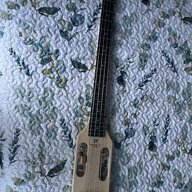
I also have traveller guitar ultra light bass that weighs 3 lbs.. sound is ok but with my driver, sound is better!
Well, I don't know. I'm simply sharing what the MarkBass website claims. Their products seem to be pretty honestly rated.I'd call 800 watts RMS a bold face lie for a 12" bass speaker assuming a reasonable frequency range.
Maybe someone with the technical knowledge to know whether this is possible or not will weigh in.
I'd call 800 watts RMS a bold face lie for a 12" bass speaker assuming a reasonable frequency range.
Well, I don't know. Barefaced also claims 800W for the Big Baby for years now, and I've never seen anybody complaining about this not being true, so why not?
(and I don't know any amp capable of throwing 800W @8ohm anyway)

- Feb 12, 2006
- 61,062
- 5
- 221,099
- Disclosures
- Development Engineer-Mesa Boogie, Development Engineer-Genzler (pedals), Product Support-Genz Benz
Note that AES power is a 2 hour test duration and the signal is high passed at 125Hz and low passed at 8kHz.
For bass guitar, few players high pass their signal at 125Hz, and most players expect their speakers to remain undamaged for more than 2 hours. Therefore, de-ratings are generally applied to AES numbers to account for these conditions. These numbers depend on the particular application.
For bass guitar, few players high pass their signal at 125Hz, and most players expect their speakers to remain undamaged for more than 2 hours. Therefore, de-ratings are generally applied to AES numbers to account for these conditions. These numbers depend on the particular application.

I'm still having a problem believing a 12" driver can take 450 Watts RMS.
Fearful/Fearless and Barefaced come to mind...
Thank you for some clarity.Note that AES power is a 2 hour test duration and the signal is high passed at 125Hz and low passed at 8kHz.
For bass guitar, few players high pass their signal at 125Hz, and most players expect their speakers to remain undamaged for more than 2 hours. Therefore, de-ratings are generally applied to AES numbers to account for these conditions. These numbers depend on the particular application.
How would this differ from the test plan used by Eminence, Mesa, GK, Ampeg, and other large companies for bass guitar use? It seems the like the US would rate a similar 12" speaker at 400 Watts RMS.Note that AES power is a 2 hour test duration and the signal is high passed at 125Hz and low passed at 8kHz.
For bass guitar, few players high pass their signal at 125Hz, and most players expect their speakers to remain undamaged for more than 2 hours. Therefore, de-ratings are generally applied to AES numbers to account for these conditions. These numbers depend on the particular application.
- Feb 12, 2006
- 61,062
- 5
- 221,099
- Disclosures
- Development Engineer-Mesa Boogie, Development Engineer-Genzler (pedals), Product Support-Genz Benz
Speaking for myself, I typically provide both thermal and mechanical limits and base the testing on a 200 hour test program. That’s 100x longer than the AES. For mechanical limits, I look at the linearity of the suspension components combined with reliability metrics.How would this differ from the test plan used by Eminence, Mesa, GK, Ampeg, and other large companies for bass guitar use? It seems the like the US would rate a similar 12" speaker at 400 Watts RMS.
I’m probably more conservative than necessary but when the manufacturer offers a long warranty that’s more often and not the case. Fortunately, the marketing guys leave me alone with regards to these calculations.
Seems like your method results in similar max RMS ratings as Eminence, GK, and Ampeg.Speaking for myself, I typically provide both thermal and mechanical limits and base the testing on a 200 hour test program. That’s 100x longer than the AES. For mechanical limits, I look at the linearity of the suspension components combined with reliability metrics.
I’m probably more conservative than necessary but when the manufacturer offers a long warranty that’s more often and not the case. Fortunately, the marketing guys leave me alone with regards to these calculations.
Also sounds like some of the European manufacturers use a much different method.
So much for an industry standard for a specific application.
- Feb 12, 2006
- 61,062
- 5
- 221,099
- Disclosures
- Development Engineer-Mesa Boogie, Development Engineer-Genzler (pedals), Product Support-Genz Benz
Eminence manufactures drivers, so their power ratings are typically based on AES metrics. The cabinet design can greatly influence the mechanical power handling of a driver. If you look at Eminence suggested designs, the notes will show the power limitations at low frequencies due to mechanical limitations. Often, they are 1/2 the thermal power rating which is the one that’s published.Seems like your method results in similar max RMS ratings as Eminence, GK, and Ampeg.
Also sounds like some of the European manufacturers use a much different method.
So much for an industry standard for a specific application.
A lot of effort goes into balancing all of these parameters in order to develop a speaker that performs well (and reliably) in the real world.


