• TalkBass has been independent since 1998. Add your voice.
    Create a free account to reply to discussions, view embedded media, and browse with fewer display ads.
    Join freeLog in
    Want zero display ads or expanded classifieds tools? Compare plans.

Making a metal fretboard.

Benjamin Strange

Commercial User
Dec 25, 2002
9,737
310
49
New Orleans, LA
www.ufodeathcult.com
Disclosures
Owner / Tech: Strange Guitarworks
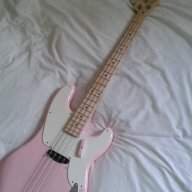
I my quest for the ultimate in out of tune guitars, I'm considering making my Hello Kitty guitar into a complete fretless. Originally I refret it for quarter-tones in the botton octave, and left it fretless at the top. I have since discovered that maple absorbs sustain on these tiny little strings, so I was considering making a metal overlay on the top octave.

After talking to my buddy who has a Vigier fretless guitar, I've decided the thing to do is to make the entire thing fretless. Now I just have to figure out how to make a metal fretboard.

Woodwork, electronics, and fretwork are no mystery to me, but working with metal is a completely new idea to me. How do I go about making this thing? How thick should it be in order to get decent sustain out of regular guitar strings? What metal would be best and easiest to use? Any ideas?
 
I used to think that metal fingerboards wold be a nightmare.

However............... I tried out one of the Vigier Deltametal fingerbaord basses about 10 years agi ata music Fair in London, England, and was completely blown away by the sound - it was the growliest, warmest sound I had ever heard on a fretless instrument - extremely surprising. In fact, I would have bought the instrument on the spot, if it weren;t for Vigier's ludicrus policy of not using truss rods in their high end basses!!!! They reckon that the graphite rods installed aleviate the need for truss rod adjustment - not to my way of thinking (e'g temp, humidity and string gauge choice all have an effect on the relief and action of your intrument)

Anyhow, let us know how your search goes on for suitable material.
 
aluminum would be the easiest to shape, steel would be the cheapest, brass would be fairly easy to shape but very expensive. For the sake of experimentation I would use aluminum.
 
There used to be Kramer basses with aluminum fretboards and necks. Never heard them, but they were not very popular ...people in music seem to be a bit resistant to change. Even suggesting anything but wood and an angry mob with pitchforks and torches will surround your house to claim your life for thinking that anything but wood can create an ideal 'tone'.
 
There used to be Kramer basses with aluminum fretboards and necks. Never heard them, but they were not very popular ...people in music seem to be a bit resistant to change. Even suggesting anything but wood and an angry mob with pitchforks and torches will surround your house to claim your life for thinking that anything but wood can create an ideal 'tone'.

Then I guess I shouldn't add that it's going on a pink guitar...
 
Hi.

I toyed around that idea in late 80's when I made most of my basses and guitars. I did try one steel fretboard, just bent a sheet and attached it over a fretboard for a test, but it didn't sound like I thought it would so that was the end of that experiment.

I've been thinking back towards that direction lately though. Titanium would be the best if someone cuts it for You, that is a major pain when working with Ti, regardless of the grade, The wear characteristics are exellent and the fingerboard can be IMO 0,5mm thick(thin), more like a wear surface really.

That same can be done with brass, bronze, stainless steel or aluminium sheet also and those are far easier to cut (and purchase).

With brass, bronze and especially aluminium, one can choose between various heat treatment states, so the surface hardness, among other properties, can be dialed to a particular application. Aluminium can be anodized, soft or hard, and dyed, so my call for Your application would be aluminium.

As the regulations vary between the countries, the seller of the metal would be the best source for the information regarding the correct adhesive for joining the two different materials in question.

Just my 0,02€
Sam
 
It's the fretless with sustain of a fretted. I would use steel. Aluminum or any soft metals may be eaten by rounds. (If you're thinking of putting roundwounds) I mean - even frets could be eaten by strings.
So go with steel
 
There used to be Kramer basses with aluminum fretboards and necks. Never heard them, but they were not very popular ...people in music seem to be a bit resistant to change. Even suggesting anything but wood and an angry mob with pitchforks and torches will surround your house to claim your life for thinking that anything but wood can create an ideal 'tone'.

I own a Kramer alum neck 8-string bass. it never sees rotation in my playing, not because of the sound/tone, but instead because it's near impossible to keep it in tune. all of that alum moves with temperature changes, and the tuning can be drastically off within the confines of a single song.

I know that I am not alone in my reasoning for casing my bass. there are many others out there who give their alum neck Kramer's the same 'respect'

all the best,

R
 
are you thinking of just tearing out the frets and putting a sheet of aluminum on it or taking the entire fretboard off and replacing it with a solid metal fretboard?

quick and dirty i'd say take a sheet of thin metal and see if you can conform it around the fretboard. trim the edges and then glue it on.

if you can get the old fretboard off in one piece you might be able to take it to someone to replicate...which could then get pricey.

i'm envisioning firing crossbow bolts into it and then tensioning guitar strings around pairs of them and then micing those up. some of the strings could have pop can tabs hanging from them. mmmm...extra noisy.
 
There used to be Kramer basses with aluminum fretboards and necks. Never heard them, but they were not very popular ...people in music seem to be a bit resistant to change. Even suggesting anything but wood and an angry mob with pitchforks and torches will surround your house to claim your life for thinking that anything but wood can create an ideal 'tone'.

The necks were cast aluminum and the fingerboards were phenolic with nickel-silver frets. They enjoyed some popularity for a few years. Wayne Kramer was in a partnership with Travis Bean when they did the original aluminum neck designs. The Travis Bean guitar necks were all aluminum and most players found them to feel cold. The one player who found fame with the Travis Bean was jazz guitarist Stanley Jordan who plays a two handed tapping style not unlike the technique used on the Chapman Stick.

Kramer split from Bean after a year or two. Kramer necks had two hardwood inlays that were separated by the casting in the center much like the skunk stripe on a Fender. Players found the interface between wood and thumb to be a better feel. The aluminum neck imparts a strong treble tone like a Steinberger. Bassists seemed to like the necks more than guitarists. The downside to these instruments was that they are heavy. Another problem is sensitivity to temperature. When transporting in the winter it was typical that the guitar or bass would be out of tune when arriving at the job by as much as whole step. Interestingly, when it was out of tune due to the cold it was still in tune with itself.
 
The necks were cast aluminum and the fingerboards were phenolic with nickel-silver frets. They enjoyed some popularity for a few years. Wayne Kramer was in a partnership with Travis Bean when they did the original aluminum neck designs. The Travis Bean guitar necks were all aluminum and most players found them to feel cold. The one player who found fame with the Travis Bean was jazz guitarist Stanley Jordan who plays a two handed tapping style not unlike the technique used on the Chapman Stick.

Kramer split from Bean after a year or two. Kramer necks had two hardwood inlays that were separated by the casting in the center much like the skunk stripe on a Fender. Players found the interface between wood and thumb to be a better feel. The aluminum neck imparts a strong treble tone like a Steinberger. Bassists seemed to like the necks more than guitarists. The downside to these instruments was that they are heavy. Another problem is sensitivity to temperature. When transporting in the winter it was typical that the guitar or bass would be out of tune when arriving at the job by as much as whole step. Interestingly, when it was out of tune due to the cold it was still in tune with itself.

Very interesting, but he is looking at a metal layer on top of the fret board which should expand/contract less and not affect tuning at all.

What about sanding the fretboard by ~3mm and making it completely flat, then glueing a 2.5mm stainless steel or aluminium plate on top
 
There's an instrument from India that has a metal fingerboard (the name escapes me). But it's played (fingered) with your fingernail. I think the loss of sustain is from your finger more than the maple. Guitar strings with their small mass damp out quickly from your finger.

Oh yeah I think it's called a Sarod.
 
A Sarod
102894748_17dafbaec2.jpg