• TalkBass has been independent since 1998. Add your voice.
    Create a free account to reply to discussions, view embedded media, and browse with fewer display ads.
    Join freeLog in
    Want zero display ads or expanded classifieds tools? Compare plans.

Double Bass making / installing a new neck block

I'm trying to decide which direction to put the grain in making a new neck block for my upright bass. Of course, the grain should go from front to back along the longest dimension of the block. But, what about the other? I'm talking about the grain direction across the front and back of the neck block. With the bass standing as it would while being played, I would think for maximum strength, the end grain should run vertical. Am I right?

Secondly, what is the best material to use in making a neck block? I'm guessing maple.
 
You are correct in that the length of the grain should run along the length of the block, the grain orientation should be fairly straight and mostly parallel to the center seam. It makes carving out the mortise a bit easier. I suppose if you had a choice at a slight angle might be preferred if strength is a concern, but a very well fit joint takes more priority than grain orientation.

Spruce is the best choice followed by poplar or basswood.
 
Last edited:
You are correct in that the length of the grain should run along the length of the block, the grain orientation should be fairly straight and mostly parallel to the center seam. It makes carving out the mortise a bit easier. I suppose if you had a choice at a slight angle might be preferred if strength is a concern, but a very well fit joint takes more priority than grain orientation.

Spruce is the best choice followed by poplar or basswood.


Dances,
Thank you so much for your thoughts. I looked up Spruce in the Janka hardness table, and it does not score near as well as Maple. Nor does Poplar or Basswood. This leads me to wonder....for strength, isn't a harder wood better than a softer? This neck block is likely one of the highest stress points on a double bass. In fact, as I look through the Janka hardness table, I see species even harder than Maple. I know there is a trade off between hardness and workability, and thus an ideal species for a neck block. As I read through other forums concerning this, I find most luthiers use Maple for neck blocks. I feel inclined to go with an even harder species. I'm in learn mode here, so any and all thoughts and opinions are much appreciated. Thanks.
 
I think there may be a bit of terminology mix up here. Are you referring to the heel of the neck or the internal block? The neck is almost exclusively made of maple, and the inner block is 95% of the time spruce or willow (pardon my poplar info earlier). Could you maybe clarify? When someone says neck block I assume they are referring to the internal block. Neck block, Corner block, end block.
 
I've heard that people have had good results from mahogany neck blocks, especially in Kay basses.

ANYTHING Is an improvement over the chronically broken hardware store grade tulip poplar and Douglas fir found as factory spec in old Kay neck and tailblocks. I use Honduras mahogany for blocks on all of my instruments for simple reasons: I've got a nice supply of it that is 16/4, air dried for almost 30 years, and it is exceptionally dimensionally stable. I also like the tone of it, but that's a whole different can of worms.

Dry, low to mid weight, and dimensiuonally stable are the main requirements to look for. As much as I like the light weight, I'd guess that over half the broken blocks I see are spruce. When you really sit down and think about it, broken blocks typically result from some kind of inpact to the instrument. There is a very fine line where an impact that is strong enough to break one block material won't do the same to a seemingly harder material, especially when you add the addidtional forces that the 3 foot long neck adds to the equation.

Good luck!

j.
www.condino.com
www.kaybassrepair.com
 
Thanks so much you all, for your thoughts. This in an Englehardt bass, and the neck block it came with is Poplar, which I thought is a poor choice given how soft a wood it is. One of you asked what I mean by neck block. I am referring to the block internal to the bass that has the mortise slot. I was amazed to see what a poor job Englehardt did in fitting the neck to the neck block! It's no wonder it failed. For the moment, I have decided on Ash for the neck block. Ash is just a bit softer than Maple, but not by much. The Ash I selected has a very tight grain. It has a similar texture to Oak. I chose this because it is readily available at my local hardwoods distributer, and not expensive. I'm in the process of shaping it, and if you all have a great opposition to using Ash, I can always make a new block of some other material. It will be good practice anyway, on this Ash block. James, I think this bass did suffer an impact. I bought it cheap, broken. I figure it just fell backwards, and the neck took the brunt of the impact. Tore the edges of the mortise off, ripping the tenon clear out! Amazingly the neck heel stayed intact, along with the tuner box, perhaps due to the softer, Poplar versus Maple neck heel. Inichols, Mahogany... again, I'm surprised considering Mahogany is much softer than Maple. I'm learning that hardness is not as critical as other wood properties. Anyway, I'm under way with Ash... what do you all think of Ash?
 
Lots of people use Spruce, which , of course, is much softer than Maple...and lots use Willow...also much softer. I don't think you want the neck block to be that hard. I have used spruce, willow and Spanish cedar, as well as basswood. I like Willow best.
 
John, have a gander at this footage shot in the Engelhardt facility back in the day. I challenge you not to laugh, or weep, when you watch the neck being set with a rubber mallet.


Last summer I replaced a trashed neck block on an '83 Engel with a replacement block I bought from Tom Link. I elected to use the factory-made yellow poplar block because it was $20 and I doubted my ability to achieve a proper block-to-shoulder fit. I'm just a hack hobbyist.

I had to file out the mortise significantly, and of course fill the air space below the tenon with spruce shims, but I think the job came out well. The kid that bought the bass from me is rough on his instruments, but he hasn't called me to complain that the repair failed.
 
Yeah, I have seen this Mr Rogers video. Interesting in some respects, and amusing in others. What got me was watching the guy spray lacquer without a respirator. I suppose laws were a bit more lapse in those days. I wonder how long that guy lived!
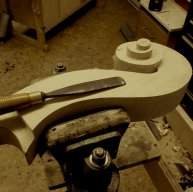
Anyway, I am coming along with making the Ash neck block. Haven't decided if I will actually use it yet. If not, it will be good practice. At the moment I am looking for a reasonably priced #4 carving gouge to make the slight curve on the two sides.
Here's a picture of the old and new:

Englehardt - Neck block - new and old side by side.jpg


Obviously the new one is not finished. Still need to carve out the curves on each side, and enlarge the mortise. This photo shows the new block fresh from the table saw, after cutting all the compound angles. Took me a while to make all the cuts, but it turned out pretty good.
 
If you are taking the effort of replacing the neck block, why not convert to a more traditional neck mortise? The Kay/Engelhart taperd dovetail is flawed from the get go, its only plus is ease of mass production. If reusing the original neck, adding wood to the heal filling in the dovetail and fitting that into a larger mortise would be easier to fit up and would result in a more solid connection. I would also advise against hardwoods for any of the blocks in any instrument construction. Lighter, easier to carve to precise curves, and more forgiving to the shock of blunt forces.