• TalkBass has been independent since 1998. Add your voice.
    Create a free account to reply to discussions, view embedded media, and browse with fewer display ads.
    Join freeLog in
    Want zero display ads or expanded classifieds tools? Compare plans.

Making string mutes

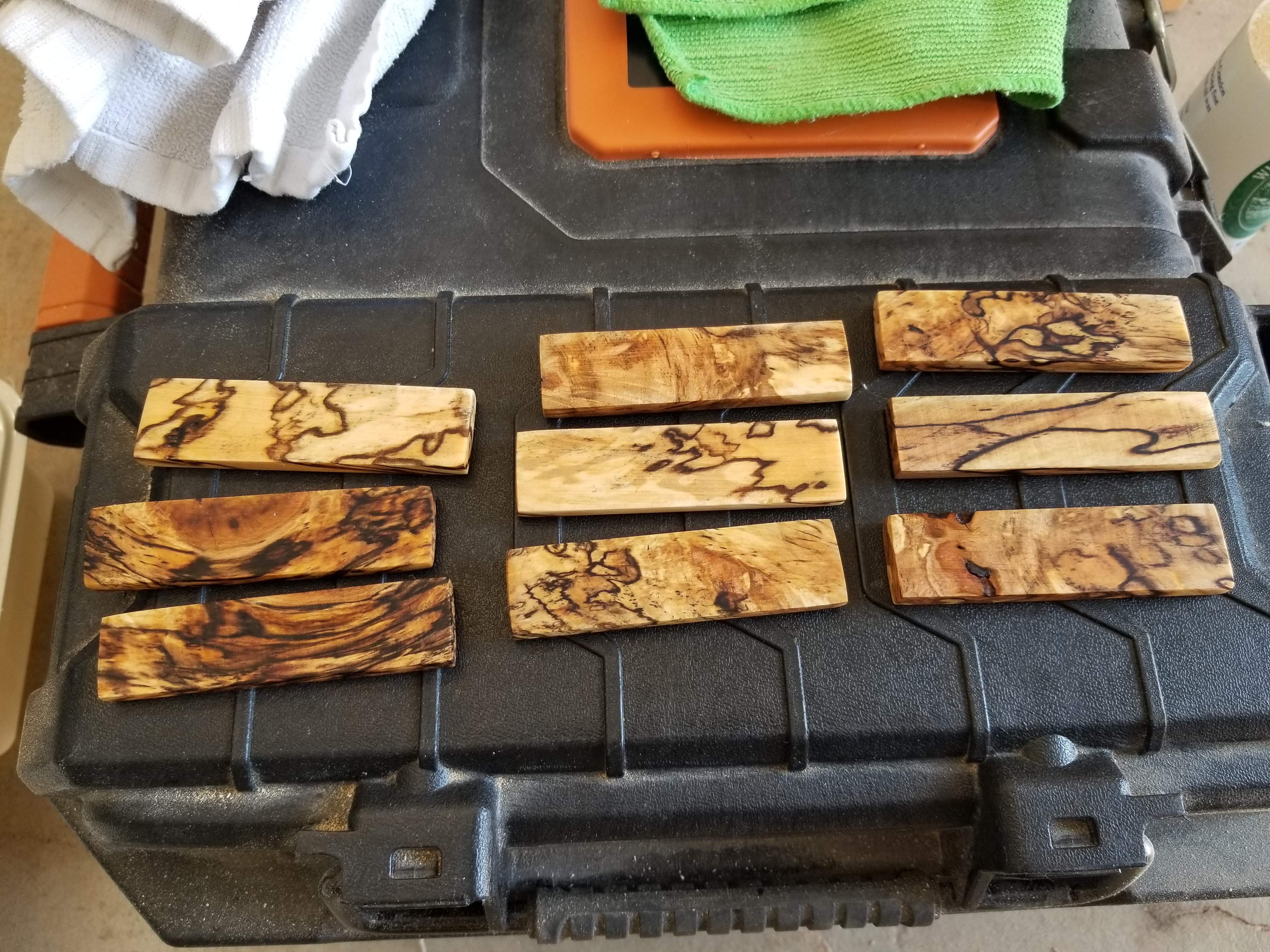
I'm trying to make string mutes for bass guitars and this is my test run. Just finished oiling some sanded spalted maple blanks that after curing I will buff with a hard wax and attach high density foam with slits cut at 19mm apart.

Oiling spalted maple is a real treat....seeing the grains "pop" makes it all worthwhile.
20200221_110914.jpg
 
The 1st fret velcro straps are for behind-the-nut sitar buzz

There's another thing where you dampen the strings up there so that when you tap, the strings don't ring out with open notes and unintentional harmonics as you lift the tapping finger. But they don't affect the tapped tone, since it's the string between the fret and bridge that is vibrating.

These bass mutes are all about the sound, and that is very, very interesting. I literally had no idea this was a thing.
 
There's another thing where you dampen the strings up there so that when you tap, the strings don't ring out with open notes and unintentional harmonics as you lift the tapping finger. But they don't affect the tapped tone, since it's the string between the fret and bridge that is vibrating.

These bass mutes are all about the sound, and that is very, very interesting. I literally had no idea this was a thing.
What I'm trying to make is "non-invasive"...meaning you can use this without drilling any new holes. There are few contraptions/assemblies out there that all require putting holes in your bass. Nope.

Example:
1-2-WEB.jpg
 
I'm trying to make string mutes for bass guitars and this is my test run. Just finished oiling some sanded spalted maple blanks that after curing I will buff with a hard wax and attach high density foam with slits cut at 19mm apart.

Oiling spalted maple is a real treat....seeing the grains "pop" makes it all worthwhile.

View attachment 3715723
What glue will you use? I have to build one for myself. I use a piece of foam near the bridge but I have to retune each time which is a bummer. Putting this mute on the strings instead of under the strings won’t affect the intonation.
 
What glue will you use? I have to build one for myself. I use a piece of foam near the bridge but I have to retune each time which is a bummer. Putting this mute on the strings instead of under the strings won’t affect the intonation.
The foam I'm going to use already has adhesive and I honestly wish it did not. Anyhow, I'm going to try construction adhesive. Its white and look very similar to caulk. It may be caulk for all I know, just sold in a tube with different name. Anyhow, it has a crazy strong hold when dried.
 
  • Like
Reactions: turcmic
Turn out I made these about 1" too short. Oh well, that's what R&D is for, I guess. My problem with the above pictured lengths is that the foam does not overlap enough on the low-E and high-G strings (not enough foam on each side to give adequate lateral, inward pressure on those outer strings).

The middle strings, however, had a very pleasant thump. I have some AAA-figured Maple due to arrive tomorrow in the mail. Now that I have the production process down, I can adjust where needed.
 
  • Like
Reactions: Reg Braithwaite
I top load packing foam from electronic gear. I've found, with this foam, that it forms imprints of the string that don't go away, and thus it needs to be finagled a bit to get in place. Not a big deal, but the backing wood, in this situation, would be a hindrance - although very nice. Perhaps a more rigid foam with slits cut to the string diameter might be worth a try.

-2 2.jpeg
 
What I'm trying to make is "non-invasive"...meaning you can use this without drilling any new holes. There are few contraptions/assemblies out there that all require putting holes in your bass. Nope.

Example:
View attachment 3716930
Actually, I believe that this particular model is fastened, not with screws, but with double-sided adhesive pads.
 
  • Like
Reactions: Danny C and JKos
It's easy to experiment with the type of mute the OP is working. Get some tongue depressors and various kinds of foam. Glue the foam to depressor, cut string slots, try. Try different widths of foam for each string. Even different types of foam for each string. What works great for the E string may not be the best for the G string, for example.

Actually, I believe that this particular model is fastened, not with screws, but with double-sided adhesive pads.
Correct.

- John
 
It's easy to experiment with the type of mute the OP is working. Get some tongue depressors and various kinds of foam. Glue the foam to depressor, cut string slots, try. Try different widths of foam for each string. Even different types of foam for each string. What works great for the E string may not be the best for the G string, for example.


Correct.

- John
After some experimentation, I found gorilla super glue works best.