• TalkBass has been independent since 1998. Add your voice.
    Create a free account to reply to discussions, view embedded media, and browse with fewer display ads.
    Join freeLog in
    Want zero display ads or expanded classifieds tools? Compare plans.

Maple vs. Rosewood

When you get a chance to hear 100 or more of the same instrument, it gets pretty easy to isolate the differences a fingerboard will make based on your understanding of the average maple neck. Of course, that is something that usually only builders get to do, or possibly store owners.

Between my repair, building, and playing experience I must've played at least a couple of hundred each P basses and J basses over the last 40+ years and even if I played all those necks on the same body I wouldn't venture to try to state anything definitive. I've heard plenty of crossover between necks with maple and rosewood fingerboards.

The only valid conclusion that can be drawn is that different necks can sound different.
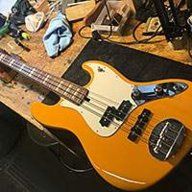
 
I notice a difference but there's one teensy-weensy problem. It wasn't just the fingerboard that was changed, it was the entire neck so it can't be said with certainty that any differences in tone can be definitively attributed to the type of fingerboard wood.

In fact, I don't think he changed necks at all. It looks like he was playing two different basses entirely, so it can't be said with certainty that any differences in tone can be definitively attributed to the neck, rather than to differences between the bodies (even though both bodies are made with the same wood), strings, etc.
 
In fact, I don't think he changed necks at all. It looks like he was playing two different basses entirely, so it can't be said with certainty that any differences in tone can be definitively attributed to the neck, rather than to differences between the bodies (even though both bodies are made with the same wood), strings, etc.

I think it's the same body...I checked again and it looks like the same pickguard pattern on both which I would take to mean the bodies are the same.
 
I agree that strings, rigs, etc have a more dramatic effect. But, my experience is that it's EXACTLY how rw and maple sound in the live mix that makes all the difference. The difference doesn't disappear in the mix, but rather stands up and says "hello".

:-D
 
When he is playing the maple neck bass, you can see the rosewood neck bass sitting on a stand. I agree that the pickguard looks the same on both, but they may just be identical pickguards.

Ha! Missed that. Maybe the pickguards are those printed types that can all look alike.

OK, it looks like you're right...good catch. Two different basses being used further invalidates the idea that it's a fingerboard only demo..
 
Between my repair, building, and playing experience I must've played at least a couple of hundred each P basses and J basses over the last 40+ years and even if I played all those necks on the same body I wouldn't venture to try to state anything definitive. I've heard plenty of crossover between necks with maple and rosewood fingerboards.

The only valid conclusion that can be drawn is that different necks can sound different.

Nicely said.

Reminder here that no one can claim the high ground and claim to know The Truth, as there is NO science to back anyone up. Even "expert opinion" is nothing more than opinion.

Maybe one of these days someone will do a scientifically valid test (double-blind for starters) with a statistically significant sample size, but I can't imagine it'll happen anytime soon.
 
I always find these debates rather funny.

So what are 99% of the people going to be doing with this guitar, whether it is with a rosewood board or maple? Well, they are going to be playing with a band.

Do you really believe that whatever difference can be heard in this video will be evident when playing with a band?

Obviously not.

So I don't understand why this debate still exists. I guess it is important if you are just going to play in your room.

Otherwise, the entire argument is simply pointless. It's like the debate about whether a tree that falls in the forest actually makes a sound if no one is there to hear it. I always thought, what a dumb question. With all due respect, if we all agree that we could not hear the difference playing with a band, who cares if you can hear a difference when you are not playing with a band?
 
The biggest difference between Rosewood and Maple will be heard when playing with a hard attack either with a pick or slapping. The finger tone on Rosewood may be a tad warmer but blindfolded i doubt anyone would be able to tell the difference. I really did like the 34 vs 35 scale video though. It debunks the 35 scale myth really well IMHO
 
I heard a difference in this test but it varied not only from bass to bass but also from riff to riff and between riffs. The player has a huge impact, whether or not consciously, too. There are infinite variables that can never be controlled for. And even our perception is completely subjective.
Not really worth the time and effort IMO.

I tend to think of necks with rosewood boards as warmer and growlier and maple more articulate with a high mid thing happening. Ebony closer to maple and a bit drier to my ear. Totally subjective and not worth much. Bottom line - I really don't care. I buy and play basses I like and some are rosewood, some ebony, some maple. In fact, I currently own one of each and dig them all.
 
I wish this had been done on a passive instrument as I think the differences would be more discernable. It was a little difficult to pin down the diffrences, but they were there: The rosewood surprisingly had more "snap" and a ever so slight scooped tone, while the maple just sounded more even...the fundamental and note to note balance was more apparent if that makes any sense.