• TalkBass has been independent since 1998. Add your voice.
    Create a free account to reply to discussions, view embedded media, and browse with fewer display ads.
    Join freeLog in
    Want zero display ads or expanded classifieds tools? Compare plans.

MDF for PU templates

gbarcus

Commercial User
Jul 20, 2008
398
12
Minneapolis & St.Paul, MN
barcusbasses.com
Disclosures
Owner of Barcus Basses barcusbasses.com
A while back, I posted that I use MDF for routing pickup templates. I have changed my IMO on this.
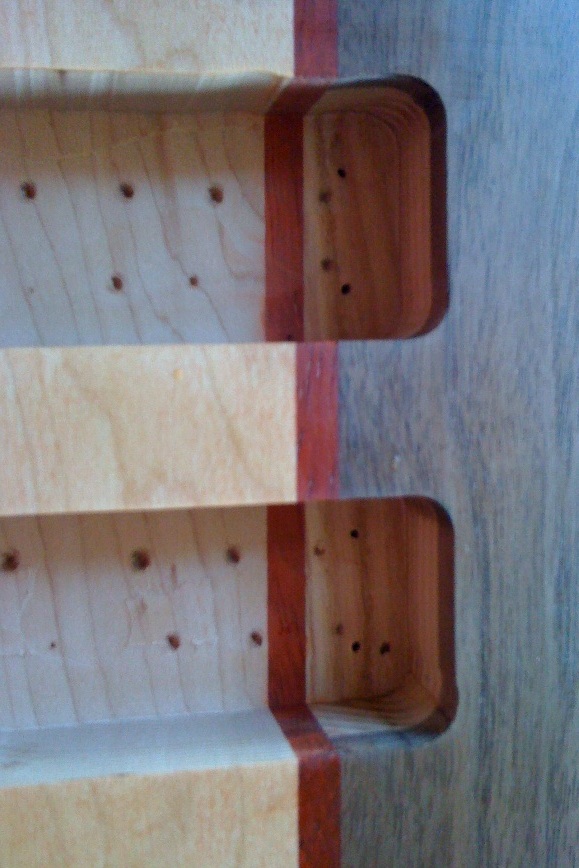
After routing out some pickups on a test bass body (luckily), it grabbed just enough at the corner to squish the MDF where it meets the bearing. I even lined the template with wood glue.
Needless to say, it only took once to really get me thinking that the $5-10 that i saved by making my own templates and the stress really isn't worth it.

IMG_0021.jpg
 
FYI - poor router use practices will cause this to happen no matter what you're using for your template material

I have used MDF for years without any bad happenings - except for those I inflicted on myself by using poor techniques or when I was rushing to get a job done (and had lost my focus on what it was I was actually doing)

MDF is a great template material, and so is acrylic/plexi/etc, birch plywood, aluminum, etc ... don't knock it simply because you lost focus, didn't do your prep work correctly, didn't have your tools adjusted correctly, and experienced a boo-boo

all the best,

R
 
FYI - poor router use practices will cause this to happen no matter what you're using for your template material

I have used MDF for years without any bad happenings - except for those I inflicted on myself by using poor techniques or when I was rushing to get a job done (and had lost my focus on what it was I was actually doing)

MDF is a great template material, and so is acrylic/plexi/etc, birch plywood, aluminum, etc ... don't knock it simply because you lost focus, didn't do your prep work correctly, didn't have your tools adjusted correctly, and experienced a boo-boo

all the best,

R

+1
 
Don't get me wrong, I've done all of my templates (body, head, control cavity...) using MDF and haven't had this happen It's just the way the MDF dented when it did grab that made me question if this was the best to use for routing a pickup.
When it comes right down to it, you are correct, this is my doing and not the fault of the material.
I love using MDF for templates, just not for the pickup cavity.
Another reason I'm going with acrylic for pickup templates, is the time to get it just right. I'd just as soon spend the few $$ and have a template that is spot on.
This mishap was just the last straw and reason for my tantrum. :)
 
Well I hate to bring the bad news but I've seen acrylic templates melt too. ;) The goal now should be how do you recover from a mistake, some of my worst mistakes have turned out cool.
Alright I lied I see all of them every time I look at them, but have learned to deal with not being perfect. I have learned so much from my mistakes that every build gets better and closer to how I want it. Improvise your way out of problems, try and make it a feature somehow.
Hey if this stuff was easy we'd all be famous and rich. LOL
Good luck,
Dirk
 
  • Like
Reactions: eddododo
Don't get me wrong, I've done all of my templates (body, head, control cavity...) using MDF and haven't had this happen It's just the way the MDF dented when it did grab that made me question if this was the best to use for routing a pickup.
When it comes right down to it, you are correct, this is my doing and not the fault of the material.
I love using MDF for templates, just not for the pickup cavity.
Another reason I'm going with acrylic for pickup templates, is the time to get it just right. I'd just as soon spend the few $$ and have a template that is spot on.
This mishap was just the last straw and reason for my tantrum. :)

If you're willing to describe the process you used, I'll bet we can offer specific suggestions to help you.

Are you using bearing-guided bits, or guide bushings?

Are you excavating most of the waste with a Forstner bit before routing?

Were you climb-cutting when your router "grabbed?"
 
i use a straight piece of steel for routing straight lines and when a router hits it, it gets pretty messed up too.

when you say it melted, do you mean from the bearing? and as for the glue, i've yet to encounter that practice. Did you wipe glue around the inside where the bearing makes contact? Did it affect the accuracy of the route?
 
Minwax wood hardener + MDF makes for a great template with a very firm edge. Learned this from Hambone, and do it to all my templates. Even after 25+ years, I learned something new when I first joined this site, so don't be rash, and don't get discouraged, we have all had it happen with all types of materials. Just keep Pushin on(in the words of REO).
 
Any help on technique would be greatly appreciated.
I did take a look at my router and noticed that there is a little play if you wiggle the bit while the base is secured to the table. As you can see in the pic, the depth is adjusted by plastic threads. It is hard to tell if the play is at the threads or if the bearings are worn. It is an older router.
Here is what I do:
I use a forest bit to get the bulk out, then use a chisel to get even more out, so no more than a 1/4" is left around the edge.
I then use a 1-1/2 x 1/2 bit (see pic) to make the cut with the template. Since there is so little left, I figure I could do it in one pass.

IMG_0022.jpg
 
first thing I notice - it appears that your router bit is WAY too far out of the collet for a bit that long :eek: unless you have an extra inch of shaft hidden in that collet, get that bit down into the collet where it belongs

next - you're missing the base plate. you can make one from a laminate topped piece of mdf, or make one from acrylic/plexi ... either way, that should be in place if nothing else to allow your router to slide on the template while giving you a solid base to keep it from teetering

then, here's my preferred workflow ...

- use a Forstner bit to remove the bulk, staying 3/16" - 1/4" shallow so you can clean the bottom with the router bit (and not leave any dimples from the Forstner bit. I also leave about 1/8" on the sides, and don't worry about it having a series of scallops. forget the chisel - that's why you're using a router ;)

- use a 1/2"D bit (I prefer a mortising bit) with collar bearing to follow the template edges, but keep it about 1/32" off the roughed bottom for the first pass. the intent here is to define the edges so they are clean

- adjust the bit so that you dig into the bottom to a depth that is 1/32" shy of your final depth and remove all the wood giving special attention to the edges

- adjust the bit to final depth and remove all the wood giving special attention to the bottom so that it's smooth

- I then follow-up with the StewMac 3/8"D corner bit to radius the corners to fit a typical Bart/EMG shell corner radius. I clean the corner in two or more passes depending on the depth of the cavity


when routing a super deep cavity (like for a Nordy Fat Stack) you may find that you need to remove the template to get your final depth without hitting the template with the router collet. in this case, simply clean the edges like it was the 5/8" deep cavity above (don't forget to do the tighter corners), and then remove the template and used the edge of your cavity as the guide to finish routing to the final depth.

DO NOT simply extend the router bit out to accommodate the added 3/8" of depth - this is a dangerous thing to do, as a bit that long needs to be held securely in the collet and not just pinched at the end

all the best,

R
 
Right off the bat I can see an issue, you need to use the base plate on the bottom, you have too much space between the router bit and the metal edges of the router. The squarer and more solid the base is the less likely this can happen.

Also when I do my mdf templates I use several coats of CA to harden up the edges.

To answer the melting question I saw a friend do it when not using a bearing and trying to get a smaller radius in the corner of a pickup route. He did lube it up but it melted quite quickly.

Dirk
 
You just got a ton of good advice in those last two posts. I prefer mdf for templates because it is smooth and generally stays much flatter than most sheet goods. Even decent quality plywood can be a real problem when your bearing ducks into a void in the center core. The other benefit of mdf is that it is cheaper. +1 on the CA glue for repeated use templates.
 
How much would you guys pay for a template that is adjustable in size, so it could do various sizes of pickups and neck pockets? I drew one up a few weeks back and have yet to decide if I want to bother building one. Anyone interested in something like that? It would either be made of brass, aluminum or steel.

lowsound