From the nut to the 12th fret is an exact distance, yet from the 12th fret to the witness point on the saddle is not the same, as the string diameter increases. Will that cause an intonation problem, at the 12th fret, on very thick strings?
Rocky
Absolutely, it causes on issue on all the strings.
Basically, if your frets are perfectly straight, then they are at least partially in the wrong place

Stringed instruments with frets are really almost impossible to correctly and perfectly tune and intonate, but setting the intonation at the bridge allows you to compensate for the majority of the discrepancies. Compensated nuts, like those from Earvana and found on EBMM instruments help as well. Luckily for us, the issues don't seem to be as large sonically on lower frequency instruments like the bass than they are on higher frequency instruments like guitars.
Believe it or not, a perfect system would look something like this - a 'near perfect' and expensive system available for guitars and basses : [Invalid or Expired Link Removed]
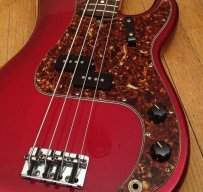
Bass picture:
[Invalid or Expired Link Removed]
So, to come back around to the original question, what you do as a solution is adjust the position of the bridge saddle (one an individual string basis) so that the fretted 12th fret note and the 12th fret harmonic are as identical as you can get them. Once you adjust the bridge saddle for one string, you consider it intonated and you go on to the next. Most luthiers and seup guys will use a tuner for this (a Peterson Strobe is what my guy uses) as those are more accurate than simply going by ear, but you can get close by ear with a bit of practice.