• TalkBass has been independent since 1998. Add your voice.
    Create a free account to reply to discussions, view embedded media, and browse with fewer display ads.
    Join freeLog in
    Want zero display ads or expanded classifieds tools? Compare plans.

Mistaking String Level Imbalance for String Tone Imbalance

Oct 26, 2010
4,826
11,394
Surprise, AZ
Hello,
Since I put Dunlop Flats on my R. Low Vaughn 007, I had not been happy with the E string. It's tone simply didn't seem to fall in line with the G, D, and A strings.
It seemed dead in comparison.

I finally examined the relative string levels using a flat signal chain and digital VU meter. What I found is that the A string was 4-6 dB louder than the other three strings. As I walked down the strings, that louder A made the E sound dead.

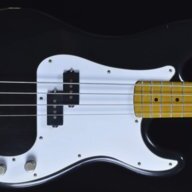
But, when I adjusted the split pickup to balance the strings (bring down the A level to match), it now sounds great.

Thus, my title. I was mistaking a level difference for a tonal difference.

Anyone else fall into this?

Thanks,
John
 
  • Like
Reactions: Matty Koff
Funny you should bring up this subject...

I spent the last week fiddling around with the two halves of the pickup on my P-bass since I changed strings on it last weekend. In my case, it was the D string that stuck out like a sore thumb. After some fine tweaking of both the heights and the angles, all four strings sound nice and even now.
 
  • Like
Reactions: JKos
Hello,
Since I put Dunlop Flats on my R. Low Vaughn 007, I had not been happy with the E string. It's tone simply didn't seem to fall in line with the G, D, and A strings.
It seemed dead in comparison.

I finally examined the relative string levels using a flat signal chain and digital VU meter. What I found is that the A string was 4-6 dB louder than the other three strings. As I walked down the strings, that louder A made the E sound dead.

But, when I adjusted the split pickup to balance the strings (bring down the A level to match), it now sounds great.

Thus, my title. I was mistaking a level difference for a tonal difference.

Anyone else fall into this?

Thanks,
John

I find that volume and tone kind of go hand in hand. Too much or too little volume can negatively affect how I hear the tone. That could also be hearing damage. I can't talk about my tinnitus or I'll hear it all night.. dang... gone and done it.
 
  • Like
Reactions: HaphAsSard
I always tweak my setup with string changes. With pickup height, I just dial the strings in by ear over the course of a couple of days until I find the "sweet spot" for each set. This is just what works best for me, as I've never really subscribed to a hard-and-fast pickup height for Fender style basses. YMMV, and have fun with those Dunlops!
 
  • Like
Reactions: NoiseNinja
What matters to me is not how it measures on a VU meter but how it actually sounds.

I adjust according to what I hear.

Usually that means my E string will be a few dB's above the other strings, that is if it sounds great played together with the other strings, if not I will adjust it or the other strings till it does.

Readings on a VU meter would be pretty pointless to me, but good it worked for you, I personally would have properly just went by trial and error while listening to how my adjustments influenced the string balance level and tone wise till I was satisfied.
 
Readings on a VU meter would be pretty pointless to me, but good it worked for you
I have learned over several basses and string type changes that, if I make the strings really close per a VU meter (C weighted, slow response), it tends be spot on how I like the string-to-string balance. It's at least a solid, repeatable starting point.

Your ears can lie just like mine were. I wasn't hearing the 4-6 dB difference as a 4-6 dB difference. I was hearing a tonal difference. And it wasn't even the louder string (A) that it impacted, it was the next string (E) because it sounded dead compared to the "hyped" A.
 
Last edited:
I have learned over several basses and string type changes that, if I make the strings really close per a VU meter (C weighted, slow response), it tends be spot on how I like the string-to-string balance. It's at least a solid, repeatable starting point.

Your ears can lie just like mine were. I wasn't hearing the 4-6 dB difference as a 4-6 dB difference. I was hearing a tonal difference. And it wasn't even the louder string (A) that it impacted, it was the next string (E) because it sounded dead compared to the "hyped" A.

My point being if it sounds good and right it is good and right, no one is going to listen to you with a VU meter but by using their ears, why you needed a VU meter to tell you it didn't sound good and why your ears didn't tell you something wasn't quite right puzzles me, but what works works, so good for you.
 
Last edited:
why you needed a VU meter to tell you it didn't sound good and how to get it to sound good puzzles me
I'm an engineer. I like numbers. Measured, known quantities make me happy and joyful.

For whatever reason, I was not hearing the A string as louder. It was translating as a dead E string. I cannot explain that. But that was my experience. I realized two things: 1) the E, D, and G strings actually were very similar tone wise [maybe the E wasn't dead after all] and 2) I hadn't checked string-to-string balance objectively [bingo].

Did I mention that I'm an engineer? I like numbers. Measured, known quantities make me happy and joyful.

But, besides that, my real question was about anyone else being "fooled" by gross string-to-string imbalances.
 
Last edited: