• TalkBass has been independent since 1998. Add your voice.
    Create a free account to reply to discussions, view embedded media, and browse with fewer display ads.
    Join freeLog in
    Want zero display ads or expanded classifieds tools? Compare plans.

Mixing Barefaced Super Twin with Mesa Subway Cabs (WD-800)

Hi everyone,

I’m looking for some technical advice regarding my cabinet setup.

My current rig is a Mesa Subway WD-800 head paired with a Barefaced Super Twin (2x12, 4-ohm). I love the clarity and punch of the Super Twin, but I’ve been feeling like I need a bit more "deep low-end" in certain situations.

I also own these two Mesa Subway cabs
1. Subway 1x12 (8-ohm)
2. Subway 2x10 (8-ohm)

Since the WD-800 supports a 2.67-ohm load, I’m considering adding one of these to the Super Twin. However, I’m concerned about potential phase issues or "frequency masking" when mixing different brands and speaker sizes.

My goal is to keep the Super Twin's quick response while adding the rich bottom end of the Subway series.

Between the 1x12 and 2x10, which one would be a better logical match for the Super Twin? Or is mixing these different designs generally discouraged regardless of the specific cabs?

I’d love to hear your thoughts, especially from @agedhorse if he’s around!

Thanks!
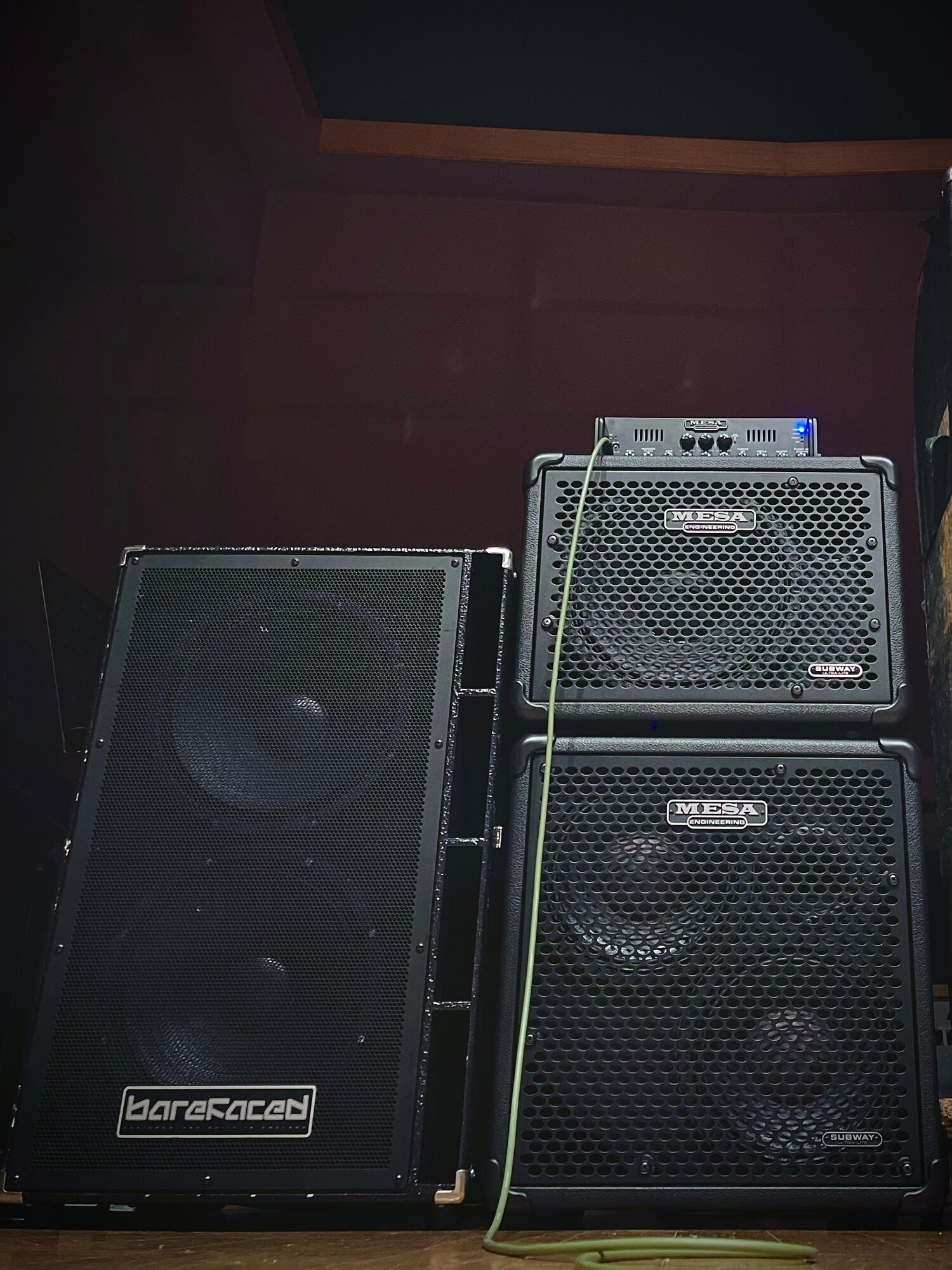
IMG_6770.jpeg
 
Hi everyone,

I’m looking for some technical advice regarding my cabinet setup.

My current rig is a Mesa Subway WD-800 head paired with a Barefaced Super Twin (2x12, 4-ohm). I love the clarity and punch of the Super Twin, but I’ve been feeling like I need a bit more "deep low-end" in certain situations.

I also own these two Mesa Subway cabs
1. Subway 1x12 (8-ohm)
2. Subway 2x10 (8-ohm)

Since the WD-800 supports a 2.67-ohm load, I’m considering adding one of these to the Super Twin. However, I’m concerned about potential phase issues or "frequency masking" when mixing different brands and speaker sizes.

My goal is to keep the Super Twin's quick response while adding the rich bottom end of the Subway series.

Between the 1x12 and 2x10, which one would be a better logical match for the Super Twin? Or is mixing these different designs generally discouraged regardless of the specific cabs?

I’d love to hear your thoughts, especially from @agedhorse if he’s around!

Thanks!View attachment 7476103
It's hard to predict, why didn't you experiment already?
 
True, but I'm a hired gun for this rehearsal, so I don't have the luxury of stopping the clock to tweak my tone.
Just trying to do my homework here so I don't run into any "hidden" problems on the job!

Unfortunately, the only way your gonna know if combining Mesa's cabinet design/tuning and Bareface's cabinet design/tuning sounds right for your ears is to try it.
 
Unfortunately, the only way your gonna know if combining Mesa's cabinet design/tuning and Bareface's cabinet design/tuning sounds right for your ears is to try it.
You're absolutely right, my ears are the final judge.
I was just trying to see if anyone had technical insights on combining these two different designs—like potential phase issues or frequency masking.

But as you suggested, I'll find a way to AB test them properly without holding up the session!
 
I have trouble picturing a rehearsal where that Barefaced wouldn't already be more than enough. That's what I'd bring, just the Barefaced.
I get where you’re coming from, but I’m looking for a very specific texture that I think only this combo can provide. I’m curious to see if combining them gives me that "extra something" I've been hearing in my head. Call it a gear addict's experiment!
 
This ^^^
My Barefaced Super Twin T has all the low end I’d ever need. The WD-800 has good headroom and controls for sculpting the tone. I’d agree with the above to try different combinations before rehearsal but if you’re trying to achieve competing goals with different cabs, they may fight each other. I’d first try to open up the low end a bit with the Barefaced cab at higher volumes and use hand position and right hand technique to keep things tight or a bit rounder with depth as needed. If there is some specific texture you’re after, perhaps the right pedal could add that special sauce? A cab may not get you there.
 
This ^^^
My Barefaced Super Twin T has all the low end I’d ever need. The WD-800 has good headroom and controls for sculpting the tone. I’d agree with the above to try different combinations before rehearsal but if you’re trying to achieve competing goals with different cabs, they may fight each other. I’d first try to open up the low end a bit with the Barefaced cab at higher volumes and use hand position and right hand technique to keep things tight or a bit rounder with depth as needed. If there is some specific texture you’re after, perhaps the right pedal could add that special sauce? A cab may not get you there.
That’s a great point. Actually, I’m experimenting with some pedals right now for that "special sauce."

Also, your comment made me realize something. I usually put my cab on a chair to bring it closer to ear level. I need to hear the high-end clearly, and if the cab is on the floor, the highs feel way too harsh whenever I squat down to listen.

Raising the cab definitely helps with clarity, but I might be losing that low-end coupling with the floor as a result. That’s probably why I felt the need to add another cab to fill out the bottom.
 
  • Like
Reactions: DJ Bebop
The answer your looking for requires engineering. Essentially models of both cabs would be developed and an engineer would compare the phase and group delay characteristics and assess if they are reasonably close enough. Without the ability to do the necessary modeling and analysis, you simply need to try it out and judge for yourself. The good news is the BF cab by itself should play stupid loud with 800W. So if adding the Subway cab doesn't do what you want, you simply unplug it and continue with the rehearsal.

The Subway cabs are all designed to work together, so I believe the phase and group delay characteristics of the 210 and 112 are reasonably similar to each other. So both will probably have fairly similar phase and group delay variances in comparison to the BF cab.

The Subway 210 is rated 600W and it has a sensitivity rating of 98.1dB 1W/1m. Minimum mechanical power is 425W at 81.3hz
The Subway 112 is rated 400W and it has a sensitivity rating of 97.5dB 1W/1m. Minimum mechanical power is 385W at 74.3hz

In the event you plan to push the amp to or beyond it's full power, the 210 will be the safer option. The Super Twin is 4 ohms and the Subway cabs are 8 ohms. When you pair 4 and 8 ohms, available power is divided by 3. The 4 ohm cab gets 2/3rds and the 8 ohm cab gets 1/3rd. At 800W the Subway cab will get 267W and the BF cab will get 533W.


The 210 is slightly more efficient than the 112, so it should match the Super Twin's level slightly better. Per the specs, the 210 and 112 combined should be a better performance match than either cab alone. AFAIK combined sensitivity of both Subway cabs should be about 100.8dB 1W/1m.
 
I would doubt that the subway cabs are tuned as low/lower than the Barefaced, so while you will gain volume, you will not gain lows. It may be that the high pass in the WD-800 is cutting what you want to hear, or maybe the original signal is lacking in those freq.

If you are boosting lows and have the WD-800 cranked, maybe you are running out of headroom? The Supertwin is rated for 1200rms, so it should take everybit of what the Mesa WD-800 can give it.

This sounds more like an eq or venue issue than hardware. Try having someone play your bass and go out in the house and walk around. The low wavelengths are long and you may just not be able to hear them as well from where you're standing.
 
  • Like
Reactions: rapidfirerob
I would doubt that the subway cabs are tuned as low/lower than the Barefaced, so while you will gain volume, you will not gain lows.
No way to know this without knowing what their “frequency range” actually means. There is no definition of what frequency range is in their specs.

You will get some additional low frequency extension due to coupling effects, so that comment may not be accurate either.
 
Hi everyone,

I’m looking for some technical advice regarding my cabinet setup.

My current rig is a Mesa Subway WD-800 head paired with a Barefaced Super Twin (2x12, 4-ohm). I love the clarity and punch of the Super Twin, but I’ve been feeling like I need a bit more "deep low-end" in certain situations.

I also own these two Mesa Subway cabs
1. Subway 1x12 (8-ohm)
2. Subway 2x10 (8-ohm)

Since the WD-800 supports a 2.67-ohm load, I’m considering adding one of these to the Super Twin. However, I’m concerned about potential phase issues or "frequency masking" when mixing different brands and speaker sizes.

My goal is to keep the Super Twin's quick response while adding the rich bottom end of the Subway series.

Between the 1x12 and 2x10, which one would be a better logical match for the Super Twin? Or is mixing these different designs generally discouraged regardless of the specific cabs?

I’d love to hear your thoughts, especially from @agedhorse if he’s around!

Thanks!View attachment 7476103
Man, talk about first world problems! Seriously though if I were you I'd consider adding a Subway 15 somewhere in your Mesa setup before I'd mix the two brands. I owned Super Twin and yes, it's very tight and punchy. Deep or enveloping low end would not be how I'd describe it's inherent voice at all.

I'd wager a guess that a 115 with either your 112 or 210 would get you close to what you're after.
 
Hi everyone,

I’m looking for some technical advice regarding my cabinet setup.

My current rig is a Mesa Subway WD-800 head paired with a Barefaced Super Twin (2x12, 4-ohm). I love the clarity and punch of the Super Twin, but I’ve been feeling like I need a bit more "deep low-end" in certain situations.

I also own these two Mesa Subway cabs
1. Subway 1x12 (8-ohm)
2. Subway 2x10 (8-ohm)

Since the WD-800 supports a 2.67-ohm load, I’m considering adding one of these to the Super Twin. However, I’m concerned about potential phase issues or "frequency masking" when mixing different brands and speaker sizes.

My goal is to keep the Super Twin's quick response while adding the rich bottom end of the Subway series.

Between the 1x12 and 2x10, which one would be a better logical match for the Super Twin? Or is mixing these different designs generally discouraged regardless of the specific cabs?

I’d love to hear your thoughts, especially from @agedhorse if he’s around!

Thanks!View attachment 7476103
There's no way to tell without trying the two combinations at some gigs. However, just guessing, I'm thinking that the MB Subway 1x12 would blend best with your Barefaced Super Twin because it'll be three twelves all drawing the same amount of power from your WD-800 head. Just the added cone area alone should add some thump to your sound.
 
  • Like
Reactions: rapidfirerob
Thank you all for the incredibly insightful advice! I really appreciate the technical breakdowns regarding power distribution and sensitivity—it’s given me a lot to think about.

To be honest, when @Hamrlik mentioned the Subway 115, it really struck a chord. I’ve actually been eyeing that cab for a while as a potential solution for that "enveloping" low-end. In fact, my ultimate dream rig would probably be a Subway 115 paired with either a 210 or 112. Seeing it recommended here was a bit of a "eureka" moment for me!

That said, before I make any new purchases, I'm going to head into rehearsal and just try everything out—slanting the Super Twin on the floor to keep the coupling, adding the 210 to check the efficiency, or trying the 112 to see how the 3x12 setup feels. I’ll report back with the results once I’ve had a chance to push some air. Thanks again for helping me navigate this!
 
From the beguinning, you said "WD-800 supports a 2.67-ohm load".
It's true, but it also supports a 2 ohm load.
So why not try the 4 ohm BF + the two 8 ohm Subways (total 2 ohm load) while you are there? :bassist:
I mean, at least for the sake of science…
That’s a bold suggestion!

To be honest, most of my gigs are in venues with about 1,000 capacity and a solid PA, so a 3-cab stack would definitely be overkill for my actual needs.

However, from a "scientific" standpoint, it is a very interesting experiment. It’s a great chance to compare the feel of moving more air with a larger total cone area at lower amp volumes, versus pushing a smaller setup harder.

I might set it up once just to see how it reacts, but my main goal remains finding the most balanced and efficient rig for the ensemble.