• TalkBass has been independent since 1998. Add your voice.
    Create a free account to reply to discussions, view embedded media, and browse with fewer display ads.
    Join freeLog in
    Want zero display ads or expanded classifieds tools? Compare plans.

Modal Borrowing labeling question

Hi all,

Learning about modal interchange. I get the whole concept of how it works, except for the labeling bc Im a little rusty on my theory.

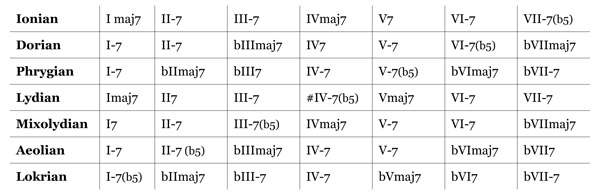
In the chart below, for example lets use C Aeolian....what do the flats before the III, VI or VII tell me? Its flat based on what....? I know C Aeolian has 3 flats. I also do know the formula for every major mode. So do the flats refer to C Aeolian as compared to C Major? Or it refers to the formula to build an Aeolian? (which is based on C Major too..).

Or bVII in G Mixolydian...it has the flat which means.....?

Ill probably get confused again later.


mi_chart1.jpg
 
Yep, everything is relative to a major scale built on the tonic of the scale being harmonized.
It's not not simply relative to C major : The flats there are not actual notated flats (not necessarily)

III min7 has a root note that is the major 3rd of the tonic I root
bIII maj7 has a root note that is the minor 3rd of the tonic I root

in your words , 'it refers to the formula to build an Aeolian'
 
Last edited:
  • Like
Reactions: pellomoco14
So lets say Im looking at a tune that seems to have a G Major tonic but not clear...

If the tune is in G Major, if I see a bVII7...its borrowed chord from G Mixo, right?

But if the tune is in G Mixo, and I see bVII...the flat is based on what?
 
So lets say Im looking at a tune that seems to have a G Major tonic but not clear...

If the tune is in G Major, if I see a bVII7...its borrowed chord from G Mixo, right?

But if the tune is in G Mixo, and I see bVII...the flat is based on what?

If a tune "seems to have a G Major tonic" then it is in the key of G Major, and everything is "in relation to" or "based on" the G Major scale.

The "bVII" notation indicates that the root of the chord is 1 half step lower than the major 7th (F natural instead of F sharp).

Hope that helps?
 
Last edited:
  • Like
Reactions: Whousedtoplay
Hi all,

Learning about modal interchange. I get the whole concept of how it works, except for the labeling bc Im a little rusty on my theory.

In the chart below, for example lets use C Aeolian....what do the flats before the III, VI or VII tell me? Its flat based on what....? I know C Aeolian has 3 flats. I also do know the formula for every major mode. So do the flats refer to C Aeolian as compared to C Major? Or it refers to the formula to build an Aeolian? (which is based on C Major too..).

Or bVII in G Mixolydian...it has the flat which means.....?

Ill probably get confused again later.


View attachment 3163202
No offense but I don't think you need that chart except for the first line ;-)

To me it seems pointless and confusing more then anything
 
If the tune is in G Major, if I see a bVII7...its borrowed chord from G Mixo, right?

Think about how chords (specifically dominant 7th chords) and scales/modes (specifically, Mixolydian) are constructed.
The "bVII" part tells you it's built on the flatted seventh degree of the scale.
The flatted seventh degree of the G major scale is...?
It's F natural. And yes, one could claim that an F natural appearing in G major was "borrowed" from G Mixolydian.
However "bVII7" tells you that it's a dominant 7th chord built on the flatted seventh degree of the scale.
We've already determined that the flatted seventh degree of the G major scale is F natural; what's a dominant 7th chord built on F natural?
dom7 = 1, 3, 5, b7 ...so a dominant 7th chord built on F natural would be an F7, which consists of the pitch classes F, A, C, Eb
Eb is not in the G Mixolydian collection.
So the answer is no. Not borrowed from G Mixo.
 
If the tune is in G Major, if I see a bVII7...its borrowed chord from G Mixo, right?
But if the tune is in G Mixo, and I see bVII...the flat is based on what?

The safe and reasonable assumption is that
Roman numeral chord symbols always relative to the major/ionian scale.
VII = always major 7th, regardless of context
bVII =always flat 7th, regardless of context

Rarely some write the roman numeral chord symbol in some modal context
and assume the reader knows when to flatten them.
that is poor communication, and the fault of the author.

But in practice you will never be handed a chord chart that is Roman numerals. It's always Spelled out chords.
 
I'm curious as to what you are trying to learn/accomplish with that table. As Groove Master mentioned, all you need is the first line. You are simply harmonizing the major scale. All the rest of that table is kinda over thought... I can't claim to know everything, but I've never seen a song written in a "Locrian Key" and certainly not notated with an uppercase I-7(b5). Maybe a lowercase.

As a sort of random example, in the instance where you do have ii-7(b5) to a V7, scale-wise, you will probably be thinking Melodic minor, Harmonic minor or major. E.g., in the progression: G-7(b5) - C7, the scale choices I'd be looking at is Ab Major, F Harmonic Minor and or Bb Melodic Minor. This is an example of a ii-V in the key of F MINOR. F minor, which is the relative minor of Ab Major. So, granted, G Locrian and Ab Ionian are for all intents and purposes the same pitch collection (scale), you refer to keys as major or minor, not in reference to a mode. Regardless, the X7(b5) is too unstable to ever be considered a tonic or I chord. Any of that make sense? Somebody correct me if I'm wrong here.

Anyway, I believe you're gonna make yourself more confused trying to make sense of all that stuff in the table... Nobody who plays, thinks in the ways the table is written.

And while occasionally you will see a song like "So What" that has "Dorian" written somewhere in the beginning of the lead sheet, The fact is that there is no such thing as a "Dorian Key". The Dorian in that song is just a guideline for solos. But regardless of what is written in the beginning of the song, you don't want to solo on just the Dorian or whatever mode you think fits. That's not improvisation. It's ok to do that as an exercise, but not so much in a playing situation.

I know all the above is a lot of blah blah. But it's stuff you really need to wrap your head around if you want to make sense of this mode stuff. If as you say, you know the formulas for the modes, then just use that knowledge. Build from that point.
 
Last edited:
Perhaps it would make more sense if yiou say "natural minor" instead of "Aeolian". The C natural minor is the relative minor of Eb major which has three flats.

In teaching the diatonic modes, some folks use the prgressive flatting concept to go around the cycle of 5ths and relate it back to a major key which can be very confusing. I am going to say no more.

People compose in modes all the time. Many songs in mix, Pop minor songs are usually in dorian, flamenco in phrygian, etc,, but i cannot think of a tune in Locrian like Spin Doctor pointed out. Maybe the locrian is too unstable as a leading scale to the tonic.
 
Last edited:
This dirt simple little chart made since to me. Hope it does for you. First there are two ways of looking at modes; 1) the relative way of looking at modes where the notes stay the same and the key changes and then 2) the parallel way where the notes change and the key stays the same. This is known as the Parallel mode method. What I will say below is Parallel.

Most mode posts do not bother telling you if they are speaking relative or parallel - and that makes it confusing.

What I'm saying below is also based upon the Major scale. Our Major scale will have seven modes, three major, three minor and one diminished. I'm going to just give you the three major modes right now.

C major scale = C, D, E, F, G, A, B and octave C.
That is also the Ionian mode. I like to think of it as home base for all the major modes. Said to have a upbeat happy mood. If that is what you are looking use the major scale or the Ionian mode. Modes are played using a chord vamp instead of resolving back to the tonal tonic key of C major.

The Lydian mode is the same as the Ionian mode with the 4th note sharped. Raised a fret. We refer to it in scale degree numbers 1-2-3-#4-5-6-7. Notice we changed one note. It's not all that complicated. Lydian is said to have a day dreamy mood. I really do not hear that and it is so much like the Ionian mode I usually skip it or add a b7 and it then becomes Lydian Dominant, and I do hear the difference.

The Mixolydian mode is the same as the Ionian mode, but, with the 7th note flatted. We refer to it in scale degree numbers as 1-2-3-4-5-6-b7 or note names as C, D, E, F, G, A, Bb. Again we changed one note of the C major scale to get C Mixolydian. Remember this is parallel where the notes change and the key stays the same. Mixolydian is said to have a Latin mood. Yes it is used in the Blues because of all the dominant chords used in The Blues.

So if you want to play the C Lydian mode it would be the C major scale with a raised (sharped) 4th note, or C, D, E, F#, G, A, B. And Mixolydian would have the C major scale notes with a flatted 7 (b7).

Lets get you playing in Ionian, Lydian and Mixolydian first. We can worry with the minor stuff later. Why am I saying that? Most Pop, Rock, and Country music is major key, so one of those three will get you going with out making it so complicated.

Guitar people get off on modes. We old bass guys seldom go there. Why? Modes are great for playing the tune and improv melodic playing, but, most of what we play is harmony and that is follow the chords and play notes of the active chord to the beat this specific song is using.

You kinda need to know about modes so the guitar guys do not confuse you will all their modal talk. Most of the time they are confused also.

Good luck.
 
Last edited:
There is a chart floating around of the 7 modes for major, melodic minor and harmonic minor . That is a very useful chart. The chart in the OP is not something I would use.

In line with OP's post, I don't use the following often outside of jazz soloing , but.....

C Lydian = G Major
C Mixolydian = F Major,
C Dorian = Bb Major
C Aeolian = Eb Major
C Phrygian = Ab Major
C Locrian = Db Maj.
 
  • Like
Reactions: Whousedtoplay
The OP's table is simply to show possible modal interchange choices.
That is, what chords may be "borrowed" from a parallel mode.

It's a common enough theoretical excuse for when a song uses a "wrong" chord for it's key.
I've seen people argue that something like a blues progression is doing this.
" The I chord isn't supposed to be a dominant 7th chord! It's a modal interchange , borrowed from the mixolydian mode !"

I do agree it is over thinking, when likely the song writer simply thought "this chord sounds cool here"

It's weird how any post about modes tends to veer away from the original question.
Almost like the responses are borrowing from a parallel thread.
 
Ok....so it seems some of you may have assumed I asked about this for performance reasons..... but that is not correct. It is for songwriting. For songwriting, there is tons of time to think and re think and explore different potential chords; knowing where they come from is very helpful as a way to cement the information in the brain.