• TalkBass has been independent since 1998. Add your voice.
    Create a free account to reply to discussions, view embedded media, and browse with fewer display ads.
    Join freeLog in
    Want zero display ads or expanded classifieds tools? Compare plans.

Modeler -> DI, why?

pwilson

Supporting Member
Jul 8, 2011
407
1,487
Kirkland, WA, USA
I've seen photos of a bunch of pedal boards of the form: compressor -> Modeler (HX Stomp, QC, Anagram, etc) -> DI (Noble, Capo, Mantle, etc)
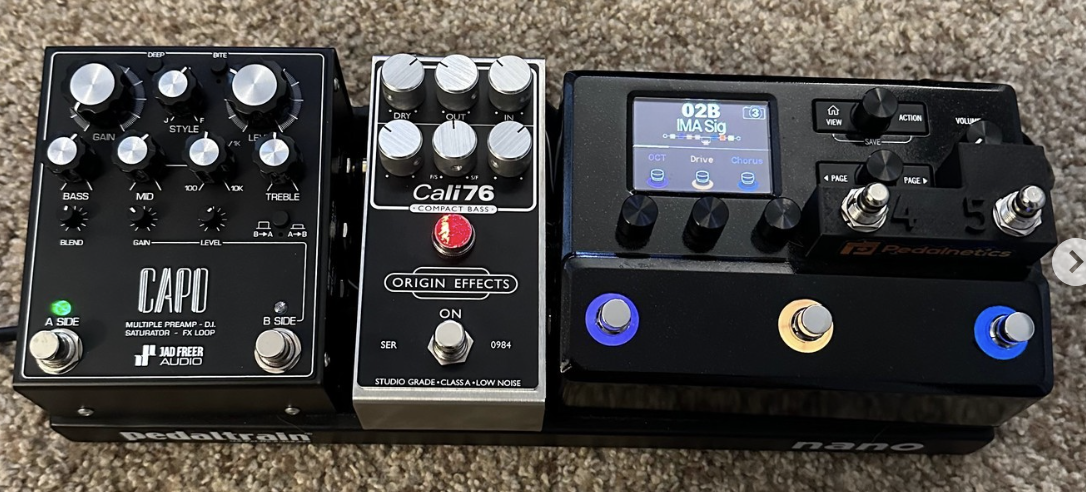
1775038549781.png


I understand why you might want an analog compressor on the front end, but what value is the DI adding? Modelers have balanced outputs and can model the saturation and sweetness of DIs. Is it because the modeling of DIs is not very good? I'm a little confused about the value add, probably because I haven't tried it.

Can someone explain?

Thanks!
 
It’s not that they’re not good, but some pedals strengths can’t be emulated. For example, a compressor may respond to touch in a particular way that a digital emulator can’t. Mostly the sims are excellent. But the blues driver bd2 for example, doesn’t respond as a sim the way it can as a pedal. The sim is 95% there and if you’re not relying on touch it’s perfect. So while these things get sorted out, it’s probably easier to put touch responsive pedals to the board.
 
Last edited:
In your example you are not showing a DI, but a preamp + DI.
Maybe in that case:
  • the preamp is not used, only the DI
  • the preamp is used to EQ the DI but not the amp
  • the preamp is used to EQ the amp but not the DI
  • it's easier to tweak the preamp EQ on the fly than to modify patches on the modeler
  • as others said, you prefer the analog feeling/touch/sound over the modeler or you're using the modeler only for effects
  • you are a gear slut and want to show that you have many toys or a lot of cash
  • you want to impress other players with your big pedalboard
 
So if I have, say, an Anagram and a Mantle and I like the Anagram's amp and cab models, is there any value in running the output of the anagram through the Mantle on its way to FRFR/PA/interface?
If you like what the Mantle adds to anagram tone sure, why not?
I personally would probably choose one or the other, but that's just personal taste.

There's only 1 rule: If it sounds good, it is good.
 
I’m in the camp you speak of. The reason I like a great DI/Preamp and analog compressor to pair with the HX is simply that these units sound great; I don’t have to menu dive to make adjustments and in the event something were to happen with the HX I’d still have a great sounding signal chain going to FOH. I use the HX mostly to run effects and to have a tuner. The Mantle and Compressor are doing the heavy lifting for my tone. While the HX could certainly be everything I need (and I’ve gigged it this way) I enjoy having some out of the box flavor, and FOH appreciated having an XLR output to plug into
IMG_6241.jpeg
 
IMG_0918.jpeg


IMG_2597.jpeg

IMG_0025.webp

I like to have a small modular setup. Having a compressor with gain reduction monitoring is a must for me. I can swap between my compressors as I see fit.

The Stomp doesn’t have a XLR out, so none better than any of the 3 SushiBox DI’s I have for that job, plus tubes!

I use the Stomp for Amp/Cab and effects for a small, light modular IEM rig.

Been doing this for quite some time with a couple hundred gigs on my board with 100% reliability.

YMMV
 
I'm pretty confident in saying I've tried every version of modeler-based PB - modeler/multi with effects in loop, multi + other analog pedals, modeler + DI, etc.

While there is overlap in functionality depending on the capabilities of the units shown, having an offboard EQ/preamp and/or compressor are so nice in the event you need to make adjustments on the fly. No menu diving, way fewer additional clicks and taps, just a knob twist or two. The ability to have that plus still having tone shaping in the event a multi-fx unit fails make that setup ideal for me and probably most who run it that way.
 
FYI the HX Stomp does have balanced out via the 1/4 inch TRS so you can get XLR out with an adapter cable

View attachment 7464867
Yep. I used a 1/4” to XLR when I was experimenting with the PODgo.

Much prefer not having an extra pig tail connector to carry around, plus the SB DI’s I have use tubes that I like to warm up my digital signal.
 
FYI the HX Stomp does have balanced out via the 1/4 inch TRS so you can get XLR out with an adapter cable
This can actually lead to problems with FOH people who insist on a device that has a natural XLR out. It is a fairly stupid reason, but I've run into that problem - trying to explain that this IS a balanced out that will work with the adapter cable.


As to the original question:
In my personal experience, the HX Stomp has two weak spots. One of them is overdrive, the other is compression. If I were to place the Stomp on my board, I'd also use a good comp and one or two good drive pedals instead of the built in models. I've had the same issue with most other multis I tried.
You're trading having the best possible pedal in each slot for having everything in one box, but you'll have to use what they put in that box. When you want to use lots of different sounds and lots of different effects and still travel light, you can get like 90% there using a multi effects unit. With some effects, it's not only about how they sound, it's just as important how it feels playing into them - and compression as well as dirt are at the forefront of these.
 
I have a Source Audio setup that, like the stomp, has extensive tone and EQ options to sculpt my tone. I considered the Zio but I wanted to add a tube element to my sound. I ended up getting a SushiBox Finally v1 to my setup and it really took everything to a different level. Maybe when using a stomp gets people wherever they want to go but they want to add a little extra oomph?
 
  • Love
Reactions: S-Bigbottom
I would guess that the majority of players with an HX Stomp on their board use it primarily for effects, rather than as a modeler or DI. I am using the term "majority" here in the literal sense of 50%+, as I certainly understand there are plenty of people who use the modeling functionality.

In contrast, I get the impression that most people use the Capo because they specifically want the sound of the Capo as part of their signal. Obviously it serves the role of DI but I don't think it is most often selected solely to mechanically fulfill that role.
 
I've seen photos of a bunch of pedal boards of the form: compressor -> Modeler (HX Stomp, QC, Anagram, etc) -> DI (Noble, Capo, Mantle, etc)

View attachment 7464797

I understand why you might want an analog compressor on the front end, but what value is the DI adding? Modelers have balanced outputs and can model the saturation and sweetness of DIs. Is it because the modeling of DIs is not very good? I'm a little confused about the value add, probably because I haven't tried it.

Can someone explain?

Thanks!

Well, my first thought is that the HX Stomp doesn't actually have XLR outputs, so there's that.

Second, I don't actually have any modeling (yet), but I think I'm going to get myself an HX Stomp sometime this year. Thinking about how I operate, even with the most perfectly dialed-in presets I know for a fact that I would still like having some sort of analog control available at my fingertips without having to do a bunch of menu diving just to tweak tones mid-gig.