I play with a brass/wind symphony as the only string player. My bow grip is terrible but it seems to be the only way I can get enough volume compared to the other instruments. Any other solutions to produce a bigger sound without ruining my bow hand?

Enjoy the benefits of a premium membership!
Upgrade Account
-
TalkBass has been independent since 1998. Add your voice.
Create a free account to reply to discussions, view embedded media, and browse with fewer display ads.
Join free Log in
Want zero display ads or expanded classifieds tools? Compare plans.
You are using an out of date browser. It may not display this or other websites correctly.
You should upgrade or use an alternative browser.
You should upgrade or use an alternative browser.
Double Bass More Bow Volume?
- Thread starter TSMartindale
- Start date
More options
Who Replied?
Bow volume should be more a function of bow speed than pressure. Also, any bass has its volume limits but if the others cannot hear you direct / turn the bass more towards them. Make sure to remove a bow quiver from the tailpiece also.
- Apr 6, 2007
- 777
- 538
- Disclosures
- Endorsing Artist: Fishman Transducers, Aguilar Amplifiers, Ear Trumpet Labs
You can often get more volume closer to the bridge, the tone will change, and you'll need more weight, but that may help you to get more volume.
Maximum volume can come from both an increase in speed and pressure applied at the same time - how much of either will depend on which string and where on the string you are bowing.
Also strings vary greatly in both the volume they will produce and their tolerance for pressure (how easily they are overpowered). I believe that Spirocores and Evah Pirazzi are both known for volume - there are others too.
You may find more volume if you try to confine your playing (when you have a choice) to open strings and half through first positions.
The comment about removing any added components, like bow quivers or even pick-ups is a good one too. If your bass or strings are encrusted with a build up of old rosin, that won't help either.
Finally, as was already said, the bass itself will have volume limitations.
Also strings vary greatly in both the volume they will produce and their tolerance for pressure (how easily they are overpowered). I believe that Spirocores and Evah Pirazzi are both known for volume - there are others too.
You may find more volume if you try to confine your playing (when you have a choice) to open strings and half through first positions.
The comment about removing any added components, like bow quivers or even pick-ups is a good one too. If your bass or strings are encrusted with a build up of old rosin, that won't help either.
Finally, as was already said, the bass itself will have volume limitations.
The problem is likely your environment. A single string bass cannot compete volume-wise with a brass section. Focus on developing a good grip and nice sound, and nailing the parts, regardless of whether you can be heard or not. I assume you are mostly doubling the tubas, and that they are plural, in which case they are moving lots and lots of air. Your only chance of competing would be to get a mic/pickup on the bass. My guess would be that a mic/pickup would be considered bad form in the group, but that may not be true. But I wouldn't wretch my right hand trying to get the bass to be as loud as a tuba(s).

The previous commenters present good ideas for increasing volume.
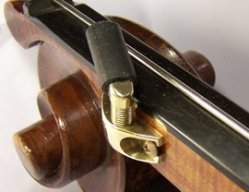
Here's an unusually affordable and practical solution that I happened upon: As the only bassist in our community orchestra, I found that a Glasser Bow, black hair and Spiro Mitts support the low end of the strings. Most importantly, the rugged fiberglass bow does not wilt in fff passages, and the black hair allows you to dig in down by the bridge. Your technique will improve so that you can be heard playing tastefully during quieter dynamics (at least that's my goal ). In addition, the pizz passages are audible with the Spiros that have been on the Shen 190 for about 6 weeks and are mellowing.
To save face, I applied pernambuco contact paper purchased from the hardware store to the bow .
.
Here's an unusually affordable and practical solution that I happened upon: As the only bassist in our community orchestra, I found that a Glasser Bow, black hair and Spiro Mitts support the low end of the strings. Most importantly, the rugged fiberglass bow does not wilt in fff passages, and the black hair allows you to dig in down by the bridge. Your technique will improve so that you can be heard playing tastefully during quieter dynamics (at least that's my goal
). In addition, the pizz passages are audible with the Spiros that have been on the Shen 190 for about 6 weeks and are mellowing.To save face, I applied pernambuco contact paper purchased from the hardware store to the bow
.
- Aug 1, 2005
- 3,546
- 1,421
- Disclosures
- Private Inventor - Bass Capos
How long have you been playing? Are you studying? I would discourage you from changing your grip to make more sound, or doing anything that isn't "good technique", as it will lead to bad habits and may cause injury. Well written wind ensemble pieces take into account that a single bass cannot compete with three bones and a tuba. In sections where the low brass is cranking it out, you just have to accept that you won't really be heard. Of course some basses and bows are louder than others, and volume also comes from good bow technique. A quick fix might be to place yourself so that you have some acoustic support. Stand near a wall, or if the rehearsal room has some of those movable acoustic panels, maybe arrange for one to be placed directly behind you. Just don't kill yourself trying to do the impossible.
Any other solutions to produce a bigger sound without ruining my bow hand?
Ampeg SVT.

The 3 factors that affect dynamics are pressure, speed, and where the bow is in relation to the bridge. If you're still not getting there, you might try raising your strings, easy to do if you have an adjustable bridge.
Remember that gripping tightly and pressing hard are things that will reduce your volume output. More vibrations mean more sound, and tensing up chokes these vibrations which will mean you won't project as much as if you just relax.
Think about the points mentioned above. Using only the natural weight of your arm, experiment with bow speed and placement in relation to the bridge. Hold the bow as loosely as possible. Whenever I've sat and watched or sat next to really amazingly loud bass players, the most striking thing has always been how little effort they seem to use to produce the sound they make. There is a certain amount of 'effort' required but it's never 'forcing' the sound.
No bass player is going to win against a serious brass section. You just have to learn to be comfortable in the knowledge you're making the best contribution you can with the tools that you have!
Think about the points mentioned above. Using only the natural weight of your arm, experiment with bow speed and placement in relation to the bridge. Hold the bow as loosely as possible. Whenever I've sat and watched or sat next to really amazingly loud bass players, the most striking thing has always been how little effort they seem to use to produce the sound they make. There is a certain amount of 'effort' required but it's never 'forcing' the sound.
No bass player is going to win against a serious brass section. You just have to learn to be comfortable in the knowledge you're making the best contribution you can with the tools that you have!
So, move really close to the bridge, more weight (but not more pressure, they're different), SLOWER bow to avoid the scratchy sul ponticello sound. It will take quite a strong pull to keep the bow moving like this, because you have optimised the coupling between bow and string. Practice so it starts cleanly. Try this in a practice room and it will sound uncomfortably bright and fairly harsh as well as really loud... add that to the brass and it'll be awesome.
As has been said, you're not competing with them, the Tuba is a bass instrument that comes in BELOW you in the blend, so you're now playing accompaniment to them; you don't want to be going for boom, you're now aiming for a sound that will change their character and add some stringy cut to the brass mellow.
As has been said, you're not competing with them, the Tuba is a bass instrument that comes in BELOW you in the blend, so you're now playing accompaniment to them; you don't want to be going for boom, you're now aiming for a sound that will change their character and add some stringy cut to the brass mellow.
You haven't said whether you are using French or German bow. The German bow might be better in this case. Also the bass has a remarkable presence in any ensemble, even though you can't hear yourself think here because of the tuba.
Actually the tuba is playing in the same range (plus a few deeper notes) as you. Their sound is thicker,warmer and more efficient than the bass so they tend to dominate, even over a full section of 8 basses. I liken their sound to a huge ship's siren that can be heard for miles. I also intensely dislike warming up beside them on stage before a performance because while I am struggling to hear an A they are honking away on B flat beside me!!
Best wishes,
DP
Actually the tuba is playing in the same range (plus a few deeper notes) as you. Their sound is thicker,warmer and more efficient than the bass so they tend to dominate, even over a full section of 8 basses. I liken their sound to a huge ship's siren that can be heard for miles. I also intensely dislike warming up beside them on stage before a performance because while I am struggling to hear an A they are honking away on B flat beside me!!
Best wishes,
DP

- May 30, 2000
- 4,707
- 257
- Disclosures
- Creator of: iGigBook Sheet Music Manager
If you are playing in a brass/wind ensemble, then why would you need to be audible? More than likely your part is doubled by the Tuba/Bass Trombone/Bass Clarinet/Bassoon. The reason the Double Bass is used in the wind ensemble setting is for color, not for being the dominant supporting bass instrument. Being concerned about blending in with the lower voices will be much more beneficial than you being audible (unless it is a solo/soli passage).
You really are at a dangerous disadvantage here. I began my bass career in a wind band in high school and brutalized myself for three years trying to be heard. My senior year I made the all state orchestra and was shocked to find that dynamic markings below forte actually meant something. After that I was the only bassist in my college orchestra for a year and again had to project too much.
The best thing you can do is back off when the brass is blasting. You'll only injure yourself and learn bad habits trying to match that volume.The sections where you can make a real difference with the brass are the mf-p passages and pizzicato note because you can produce a sound that no one else in the group can. The biggest passages where you can make a difference are the woodwind dominant sections. Your timbre as a bassist will blend much better with the winds and you can really help the bass clarinetist as well. Don't hurt your arms trying to push the.bow through the strings. The sound gets rough and phrasing goes out the window. Focus on producing the best sound you can and really take advantage of the sections where you can make a difference.
When I was in college I also played in the wind band for scholarship money. By then I was playing a VERY loud full size 5 string and even with that bass it was hard to keep up in the louder sections. Though one of my prouder days was when I came in early and the conductor yelled at the tubas.
(For what its worth I used to be a good tubist as well so do have some idea of what I speak)
The best thing you can do is back off when the brass is blasting. You'll only injure yourself and learn bad habits trying to match that volume.The sections where you can make a real difference with the brass are the mf-p passages and pizzicato note because you can produce a sound that no one else in the group can. The biggest passages where you can make a difference are the woodwind dominant sections. Your timbre as a bassist will blend much better with the winds and you can really help the bass clarinetist as well. Don't hurt your arms trying to push the.bow through the strings. The sound gets rough and phrasing goes out the window. Focus on producing the best sound you can and really take advantage of the sections where you can make a difference.
When I was in college I also played in the wind band for scholarship money. By then I was playing a VERY loud full size 5 string and even with that bass it was hard to keep up in the louder sections. Though one of my prouder days was when I came in early and the conductor yelled at the tubas.
(For what its worth I used to be a good tubist as well so do have some idea of what I speak)
And by the way, if you check out the Presidents Own Marine Band you will often see their bassist(s) using an amp and Mic/pickup with the full band.

