• TalkBass has been independent since 1998. Add your voice.
    Create a free account to reply to discussions, view embedded media, and browse with fewer display ads.
    Join freeLog in
    Want zero display ads or expanded classifieds tools? Compare plans.

More than 2 cabs with SVT-4 Pro

Hi people!

Lately I got a SVT-4 Pro head and I am pretty much satisfied with it and amazed with its possibilities. I am running two FMC cabs 410 and 2128, each with 4 ohms. It is running currently pretty simply: each power amp from SVT-4 is pushing through one cab.

I'm getting curious about running 3 or 4 cabs with it? Has anyone ever done it? I bet so, but I don't find any threads about it.
Is it ok to run two power amps at different impedances, for example one side 2 ohm, other side 8 ohm? The power amps are independent from each and it should work in theory, right?
How about 4 cabs at 2 times 2 ohm? Are we looking at temperature related issues?

Thanks

 
It's like just in case. I just like to know the expansion possibilities. There is actually no need, only a slight wish and curiosity.
Did you try it?

Running a massive rig can be cool, but it's pretty hard to justify all the work needed to transport and setup everything unless you are a huge star who can pay roadies to deal with your gratuitous rig. For context, I toured professionally and frequently used only a single 210 with about 200-250 watts. I had full PA support so the cab only served as my personal monitor. My last rig also included a 410 that I could run of a second channel wity 250W, but I rarely used it. When I did use it, it was often to satisfy someone else's needs.

This is a quad of Genz Benz 1288T Uber Quads. I doubt I ever gig any of these cabs as I am pretty much retired from playing out.
upload_2022-12-26_12-9-51.jpeg

The cabs were bought mainly for an experiment that I had thought about for decades, based on the Grateful Dead's Wall of Sound. Each cab is 8 ohms. The amp in this photo is an Epifani UL902C, which has two output sections rated for 900W per channel at 4 ohms. So each channel is pushing two of the cabs.

The difference between 1 and 2 cabs is pretty noticeable. The sound becomes significantly fuller and more solid. The difference between 2 and 3 cabs is also fairly noticeable but not as significant. The difference between 3 and 4 cabs is pretty small; the overall tone stays pretty much the same, but the perceived sound source moves up...I'll explain this next.

This stack of speakers forms a column line array. From what I have seen, column arrays create the perception that the sound is emanating from the center of the array. So if you make the array taller, the perceived sound source moves higher.

Using two of these cabs makes sense as the sound is significantly improved. It would definitely be cool to use three or even all four, but I suspect it would be a mixed blessing. It would sound slightly better to the bassist, but my guess is the bass would be way to strong out in the house.
 
It's like just in case. I just like to know the expansion possibilities. There is actually no need, only a slight wish and curiosity.
Did you try it?
I don't need to try it, 40 years of experience designing commercial speakers (including the ones in @Wasnex post above) and the math tell me all I need to know. Especially given the results I see when folks try to do this with random speakers.

The Uber 1288 stack posted above is a good choice because the speakers were designed to work together, but even with identical speakers, the point of diminishing returns is reached fairly easily.
 
I don't need to try it, 40 years of experience designing commercial speakers (including the ones in @Wasnex post above) and the math tell me all I need to know. Especially given the results I see when folks try to do this with random speakers.

The Uber 1288 stack posted above is a good choice because the speakers were designed to work together, but even with identical speakers, the point of diminishing returns is reached fairly easily.

While that's a fair answer, it's not a fun answer.
 
Hi people!

Lately I got a SVT-4 Pro head and I am pretty much satisfied with it and amazed with its possibilities. I am running two FMC cabs 410 and 2128, each with 4 ohms. It is running currently pretty simply: each power amp from SVT-4 is pushing through one cab.

I'm getting curious about running 3 or 4 cabs with it? Has anyone ever done it? I bet so, but I don't find any threads about it.
Is it ok to run two power amps at different impedances, for example one side 2 ohm, other side 8 ohm? The power amps are independent from each and it should work in theory, right?
How about 4 cabs at 2 times 2 ohm? Are we looking at temperature related issues?

Thanks
Yep, years ago I had a crazy 4Pro setup. It was killer! Used both channels for all four cabs. I mostly used the 2x15 or the 610 setup though…
4FD8CB0F-6A42-4D29-B477-175594FCB81A.jpeg
 
Last edited:
I don't need to try it, 40 years of experience designing commercial speakers (including the ones in @Wasnex post above) and the math tell me all I need to know. Especially given the results I see when folks try to do this with random speakers.
Could you please elaborate? I am really curious what happens?

I kind of natively expected that it will get better and better or at least louder and louder. Didn't expect that the point of diminishing returns would be so close.
How would it be with more different sized speakers from different brands? More probabilty of phasing?
 
I was a bit underwhelmed with the SVT-4 Pro’s volume when I ran the head in stereo mode, powering a pair of 4 ohm Ampeg 4-10” cabs. In stereo mode the amp puts out 490 watts per channel.

I was a lot more impressed with it’s overall volume when I ran the head in mono-bridge mode into an Ampeg 810E, which is a 4 ohm cabinet. In mono-bridge mode the 4 Pro puts out 1200 watts into a 4 ohm load.

If I owned a pair of 810E’s in those days, I would’ve at least tried running the 4 Pro in stereo mode. Granted, each cabinet is getting *only* 490 watts, but I’d be curious if the second cabinet provided more volume as opposed to a single 810E. :bassist:

I’m an old guy, and a pair of 810E cabinets just looks so *right* to me. :D Whether you’re using an all tube SVT head or a tube/solid state hybrid head like the SVT-4 Pro. It’s simply an iconic look. :woot:
 
Last edited:
  • Like
Reactions: BasturdBlaster
I don't need to try it, 40 years of experience designing commercial speakers (including the ones in @Wasnex post above) and the math tell me all I need to know. Especially given the results I see when folks try to do this with random speakers.

The Uber 1288 stack posted above is a good choice because the speakers were designed to work together, but even with identical speakers, the point of diminishing returns is reached fairly easily.

Not to hijack the thread, but I’ve noticed oftentimes on touring backines, the bassist has two Ampeg SVT stacks; for instance a pair of SVT-CL’s, each powering an 810E. If both stacks are truly powered on, does this second stack provide more volume than a single stack?
 
Could you please elaborate? I am really curious what happens?

I kind of natively expected that it will get better and better or at least louder and louder. Didn't expect that the point of diminishing returns would be so close.
How would it be with more different sized speakers from different brands? More probabilty of phasing?

Adding cabs usually gives you more SPL, but it does not necessarily improve sound quality. If the speakers are not designed to work together the sound quality can actually be pretty bad.

Even pairing identical cabs is not necessarily going to improve every aspect of the sound. Whether adding a cab is beneficial depends on what your goals and priorities are.

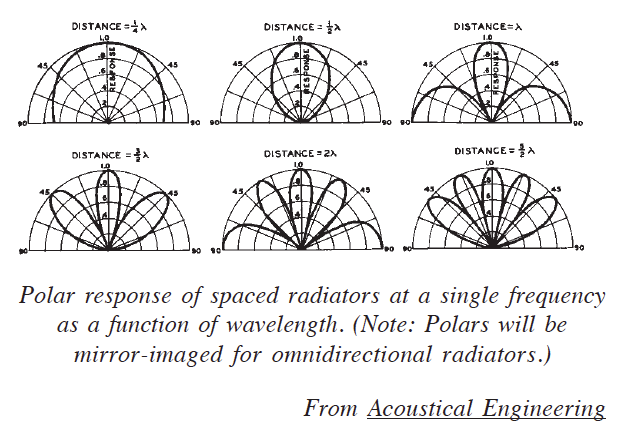
When you use two cab close together they produce mutual coupling. This mutual coupling is most effective were the distance between drivers approaches 1/4 wavelength or less. As the frequency goes up the wavelength gets shorter and mutual coupling decreases, so the ramification is the mutual coupling is strongest a low frequencies.

It's not all good though. You also get something called lobing or comb filtering, that occurs across the axis the drivers are aligned upon. FYI, lobing and comb filtering are essentially different ways to describe the constructive and destructive interference that occurs between two sound course that are located in different positions.

The following will be related to lobing.
The resultant pattern is based on the ratio between the wavelength (Lambda)
upload_2022-8-14_21-20-47-png.4782575
and the spacing or distance between the drivers.
While reading this post, try to remember that Lambda
upload_2022-8-14_21-20-47-png.4782575
is just a fancy name for wavelength, and distance is the center to center spacing between drivers.
Low_Directivity-polars1.png


Here is the approximate dispersion pattern you get when driver spacing = 1 Lambda. This image assumes vertical alignment of the drivers.
upload_2022-7-30_18-46-28-png.4766968

Notice the ear is in the null between the lobes. So this guy will not hear this frequency very well. For a vertical 210 I believe this pattern occurs at approximately 1,130hz.

This is a higher frequency where driver spacing = 2 Lambda (2,260hz)
upload_2022-7-30_18-49-31-png.4766969

Notice one of the secondary lobes that is shooting up at an angel is pointing straight at the ear. So he will hear this frequency.


But if he moves here, his ear is in the null again.
upload_2022-7-30_18-59-37-png.4766972


Notice the primary lobe always shoots straight out (on axis). So if you make sure your ears are on axis to the primary lobe, you should hear the intended full range response of the cab. You can do this by moving further from the cab, tilting the cab back to aim at your head, or elevating the cab to a suitable height.
upload_2022-7-30_18-45-50-png.4766967
 
  • Like
Reactions: BasturdBlaster
I was a bit underwhelmed with the SVT-4 Pro’s volume when I ran the head in stereo mode, powering a pair of 4 ohm Ampeg 4-10” cabs. In stereo mode the amp puts out 490 watts per channel.

I was a lot more impressed with it’s overall volume when I ran the head in mono-bridge mode into an Ampeg 810E, which is a 4 ohm cabinet. In mono-bridge mode the 4 Pro puts out 1200 watts into a 4 ohm load.

If I owned a pair of 810E’s in those days, I would’ve at least tried running the 4 Pro in stereo mode. Granted, each cabinet is getting *only* 490 watts, but I’d be curious if the second cabinet provided more volume as opposed to a single 810E. :bassist:

I’m an old guy, and a pair of 810E cabinets just looks so *right* to me. :D Whether you’re using an all tube SVT head or a tube/solid state hybrid head like the SVT-4 Pro. It’s simply an iconic look. :woot:
Specs​
Ampeg 810E
-Sensitivity 100dB 1W/1m for one cab
-Sensitivity 103dB 1W/m for two cabs
-Power Handling 800W RMS

Usable power:
-490W x 2 = 960W
-1200W...the 810E is rated for 800W RMS

One cab at 490W
[Log(490) x 10] + 100 = 126.9dB

Two cabs at 490w x 2 960W total
[Log(960) x 10] + 103 = 132.8dB

Note adding a second cab and doubling the power nets approximately +6dB

One cab at 800W
[Log(800) x 10] + 100 = 129dB...Ampeg claims the max SPL is 130dB.

If the cab could handle the full 1200 (not advisable IMHO)
[Log(1200 x 10] + 100 = 130.8dB

The real world measured SPL will be a bit lower than calculated. Cabs tend to experience power compression as they approach their power rating. Also the mutual coupling will not necessarily be perfect.
 
  • Like
Reactions: Arthur U. Poon
Not to hijack the thread, but I’ve noticed oftentimes on touring backines, the bassist has two Ampeg SVT stacks; for instance a pair of SVT-CL’s, each powering an 810E. If both stacks are truly powered on, does this second stack provide more volume than a single stack?
Yes, it typically provides +3dB due to power doubling and another +3dB due to doubling of the effective radiated area (with double the total motor strength). It also typically provides a little more low frequency extension, some real and some perceived.