• TalkBass has been independent since 1998. Add your voice.
    Create a free account to reply to discussions, view embedded media, and browse with fewer display ads.
    Join freeLog in
    Want zero display ads or expanded classifieds tools? Compare plans.

Double Bass "Mortising" an old Kay dovetail joint

james condino

Spruce dork
Commercial User
Sep 30, 2007
5,443
13,478
asheville, nc
www.condino.com
Here is your dose of mid week old Kay drama:

I had a pretty good neck failure come into the shop this week that is a common discussion around here, so I wanted to show it. None of this was my prior repair work.

There is a common response around here that you can take an old Kay dovetail (or Epiphone, American Std., Englehardt, et cetera), open up the old tulip poplar neck block, add a few large shims to the dovetail and suddenly you have a structurally sound traditional mortise and tenon joint.

Basically, all you have done is created an even weaker joint that was two pieces and now turned it into a minimum of four pieces, often with additional shims, that creates more potential for failure. A stacked jigsaw puzzle is not equivalent to a well fit traditional two piece mortise and tenon joint. Here is a photo of this week's fail:
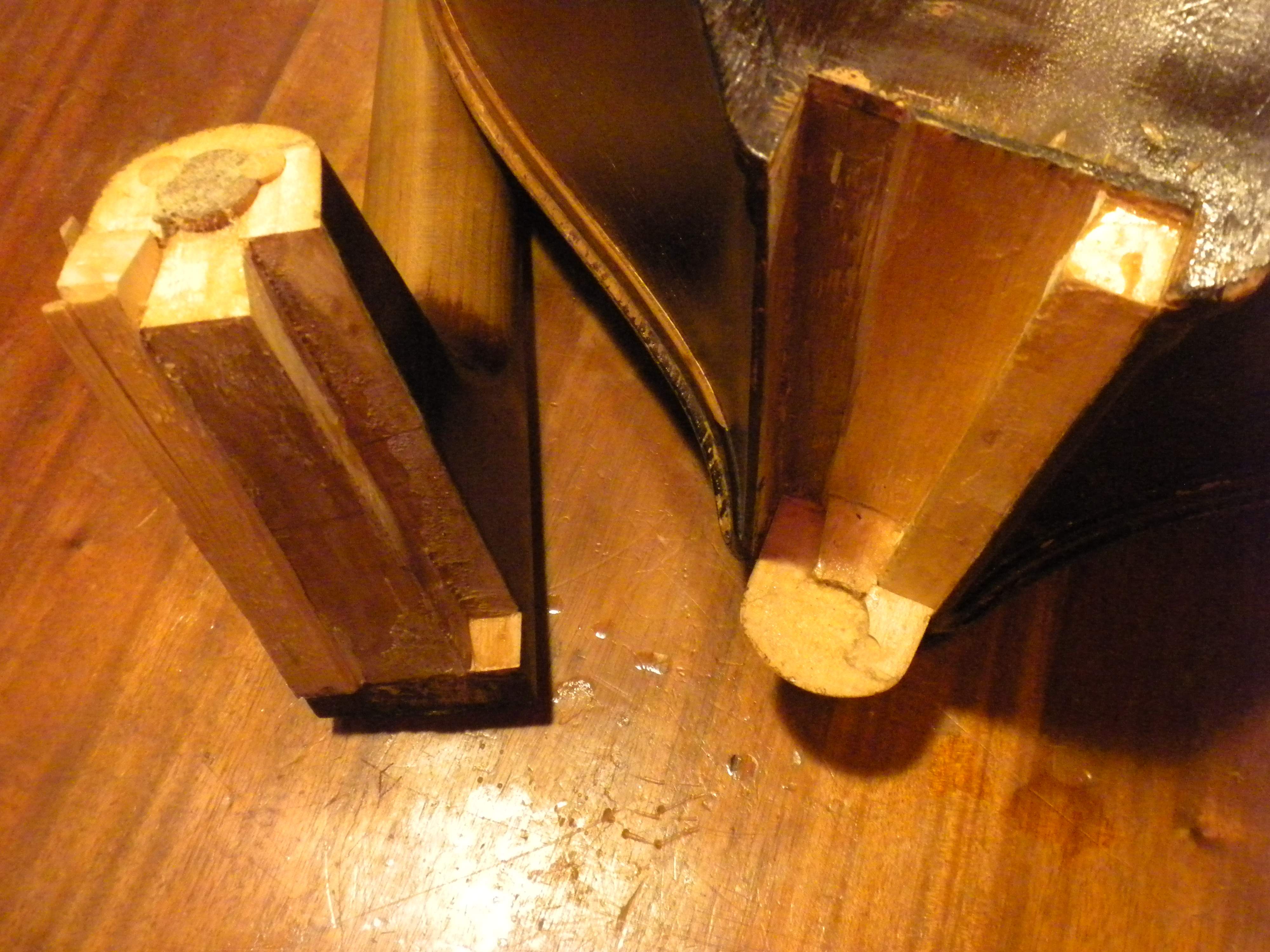
DSCN8314.JPG


It appears to have started with a common broken heel. One large and two smaller dovetails were installed with the wood grain at 90 degrees to the neck grain, creating a lot of future wood movement conflicts. Next the block was opened up only in width, wings were added to the dovetail cheeks, and also a front spruce shim was added to the endgrain of the front of the neck, likely from a factory gap, and then another shim where the button connects. That is a lot of parts under 300 lbs of tension with what also appears to be not much glue connecting all of it....
 
If repairs such as these always fail, then what is the best way to fix a neck that’s lifting up from where the button used to be? I’m almost at the point where I think I should just leave my slightly lifted Kay neck alone rather than try and have someone fix it. It doesn’t have a button either (as it apparently fell off many years ago), but looking at it in the shape it is in really bothers me.
 

Attachments

  • C9621555-7C01-4249-BE2A-31D793656BE2.jpeg
    C9621555-7C01-4249-BE2A-31D793656BE2.jpeg
    646.8 KB · Views: 173
  • EE9EF161-1D39-4319-83EC-6830FCEBD83D.jpeg
    EE9EF161-1D39-4319-83EC-6830FCEBD83D.jpeg
    767.4 KB · Views: 169
  • 45700391-8877-4C3D-BCA5-7CAE1041EBD8.jpeg
    45700391-8877-4C3D-BCA5-7CAE1041EBD8.jpeg
    833.8 KB · Views: 165
Here is your dose of mid week old Kay drama:

I had a pretty good neck failure come into the shop this week that is a common discussion around here, so I wanted to show it. None of this was my prior repair work.

There is a common response around here that you can take an old Kay dovetail (or Epiphone, American Std., Englehardt, et cetera), open up the old tulip poplar neck block, add a few large shims to the dovetail and suddenly you have a structurally sound traditional mortise and tenon joint.

Basically, all you have done is created an even weaker joint that was two pieces and now turned it into a minimum of four pieces, often with additional shims, that creates more potential for failure. A stacked jigsaw puzzle is not equivalent to a well fit traditional two piece mortise and tenon joint. Here is a photo of this week's fail:

View attachment 3567296


It appears to have started with a common broken heel. One large and two smaller dovetails were installed with the wood grain at 90 degrees to the neck grain, creating a lot of future wood movement conflicts. Next the block was opened up only in width, wings were added to the dovetail cheeks, and also a front spruce shim was added to the endgrain of the front of the neck, likely from a factory gap, and then another shim where the button connects. That is a lot of parts under 300 lbs of tension with what also appears to be not much glue connecting all of it....

Thanks for taking the time to post James. Looking forward to repair pics if you have the time!
 
  • Like
Reactions: 210superair
If repairs such as these always fail, then what is the best way to fix a neck that’s lifting up from where the button used to be?

This is the classic symptom of a failed Kay joint. It may feel solid now -- I've myself played basses with this symptom for years before the fix -- but the neck is crawling out of the block, the action is rising, and the block will eventually give way. I expect that in this thread James will illustrate how he handles this problem.
 
If repairs such as these always fail, then what is the best way to fix a neck that’s lifting up from where the button used to be? I’m almost at the point where I think I should just leave my slightly lifted Kay neck alone rather than try and have someone fix it. It doesn’t have a button either (as it apparently fell off many years ago), but looking at it in the shape it is in really bothers me.


Gotta give it up for the TCB decal tho bro... Nice.

And also, watch James here, and listen to Steven, and you'll be fixing it yourself. With confidence. These guys are a wealth of information...
 
  • Like
Reactions: Keith Rawlings
I don't understand what's going on on the treble side... it looks like the cheek/wing (?) broke off and a new c/w was crafted but accidentally made too small and a ~0.050" slice was then added to go between it and the block? And there appears to be at least one ~0.010 slice stuck into the block?

Is this as shyster-ish as it appears or is this an amateurish execution of what could otherwise be done well by someone qualified for the title "luthier"?
 
Brian! How come we live so close but only see each other every three years or so????

Impact trauma, but it would have failed either way eventually. I see a lot of these, all with the same end result: a big pile of parts and an unhappy customer...often yelling at me over someone else's fail, while I patiently remind them (multiple times)...."Yes...but I didn't break the $#@!%^& neck!..."

At this point, a moderate two piece neck and block has been transformed into 8+ pieces of wood. The obvious solution is simple: it needs a new $#@!&% neck! Anything that can be done to make it structurally solid by this point is acceptable damage control. I'll get this all back and running solid for the customer, but I'm not yet set on my final approach. I'm leaning towards removing all that mess....

My main point is that reboxing a dovetail is still a weak dovetail, now made weaker with the addition of more stacked parts.
 
reboxing a dovetail is still a weak dovetail, ...

Am I correct in my feeling that heels crack and blocks fail, but the dovetail tenon on the neck usually remains in place? I notice in your photo that the heel has three dowels in it, including one that's big enough to nearly decouple the tenon from the neck, yet the tenon didn't fail, the block did. The blocks I've seen have been poplar, soft, old and getting punky. How often do you recommend replacing the block rather than the neck? This would at least get you back to a two-piece joint.
 
"Am I correct in my feeling that heels crack and blocks fail, but the dovetail tenon on the neck usually remains in place? " Yes, that has been my observation- block fails are the most common and true failures of the dovetail are not very common. Block fails are simple- make a new block out of a stronger material and a better fit.

The big dowel is a separate conversation...while not my favorite, it did hold together.

The block did not fail. What you are looking at is a prior repair where someone else left the dovetail intact, chopped up both sides of the block to be similar to a traditional mortise, then glued "wings" to both sides of the dovetail (possibly because I have seen multiple posts here claiming that this somehow removes the dovetail and turns it into a mortise) then the whole thing failed, leaving one side of the wing repairs attached to the dovetail and the other still attached to what we are seeing as the right side of the mortise.
 
So in lieu of removing the top and replacing the neck block, "What would JC (James Condino :D) do?"
Would you square off the dovetail, re shim the neck pocket with the proper wood/ grain direction and re glue or does the existing wood dowel complicate things? Maybe additional reinforcement through the neck heel?
 
Brian! How come we live so close but only see each other every three years or so????

Impact trauma, but it would have failed either way eventually. I see a lot of these, all with the same end result: a big pile of parts and an unhappy customer...often yelling at me over someone else's fail, while I patiently remind them (multiple times)...."Yes...but I didn't break the $#@!%^& neck!..."

At this point, a moderate two piece neck and block has been transformed into 8+ pieces of wood. The obvious solution is simple: it needs a new $#@!&% neck! Anything that can be done to make it structurally solid by this point is acceptable damage control. I'll get this all back and running solid for the customer, but I'm not yet set on my final approach. I'm leaning towards removing all that mess....

My main point is that reboxing a dovetail is still a weak dovetail, now made weaker with the addition of more stacked parts.

I hear you... are your in laws still down this way? If so, we need to hang! Next time I'm up your way I'll give you a shout.

I understand about the pieced together neck stuff, but sometimes we just have to "make it work". I do think the "mortising" is still better than the ill fit dovetail I find with most Kay basses. Most owners don't want me to pull the top, replace the block, etc... they're looking for the quick fix that gets them up and running and the "mortising" repair fits that bill. Not sure how this one was executed, but it looks kind of sloppy. I think if it's done cleaner and with the right fit it should be pretty secure.

All neck joints can fail, given the right time or trauma. I've seen $30,000 instruments with the button area coming loose and hinged at the front of the block. No grafting or mortising, just failure. It happens.

FWIW,
BG
 
It seems to me (me not being a luthier or engineer...) that a lot of the Kay/Engle neck failures occur because of the vertical space between the tenon and block, which ends up leaving the block cheeks to do all the work. Am I wrong in thinking that, short of a new block or neck, the jigsaw puzzle approach could work if the grain is oriented correctly and the surfaces all have very tight tolerances?
 
It seems to me (me not being a luthier or engineer...) that a lot of the Kay/Engle neck failures occur because of the vertical space between the tenon and block, which ends up leaving the block cheeks to do all the work.

I know that feeling, it really does seem untidy to allow space under the tenon. But on thinking about it I concluded that there's a much wider area to take the engineering load on the shoulders of the block, seating the neck more stably in all directions, than at the bottom of the mortise. So you cut the mortise deep enough that the tenon won't bottom out. (Keeping this depth to minimum would increase the strength of the block, I think, but I expect they wanted some making-sure space to prevent fiddling with the gap at the assembly stage.)

As I see it, when the joint fails it's usually not because the tenon sinks into that space, rather that the block gives way to the leveraged load at the rear of the mortise. Does that make sense?