

Enjoy the benefits of a premium membership!
Upgrade Account
-
TalkBass has been independent since 1998. Add your voice.
Create a free account to reply to discussions, view embedded media, and browse with fewer display ads.
Join free Log in
Want zero display ads or expanded classifieds tools? Compare plans.
You are using an out of date browser. It may not display this or other websites correctly.
You should upgrade or use an alternative browser.
You should upgrade or use an alternative browser.
Most consistently well-crafted and problem-free basses?
- Thread starter el_Bajo_Verde
- Start date
More options
Who Replied?

My 2 cents, there are 5 brands that I have yet to see poor QC from. Cort, Ibanez, G&L, Ernie Ball, & Dingwall. Cort & Ibanez fall within your budget. Ernie Ball's a bit of a stretch, as I have seem some Sterling By Music Man dogs.

I think the best QC bass you can own is one that you customize yourself. Based on your requirements for tone, versatility, shape, feel, and finish/ color there are a lot of ways to get something that will be reliable for years to come.
You can take just about any bass and change out parts on them to do all the fancy stuff I've mentioned. Some people like the simplicity of one volume job and one for tone, others like a little more flexibility with a preamp. These of course, contain a battery which is another issue and not related to fit and finish, but simply longevity and normal wear and tear.
I can make an olp or a sterling sub sound like a music an with a few simple mods, or I can buy the real thing. There is a noticeable difference here.
You can take just about any bass and change out parts on them to do all the fancy stuff I've mentioned. Some people like the simplicity of one volume job and one for tone, others like a little more flexibility with a preamp. These of course, contain a battery which is another issue and not related to fit and finish, but simply longevity and normal wear and tear.
I can make an olp or a sterling sub sound like a music an with a few simple mods, or I can buy the real thing. There is a noticeable difference here.
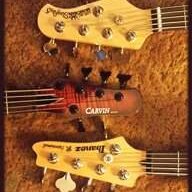
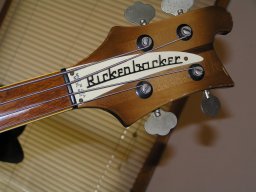
I think you'd be best served by building a killer mutt for many reasons. From an educational standpoint, you'll understand the inner workings of the instrument. This will pay dividends down the road when your bass needs adjustment or repairs and no one else is available. From a player's standpoint, you get to choose what features you want and don't want without being stuck with a mixed bag. From an economic standpoint, you control the budget and the time line for that budget (if you want an expensive bass, buy the parts a few at a time as you can afford them and start working on the bass when the inventory is complete). From a QC standpoint, because you have access to every single part on this instrument, you control QC 100%. From an owner's standpoint, you'll have a one of a kind conversation piece. From a craftsman's standpoint, you can rip it apart and put it back together as many times as you like and it will still be your original design (without voiding the warranty!) From a collector's standpoint, you're screwed, unless you like an oddity for pocket change. If you are hesitant to begin a project, there are kits available and videos, etc. to give in depth instruction on how to proceed. To answer your original question, the killer mutt is the most consistent and problem free, because you are in control of every phase of design and construction and are therefore able to correct problems as they arise rather than allowing them to fester and ruin an otherwise perfectly good instrument. Best to you and I hope this helps.

My Guild Starfire is an exceptionally built bass and it had a loose tone pot when I received it. It took me all of 30 seconds to fix it. Having a nut or screw come loose is not the result of inconsistent QC and says nothing about the overall quality of the instrument. If you want a bass that is "consistent, reliable and easy to fix" but an instrument that may require a few turns with a wrench or screwdriver to tighten a loose pot or jack is enough to scare you off, I dont know what to tell you. Get acquainted with a small tool set? Because the issues you listed are probably two of the easiest fixes to perform.

Another vote for yamaha. But I don't know why it has to be brand specific, are you buying 1 or 100?
Just pick a style of bass you like and then find one that is a winner. You may have played some sketchy Epiphones but my thunderbird is an absolute workhorse; just because some have issues doesn't mean I would give up my fantastic one.
Just pick a style of bass you like and then find one that is a winner. You may have played some sketchy Epiphones but my thunderbird is an absolute workhorse; just because some have issues doesn't mean I would give up my fantastic one.

»Every bass with straight edge is a no go for me, they always hurt the arm and doesn't feel right on my lap. I also don't enjoy instrument that could have the fret sprout out.
So I like Warwick, Fender if the has a maple fretboard or neck binding, Carvin fretless, some Yamaha
So I like Warwick, Fender if the has a maple fretboard or neck binding, Carvin fretless, some Yamaha
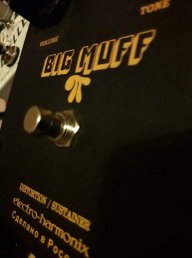

The only basses I've had for a few years or more are Lakland (skyline) and I've had zero problems...
I like the basic fender type bass, it's simple to maintain and adjust, and if something goes wrong it can be easily replaced... the rest is a gamble, but the more you can spend, the better the quality tends to be (less corners cut). But each individual specimen can fall anywhere - a cheapo bass can last decades, and an expensive one can, say, have a bad neck.
I like the basic fender type bass, it's simple to maintain and adjust, and if something goes wrong it can be easily replaced... the rest is a gamble, but the more you can spend, the better the quality tends to be (less corners cut). But each individual specimen can fall anywhere - a cheapo bass can last decades, and an expensive one can, say, have a bad neck.

Not that I've been around that long, but I have done a good bit of shopping! I highly recommend this as it taught me a lot about different feels and sounds (and helped me gather the fine herd I now have to thin ; ) Anyway, to address your question, I have found anything but consistency in anything but the cheaper basses I looked at.
A fine American Fender P was mentioned above- coincidentally I looked at an American P at GC this afternoon and it was the worst of its kind I have ever played. The last time I was looking for a p bass I managed to find 3 American Standards at the same store and all 3 sounded different (but I thought all p basses sounded the same?). I ended up buying a MIM that sounded better than any of them. I've seen 2 Music Man basses with some pretty bad fret sprout in spite of them being known as quality, well made instruments- the one I bought used certainly is! I had a German Warwick that pretty much sucked, too.
Now here's the good news- you don't need to care about consistency because you only need one, right? It's not like you're going to play a different bass every day so they need to all be the same. As pointed out above, any decent bass is going to be pretty maintenance free, at least all of mine have been. I just can't stress the importance of either trying before you buy, or if you have to buy sight unseen, having a generous return policy. I've played at least 5 fairly high-end basses with dead notes, so make sure to play every note on the neck. A salesman at GC actually asked me when I pointed this out on one of his basses "Do you play that note a lot?" I wanted to ask him how much he'd take off, but I wasn't going to buy it anyway so I just looked at him and handed him the bass- and lost all respect for that particular salesman.
Have fun, nothing like shopping for your next bass!
Please excuse my ignorance, but what do you mean by 'dead note'? Is that note not audible at all, or dampened... ?

Quality only means something on a bass you want to play. What kind of sound and feel do you want?
I see you mentioned Fender Precisions. I played a wonderful American Standard Precision yesterday at GC. In my heart, I'm not a P-bass guy, but I wanted that bass. I think the American Standard or Roadworn Precision would be great. It is hard to screw up a P-bass.
This. Knowing a budget, and what style of music you play, and what tone you're after will help narrow the field.
If not, people will chime in with $10,000 Ritter, Federal and Alembic basses.
Dollar for dollar I'm with Doc. A PhD bass if you're a traditionalist. If not, it's hard to beat Yamaha quality control. I used to work at a music store. I sold Yamaha everything from trumpets to PA equipment to Pianos to basses. One thing you can say about them is that every one is the same out of the box. And they all work.
... low-maintenance, reliable, and easy to fix. What brands/models tend to be the least problematic?
As much as I love my Fenders, I would have to say my FBB fretless is the most easy to maintain... since I've owned it (several years) I have had to adjust the truss rods one time. Plays like butter with very low action.
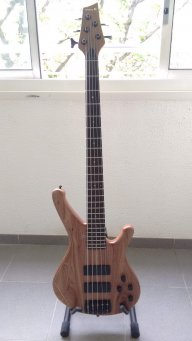
This isn't exactly an answer to your question but hear me out. The problems you listed (a loose nut or knob, maybe something that needs a setup or adjustment) are things that you'll eventually encounter. Maybe even right before a gig, let's say you transported your instrument, you get it out of the car and suddenly you realize the input jack is loose or a solder joint broke, just by random chance during the transport. In that case it would be best if you know how to fix it and already have experience. I think that's why many people still recommend that people start out with cheap basses, you don't have to be afraid of breaking anything and you can learn the basics of maintenance and repair on them.
By all means, get a properly crafted instrument that'll hopefully be problem free for the longest time, but also learn how to deal with these small issues because they'll probably hit you at some point. As for what instruments, most decent solid body basses are very easy to repair and maintain, I personally find basses with a dedicated electronics compartment easier to deal with than the ones where everything is mounted to the pickguard or to a plate, but that's just me. Warwick has some really neat features on their higher end models in terms of maintenance and adjustments.
By all means, get a properly crafted instrument that'll hopefully be problem free for the longest time, but also learn how to deal with these small issues because they'll probably hit you at some point. As for what instruments, most decent solid body basses are very easy to repair and maintain, I personally find basses with a dedicated electronics compartment easier to deal with than the ones where everything is mounted to the pickguard or to a plate, but that's just me. Warwick has some really neat features on their higher end models in terms of maintenance and adjustments.
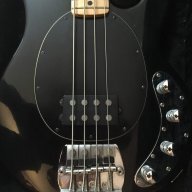
Ernie Ball MusicMan!! Mines 25 years old and still feels as sturdy as new..


Ernie Ball MusicMan!! Mines 25 years old and still feels as sturdy as new..
That's because they're like 12 lbs of a blunt instrument!!!

View media item 10026If you're looking for a 5 string, an Ernie ball Music Man stingray 5 H will never let you down!


