• TalkBass has been independent since 1998. Add your voice.
    Create a free account to reply to discussions, view embedded media, and browse with fewer display ads.
    Join freeLog in
    Want zero display ads or expanded classifieds tools? Compare plans.

Double Bass Most efficient way to play root 5

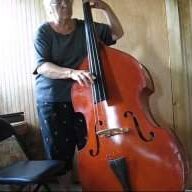
Good thread. I am in your same boat. I am moving from BG to DG and playing bluegrass. I think I found somewhat of a "cheat" to get me started. I am going to be playing on a 5/8ths size bass, with a string length of 38 1/8", so the root-V and octave stretches more closely resemble what I am used to on the bass guitar. I'm all for finding an easier way that still works.
 
my bad self is very happy
DSCN9969_zps2a58c90b.jpg
 
Using the 5th position ("fret") as a home base, I have developed a style of minimalist simplicity that uses almost exclusively the index finger for the root and the 5th on the next lower string combined with the pinky for the 5th on the next higher string. The pinky can also be used for playing the root on the higher string and then rocking back and forth with the 5th on the next lowest string. A position shift can be accomplished by moving the hand up or down and replacing the index finger with a pinky or vice versa.

Most songs can be played with using no position shift at all. All of the roots and fifths in a three chord song can be played with the index finger and the pinky in one spot using as few as two strings. Band mates greatly appreciate a large, but quick presence in the right spot that quickly gets out of the way for the instruments and singers. A short note can be played very loudly without distracting because it isn't around for very long. It's a very strong pulse for the band.

.
I started on DB doing bluegrass and just recently discovered some of the finger technique Steve mentions while using a 5 String EUB. If a song didn't have a ii or vi you could stay in the same position, pretty much guaranteeing good pitch and it worked in any key.

Open notes can be your best friend at times if you learn how to mute and stop well. We play a blazing fast irish fiddle tune in our group as part of a medley. Many of the chord changes are only held for 1, however the only chords in the song are D, G, and A. I play the whole song open for the most part. Other than a few root-five combo's, there isn't much room in the song for anything else (on bass).

When I first started playing I could go out and jam with really good players because I hardly ever needed to play a closed string.
Bill Cheatum is an example of a tune with a lot of chord changes on the B section but all open strings.
I was able to concentrate almost entirely on driving the group.
 
I have a couple of different tricks.

G Chord: Obviously Open G/Open D, but you can also play open G and then slide your hand all the way down the neck until it hits the joint. Where your pinky lands should be D. It takes a little bit of practice and fiddling about with intonation, but it is a nice trick.

C Chord: I usually use the C on the G and the open G.

D: Lots of possibilities. The D at the joint and the A on the G work well, but I like open D because you can get good walks.

Great thred, by the way. Always like to talk Bluegrass.
 
  • Like
Reactions: cultrvultr
So, here's my take on an answer to the OP:

I had EXACTLY the same questions when I started about 2 years ago. I began watching the original Flatt and Scruggs TV show tapes in Black & White to figure out an answer. I figured, if it was good enough for them, It would work for me. I also watched ever traditional Bluegrass player I could find on YouTube, and live. I watched and watched. I can summarize my results below in 5 simple stupid rules to make it sound like traditional Bluegrass:


1) If you possibly can play an open string, do it. It sounds better, and is easier on the Left hand

2) Always pick a 5th that is LOWERr than the root in tone, whenever possible.

3) Try not to play anything except Roots and 5ths except for an occasional passing tone or walk

4) Think about your bass the way a drummer thinks about his bass drum. Primarily you are there to keep rhythm.

5) Most of the time, the other players don't even know what notes you are playing, but feel your rhythm. If you mess up a note or two NO ONE will even notice - even if it is an egregious error, as long as you are playing in time.

Unfortunately, this is a very boring and unrewarding playing style for the bass player. But my experience, it this is what the traditional Bluegrass players crave and demand from the bass player. Some times I feel like a Baskin Robbins ice cream parlor where no one ever wants to buy any flavor other than vanilla :-(

If you do this enough, every damn song starts to sound and feel the same. I often find myself asking "Why am I even bothering to do this?" But its what they all seem to want. I get away from the boredom by listening to the other instruments and reminding myself how lucky I am to be enjoying great Bluegrass up close from folks I enjoy playing with. I also have learned to sing, and that gives me plenty to do.

OK, I'm having a really angry moment now - I'll just say it: Bluegrass Bass can be a totally thankless, mind numbing boring, back breaking, painful to the arms and hands, inconvenient, expensive, and unnoticed pursuit. Yet, I can't imagine giving it up. I absolutely adore it.

Why do we do this to ourselves??? The damn upright bass has somehow gotten into my blood like a space alien parasite on Meth. It hurts a lot both mentally and physically, but I can't seem to get enough of it.

Does that answer your question? OK, done ranting, going back to my disconnected fugue state in 3..2..1...
 
I take this with a grain of salt and a good dose of humor but I also disagree with much of what you said:). There is so much you can do besides 1-V and if you listen closely to the greats, Mike Bub comes to mind, they are doing a lot of subtle things that make good bass playing great bass playing. Framing every song differently is where the art lives. And what keeps it endlessly interesting. But in order to do this you need to be able hear it and execute it AS IF all you are playing us I/V. They're not bass players, they know not what you do, but if you play great baselines that reveal the song while propelling it with a fat sound and great feel they will know it.
 
It is really amazing. When I played a straight I / 5 for close to 3 hours, the guitar player and banjo player told me that I was one of the "best bass players they had ever heard or had he honor to play with." They had no idea I was being boring on purpose to make a point.

I wanted to break down laughing, but instead told them I appreciated their comments and "I work hard to be creative and make every song unique and musically challenging" I almost couldn't keep a straight face. I hand been bored out of mind for 3 hours seeing if I could play the whole gig with just 1/5s and no passing notes or walks. The whole thing kind of depressed me knowing what they really wanted - not that they really knew what they wanted. But that's the way it is folks. It's also why someone with a washtub a stick and a string can replace us in a heartbeat.
 
  • Like
Reactions: michaeln
I take this with a grain of salt and a good dose of humor but I also disagree with much of what you said:). There is so much you can do besides 1-V and if you listen closely to the greats, Mike Bub comes to mind, they are doing a lot of subtle things that make good bass playing great bass playing. Framing every song differently is where the art lives. And what keeps it endlessly interesting. But in order to do this you need to be able hear it and execute it AS IF all you are playing us I/V. They're not bass players, they know not what you do, but if you play great baselines that reveal the song while propelling it with a fat sound and great feel they will know it.

This is also well said.

And it got me thinking. There are really 2 ways to look at this:

1.) in a jam setting, 1/5 is the way to go since there's lots going on and lots of musicians usually playing. Hanging back and helping with time is key. Let the mandos, banjos and fiddles do their thing. Throw in your walk-ups here and there but stick to your 1/5


2.) in a band setting, you should be composing a bass line. Our band has been in the same lineup for a couple years now, which was an intentional move. It was tough playing out when you had a different lineup every gig. Who takes their breaks where and whatnot made us less tight. It's been nice that all that has been sorted out and now the songs are much more composed. I can put together lines and runs that compliment what the soloists are doing. I haven't abandoned 1/5 but I'm trying add more to it for the musical part but also to keep challenging myself and prevent boredom. And we all get lots of compliments for it.

Hope that makes sense. Just my .02

.
 
  • Like
Reactions: michaeln and Holdsg
Yes, it makes perfect sense. The only red flag to me is the "Get bored " part. I have to say that I never find myself bored, even playing a simple part. I focus so much on making it the best sound I possibly can. I guess that makes me a bass player :). Two notes, how can I make them huge, round, supportive, musical, beautiful? That's an endless quest...
 
jasonsypher wrote:
"....... if you play great basslines that reveal the song while propelling it with a fat sound and great feel they will know it."

Jason: Very well stated! Finding some musicality to add to my playing keeps me from getting bored. Constant root fifth over time will end up making all your tunes sound like marches if you are not careful.
To the OP....listen to Bob Moore, Mark Fain, Dennis Crouch and Travis Book. There are others but there is lots of material on Youtube with these fella's. They do tons of subtle stuff you can learn to make your bass playing more interesting while not getting in the way of a fat sound with solid timing.
 
Last edited:
I've been listening to a lot of Crouch lately because I'm touring with an artist whose record was recorded with Dennis. He mixes things up nicely and always gets a beautiful tone. I'm learning some nice twists to add to my bass lines for the live shows.

Jason: Dennis Crouch has a lot of great stuff. He's a Bob Moore disciple but also adds his own flair. Bluegrass music has changed a lot in the past 25 years. More country- flavoured material and music from other non-bluegrass sources are being incorporated into what the bands are playing. All this requires bluegrass bass players to broaden out their playing a bit more to accommodate the newer stuff without losing the solid rhythm that propels the music. That's why I included Travis Book in my list of bass players who are worth listening to for new ideas.
I love some of the newer material from bands like Joe Mullins, Audie Blaylock and the Infamous Stringdusters. But at the same time I love playing full-bore traditional songs and instrumentals. I would say because of the variety of music that is being played under the "bluegrass" umbrella, that now is a great time to be a Bluegrass bass player. :hyper:
 
  • Like
Reactions: Jason Sypher
I use open strings on the UB (never on the BG) partially to rest my hand. Some of these jam session tunes can go on for.ev.er! I damp the strings on the off-beat if I'm not doing a run. (Sorta like a mini slap on the neck.) But moving around does give a variety of tones.
 

Latest posts