• TalkBass has been independent since 1998. Add your voice.
    Create a free account to reply to discussions, view embedded media, and browse with fewer display ads.
    Join freeLog in
    Want zero display ads or expanded classifieds tools? Compare plans.

Multi-scale or "fanned fret" basses

What do you think of multi-scale basses?

  • They're a game changer. Never going back to "regular" frets again!

    Votes: 41 17.2%
  • They're pretty cool. I like them but don't love them.

    Votes: 71 29.7%
  • Carrots (or "no opinion")

    Votes: 20 8.4%
  • Not a big fan (no pun intended).

    Votes: 19 7.9%
  • Hate 'em. I'd break every one with a hammer if I could.

    Votes: 5 2.1%
  • Don't know. Never tried one. (But I want to.)

    Votes: 58 24.3%
  • Don't know and don't care.

    Votes: 25 10.5%

  • Total voters
    239
Anyone here played one? Have an opinion?
Try before you buy. I played one in a music store one time to see what the fuss was about. What I found was the I couldn't fret the C on the low B string without causing my wrist a lot of pain. Now, I have limited mobility in my wrists, so my experience is in the minority -- but if you look at pictures of people playing at the end of the neck, their fingers are practically perpendicular to the frets at that point.

I've had people argue with me about this, so I expect some comments moving forward. Let me just say that fanned frets work great for a lot of people, and I get that. It's nevertheless true that fanned frets aren't as ergonomically friendly as some would have you believe. They're not for everybody.
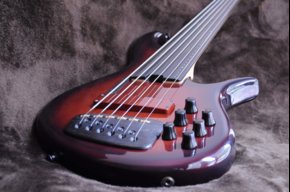
Fanned frets 6il.jpg
Fanned frets 4il.jpg
Fanned frets 3il.jpg
 
Last edited:
What I wouldn't do
Buy a multiscale that isn't on the 37" B. You get all of the disadvantages of the multiscale neck, without the advantages. The 37" scale length isn't arbitrary, it's the correct speaking lenght for that note/string size.
Running a multiscale on a 35" B - is (IMHO) stupid. You don't get the power on the low strings and the scale length on the high strings gets too short.
If you aren't going full 37" MS, just buy a 35" linear scale bass.
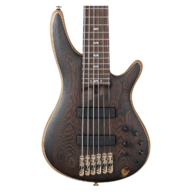
I was looking at the Ibanez Iron Label.
Ibanez Iron Label SRMS625EX - Black Flat

It says it is a "34-35.5 inch" scale. I suppose that means that it's 34 on the first string and 35.5 on the fifth.
Are you saying that this will most likely NOT be an improvement over the Yamaha TRBX605? I'm looking more for what is easy to play. I *FEEL* like a tighter string would improve my playing. (Of course, practice would improve it too. But I digress....)
 
  • Like
Reactions: Kubicki Fan
Did you try one with the reach extender strap button?
No. It was the old Bass Northwest in Seattle before they closed, and I think I played a Dingwall. For me, it wasn't a matter of reach, I could reach the end of the neck just fine. The problem was that I had to twist my wrist in order to get my fingers in line with the frets (the sort of thing I'd have to do when playing octaves or arpeggiating a chord, which I do a fair bit of). When I stick my arm out in that posture and just relax everything, my fingers naturally just point back at me. When playing a normal bass with parallel frets, I have to twist my wrist a bit to be in playing position, but it's within my range. Doing it on a fan-fretted bass just isn't possible for me, at least not without a lot of pain.
 
There is such a thing as too much sonic clarity for certain genres and styles in my opinion, you would have to do some experimenting to get a sound that is adequate for those styles.

There are things that can vintage up a 37 inch scale fanned fret bass, a passive mode option/flatwounds or a passive tone control come to mind as well as certain amp + cab combinations.

The Super P and J series from Dingwall seems like a best of both scenario in my head but never played one.
Love my Super P :bassist: Got a custom Super J on order that should be arriving soon.
ICS02078.jpg
 
I can talk about this.

I have owned:

34"
35"
36.5"
37"

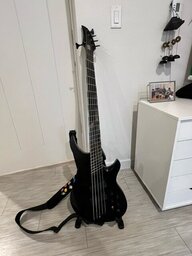
IMG_20230511_100919.jpg


IMG_20211229_174622.jpg


IMG_20220809_131838(1).jpg


IMG_20240303_112444.jpg


I would say that 35" 5 stringer was the most cozy to play, scale length wise.

If we were including other factors, the DROC would win.

It's honestly all dependant. One bass might be great sitting down but a struggle to play standing up or vice-versa. Position matters. Technique matters. If you are like me and are playing your bass when you're not at a 100% of your game all the time, then a MS will be harder to figure out. It's just how it is. Especially if you switch between MS/Non MS.
 
Ah.

I voted for:

"They're pretty cool. I like them but don't love them."

Would my next bass be MS? Perhaps. The only one I can think of is either a Dingwall DROC Custom or a Super J.

I think if I had to have a MS, it would be one of those. Although as stated, I think the 35" is plenty and feels great for a B. 34" is also okay, but again, it depends.

My gripes with my current bass have nothing to do with its scale length. Just ergonomics. It's always best to try before buying, if possible.
 
I briefly tested an Ibanez multi-scale. I liked it. I was surprised at how quickly I got used to it- wasn't as difficult as I anticipated. I appreciate the concept- it definitely makes a difference. Chords in the upper register are definitely tricky. I wasn't excited about the tone of this particular bass. I imagine a really nice Dingwall for example sounds awesome.
 
  • Like
Reactions: Itsabsolem
I only own 5s and 6s and getting used to the extended range was quick for me and I have never gone back to 4 except for random times (sitting in with a band using someone else's bass). All four basses I own right now are 34" (34.5" for the Fbass). I have tried multiscale / fanned frets and I am interested in getting one, potentially for my next purchase. Likely a 5, but I am in the air on brand; I have tried Dingwall Combustion and Ibanez at my local Long & McQuade, and I also have my eye on the Specter NS Dimension, but it is not one I have seen in person to try before buying.
 
I voted pretty cool, like 'm, don't love 'm.

Actually I do love my multiscale, I have a Canadian Dingwall ABZ 5 stringer that I enjoy the hell out of, but I switch it up with my straight fretted 4 string Sandberg, which I also love. It's a matter of purpose, the Dingwall is great for metal, with it's nice and tight B-string and good tension for fast plucking, but playing in the upper register and doing chord voicings is better on the Sandberg. A next 5 or 6 stringer might actually be a straight fretter, for that reason. But I might want a back-up multiscale as well. Ah well, at least switching between them takes zero effort!
 
My 2 fretted basses are Dingwalls and my fretless is a shortscale. I haven't struggled switching between Dingwalls and mono-scale basses.
I really like Dingwall basses for the design/engineering that goes into them along with the benefits of multi-scale. I have had a total of 6 Dingwalls over a decade. My first was a 1st gen Combustion and it wasn't long before I had an AfterBurner. I currently have a 5 string Z3 and that is the best bass I have played or owned, period. (Sorry but not sorry Wal, Alembic, Warwick, Fender Custom Shop, Ernie Ball, etc etc etc) I also have a 4 string Super J because it smokes a Fender Jazz in the way it's engineered and plays - I had it painted & added in an ACG/East EQ 01 filter-based preamp. It sounds great and can cop a lot of different tones. I found my keepers.

I don't think the reach on a 37" scale bass is bad. I am 6' 1" but not a giant. The reach is similar to an Alembic Series 1 34" that I had but of course the bridge is at least 3" in from the end of the bass. I know there are other 34" basses with long reaches too.

I am sure there are other multi-scale basses that I would like (Elrick or Le Fay maybe) but a lot of them feel like Me Too! basses rather than thoughtfully designed, functional tools that are works of art.

Might as well show you all some pics:

IMG_5801.jpeg

IMG_5808.jpeg
IMG_0201.jpeg


OP, do what makes you happy!
 
Last edited:
Hey man, I regularly bounce between upright and electric, 4, 5 and 6, fretted and fretless, parallel and MS—not infrequently on the same gig. I probably have had a lot more experience switching back and forth than your average player, but really, any "adjustment period" is really short lived and playing one isn't going to close off any other of your options.

Only thing that ever gets me is the high 'C' string. Just ain't feel right to me.
 
this is a more complicated answer
I own a Dingwall Combustion (37" Multiscale), a Yamaha BBP35 (34" scale) and a MTD Kingston ZX (35" scale), so I think I'm pretty qualified to discuss.

Ignoring the differences inherrent in tone from electronics

The upsides of multiscale:
  • The Dingwall's low B String hits harder than any other Bass on earth. It is tight, it is clear. Not unlike a Grand Piano.
  • The volume balance and feel between strings is very consistent.
  • Increased sustain is pronounced, a shorter scale instrument isn't physically capable of competing.

Downsides
  • Above the 12th fret the multiscale fret placement can be difficult to deal with, especially playing chords. Scales can be a little goofy as the fret spacing difference between strings is odd. If you don't play up there, it's not an issue.
  • The neck on the Dingwall is LONG - 3" difference between it and a traditional 34" 'Fender neck'. If you play extended scale runs this can mean some pretty good stretching of the fingers. It's a long ways from the 7th fret E string to the 9th fret G string

Worth noting
  • The Long scale basses sound like modern basses. If you want that short scale thump like on a Beatles record, it's not really there.
  • Likewise for metal or prog, 34" just won't give you the same clarity as the multiscale.
  • I spend very little time on the open B string in gig playing. The 5-string's main appeal to me is to be able to play across the neck. IE - the 8th fret G on the B-string allows me to run 3 octaves without changing hand position. For this, the multiscale doesn't really have an advantage anymore.
  • My main Bass for my current project is the 34" Yamaha, but again that's because I don't spend much time below E1. This is a more class sounding band. If I play metal or prog stuff, the Dingwall comes out

What I wouldn't do
Buy a multiscale that isn't on the 37" B. You get all of the disadvantages of the multiscale neck, without the advantages. The 37" scale length isn't arbitrary, it's the correct speaking lenght for that note/string size.
Running a multiscale on a 35" B - is (IMHO) stupid. You don't get the power on the low strings and the scale length on the high strings gets too short.
If you aren't going full 37" MS, just buy a 35" linear scale bass.


I'll just give a general disagreement that 37" is the "correct" length for a B string at a given string gauge. There's no mathematical equation for correct and you can find any number of people who prefer different lengths, including many notable pros. Sheldon determined that by building an adjustable jig and using a B string from an unknown manufacturer (there's a story he's told that he couldn't find a suitable string for some time after determining he wanted to go with 37" scale length on the B).

I've played multiscale basses at lengths other than what Dingwall has worked out for the Voodoo derived basses (Prima/Z/AB/Combustion) that I felt had merit. I've spent some time with a Super J 5, Conklin 9 String (35 to 32" scale) and an Ibanez EHB1505SMS 5 string (32 to 30") as well as owning an early 2000s Dingwall Prima 5 string. The string to string consistency you describe is something I've found fairly consistentt across multi scale basses I've played.
 
I went in blind with my first 5 string and multi-scale with a 2020 legator 37-34. I personally love em. Now have a dingwall 6 on order. The low 'B' on the 37 scales have a piano clarity nuance to it I really like that I don't hear in other 5s. Hard to explain that one and it's not like other 5s don't have a clear B it's just a slight touch I notice.

My only adjustment period was the extra string and I don't notice the fanned frets really unless I attempt chords on the lower registers for fun.
 
I've got the whole spectrum of scale lengths - four 30", four 34", two 35", and a Dingwall 34-37"

The Dingwall was my primary bass for a few years and is more versatile than I would have imagined. I'm a big believer in a tool for every job and depending on the project I'm working on or the specific sound I'm going for. These days, I force myself yo switch between them regularly so I don't get so used to one setup that I get lost when I go back and forth.
 
For me, it wasn't a matter of reach, I could reach the end of the neck just fine. The problem was that I had to twist my wrist in order to get my fingers in line with the frets
That's one of the principal things that the Dingwall reach extender resolves. That said, it's not a perfect solution as it puts your picking hand in a different position relative to the pickups unless you adjust it back to compensate. It's all a series of compromises, just like any multi or monoscale bass.
 
That's one of the principal things that the Dingwall reach extender resolves. That said, it's not a perfect solution as it puts your picking hand in a different position relative to the pickups unless you adjust it back to compensate. It's all a series of compromises, just like any multi or monoscale bass.
I don't know how long those extenders are, but shifting the bass another inch or two to the right wouldn't have made enough of a difference in my case. The angle of the frets would have to be pretty shallow for that to do me any good. And like you say, that only potentially solves the problem with my left wrist while introducing a complicating factor to my right.

To the people who like fanned frets and for whom they work well, more power to them. I'm just not one of those people.