I used 66's back in the 70's -80's. They were the best thing going at that time. I don't recall any issues with them. Later I started using DR nickels. Then about 4 years ago, I put some 66's on my Jazz. They're still on it and they sound great. A little rough on the fingertips and tight on the string tension on the D and G. They still have that slight "grind" to them. Great for rock and slap.

Enjoy the benefits of a premium membership!
Upgrade Account
-
TalkBass has been independent since 1998. Add your voice.
Create a free account to reply to discussions, view embedded media, and browse with fewer display ads.
Join free Log in
Want zero display ads or expanded classifieds tools? Compare plans.
You are using an out of date browser. It may not display this or other websites correctly.
You should upgrade or use an alternative browser.
You should upgrade or use an alternative browser.
Multiple questions about ROTO 66 In The 70s
- Thread starter Dust2Dust
- Start date
More options
Who Replied?

Older Factory toursMe and a lot of other guys will tell you Roto's QC isn't all that. By the early 90's I got real tired of good set-bad set- what THIS time? I walked away to never come back.
The DR was too edited -- too marketing slick


Then they should have changed, since the new 66's aren't stiff at all. In fact I don't remember playing any more supple rounds in a few years.Lots of zing, very stiff, very hard on the fingers and frets. They really have not changed all that much.
Back in 2017 when I had my first bass, I used paper-bag Rotosounds because of John Entwistle (although the Bass was as un-Ox as it gets). For 2 years I moved to Fender, which was more widely available with more consistent QC. In 2019 I returned to plastic-bag Rotos which seems a lot more consistent than before. My band was gigging a lot, and I loved the tone and feel of Rotos but wished they could last longer. I tried DR and La Bella for that, but keep coming back to Rotos (with good cleaning habits to help it last longer).
Back then there were not many string choices. Rotos were terrible quality strings. Under a microscope they are jagged. Fret eaters for sure.
I wasn't around the 70's either, but I know nothing has changed. I stopped using the 66s for that reason (and because they made my fingers bleed multiple times) after using them from 2012-2021. I now exclusively play D'Addario XL Nickels for my rounds.I wasn't around in the 70's but I used Roto 66 (and 77, at times) exclusively until discovering Dunlop stainless rounds.
Now the 77 Jazz Bass flats are a different story. They're the best bass strings Rotosound makes!

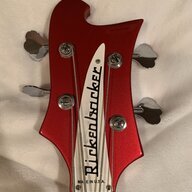
String selection in general was pretty limited in stores. I don’t think I knew there WAS a choice beyond 45 or 50 to 105 in bass strings, because that’s what stores stocked. My first bass, a 78’ Ric 4001 came strung with flats, which I immediately replaced with Roto Swing 66, I think 45-105. I recently tried a set after 40 years of avoiding them, and was pretty disappointed. Lightly corroded right out of the sealed package, and went dead in about 8 weeks. Nope.

The gauge for the long and extra long scale Rotosound Swing Bass strings until 1980 were 46-63-80-102. It was changed to 45-65-80-105 in 1980. However, a talkbass user on a post a decade ago used a digital caliper to measure the strings and found that the actual gauges are closer to the original gauges than what it actually says on the pack:
I have taken the precise measures with a digital caliber:
Rotosound RS66LD 45-65-80-105, two sets:
one set has a .048 G string, a .063 D string, a .082 A string and a .103 E string
the second set has a .046 G string, a .064 D string, a .082 A string and a .102.5 E string
the DR Hi Beam 45-65-85-105 set has: .045 G string, a .063 D string, a .084 A string and a .103 E string
I've measured a Thomastik JF344 and an Elixir 45-105 set:
Thomastik JF344 43-56-70-100: .043 G string, .056 D string, .070 A string and .100 E string (awsome! perfect gauge!)
Elixir...

here I am, and I can confirm with many other sets I've used in the years, they are still my go-to rounds, in particular for that heavier G string and the balance from string-to-string.
the RS66LD set is the "original" set.
if I compare it to sets I use to buy in 2008/2009, when I discovered them (the old "lion" package), now they are a bit less rough when new, but the sound is the same.
Then they should have changed, since the new 66's aren't stiff at all.
I agree, considering the actual gauges are smaller (except the G string) compared to other strings.
FE I use D'Addario/Fender/Elixir/Ernie Ball nickel on some basses, and I always find that the Rotosound are more consistent in string-to-string balance and tone.
when I use "standard" sets from these brands, the D and A strings in 45-105 sets are always harder, the G is snappier and lighter, and the E string a bit tighter.
I do prefer Rotosound RS66LD set, always my favourite.

Relatively speaking for sure. I remember them as really expensive compared to other strings, seemed a multiple of the price of a set of GHS Boomers. They are $25 a set these days and I remember them being not a whole lot different in price 40 years ago - and that's not adjusted for inflation.Weren’t they considerably more expensive back then than they are now?
and that's not adjusted for inflation.
it probably depends on the region/state. for example, today in Europe a set of Thomastik strings costs 58€ (and it's high... they used to cost just 35/40€), in USA they are expensive, and from what I read here on Talkbass, 80-100$.
the price has always been different. Rotosound are made in the UK and probably cost more in USA, ad for GHS costing more here in Europe still today compared to the prices in USA.
Agreed, and a good reason back then in the US to use US based products instead of strong currency country products (e.g., UK and Germany) when applicable. It was the infancy of currency hedging as a tool for manufacturers and tougher to even out cross border prices for their products. Back then the rule of thumb was +/- 2 USD to 1 GBP versus about 1.3 today.it probably depends on the region/state. for example, today in Europe a set of Thomastik strings costs 58€ (and it's high... they used to cost just 35/40€), in USA they are expensive, and from what I read here on Talkbass, 80-100$.
the price has always been different. Rotosound are made in the UK and probably cost more in USA, ad for GHS costing more here in Europe still today compared to the prices in USA.


