
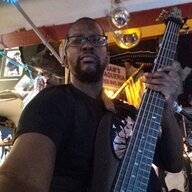
I'll be away from my bass for eight days starting tomorrow due to travel plans. I've been playing a little bit tonight and I've had a few bass thoughts - some about my current bass, and I thought I'd share my thoughts with fellow hex thumpers and the rest of the population here.
Going to miss playing and even just noodling around during my travels.
Edit: Formatting.
- Four-string basses with 21 frets have 84 distinct string/fret positions (96 positions with 24 frets); my six-string with 24 frets has 144 distinct positions.
- My bass has 50 distinct notes - from B0 to C5 (using a regular tuning, in fourths, strung BEADGC).
- The number of notes a bass has can be determined by: (the number of frets per string plus the open string) + (one less than the number of strings * the intervalic difference between the strings in half-steps). My bass is 25 + 25. The average Fender P is 22 + 15. This only works if the bass is in a regular tuning (meaning the intervals between all strings is the same) and if the number of frets per string is constant.
- A 24-fret four-string bass in a fifths regular tuning strung CGDA would have the same range as a 21-fret six-string (46 notes, assuming the same fret count), but it's only possible to play a single-position chromatic scale using a seven-fret zone instead of a five-fret zone. This means that diatonic scales can't be played without shifting hand position, unless you can span six or seven frets easily. (Cellos use this tuning because their scale length is much closer to a guitar - it's around 27 inches or so.)
- Every note (every pitch class; disregarding octave differences) appears on a 24-fret six-string fretboard 12 times (twice per string) - except for notes that are found on an open string (generally B, E, A, D, G, and C); those notes appear 13 times.
- B3 and C3 are the only notes (pitches) that appear on my fretboard five times.
- Many bass exercises for four-string basses emphasize two-octave scales for learning the fretboard and hitting the boundaries of the bass. On a six, for optimal practice, it's necessary to expand this to three octaves minimum, which forces a player to span the fretboard from low string to high string and from headstock to bridge.
- Playing a two-octave scale restricted to only two strings - it's possible to complete the two-octave scale to the starting pitch class from all fretboard positions on those two strings if you are allowed to play an ascending scale using a higher string or use a descending scale using a lower string - except if you start from the sixth- or eighteenth-fret tritone. (This applies to regular tuning in fourths on any bass with more than one string. Go ahead, try it, I'll wait.)
- I need to practice more.
- I need to learn my bass more!
- Edit: I need to start practicing like this: . Poor guy, hope his wife didn't make him sleep on the couch that night, but this is inspiring stuff.
Going to miss playing and even just noodling around during my travels.
Edit: Formatting.
Last edited:


