• TalkBass has been independent since 1998. Add your voice.
    Create a free account to reply to discussions, view embedded media, and browse with fewer display ads.
    Join freeLog in
    Want zero display ads or expanded classifieds tools? Compare plans.

My 4 string bridge won't intonate at low C. Solutions?

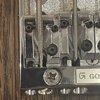
I have a partscaster Jazz-Ray with a gotoh bridge.

I want to tune it down to CGCF, using a .120 for the C, sometimes tuning up to D.

I can't move the low string saddle any further, and intonation is still out by a lot (over 1hz).

Looking for suggestions for how to make this work. Bridge photos below.

Can anyone estimate if I can get enough distance to solve this problem by removing the bridge, filling the screwholes, an reattaching it a little bit further down, without exposing the screwholes on the neck side of the bridge?

If not, could I mod the low C saddle?
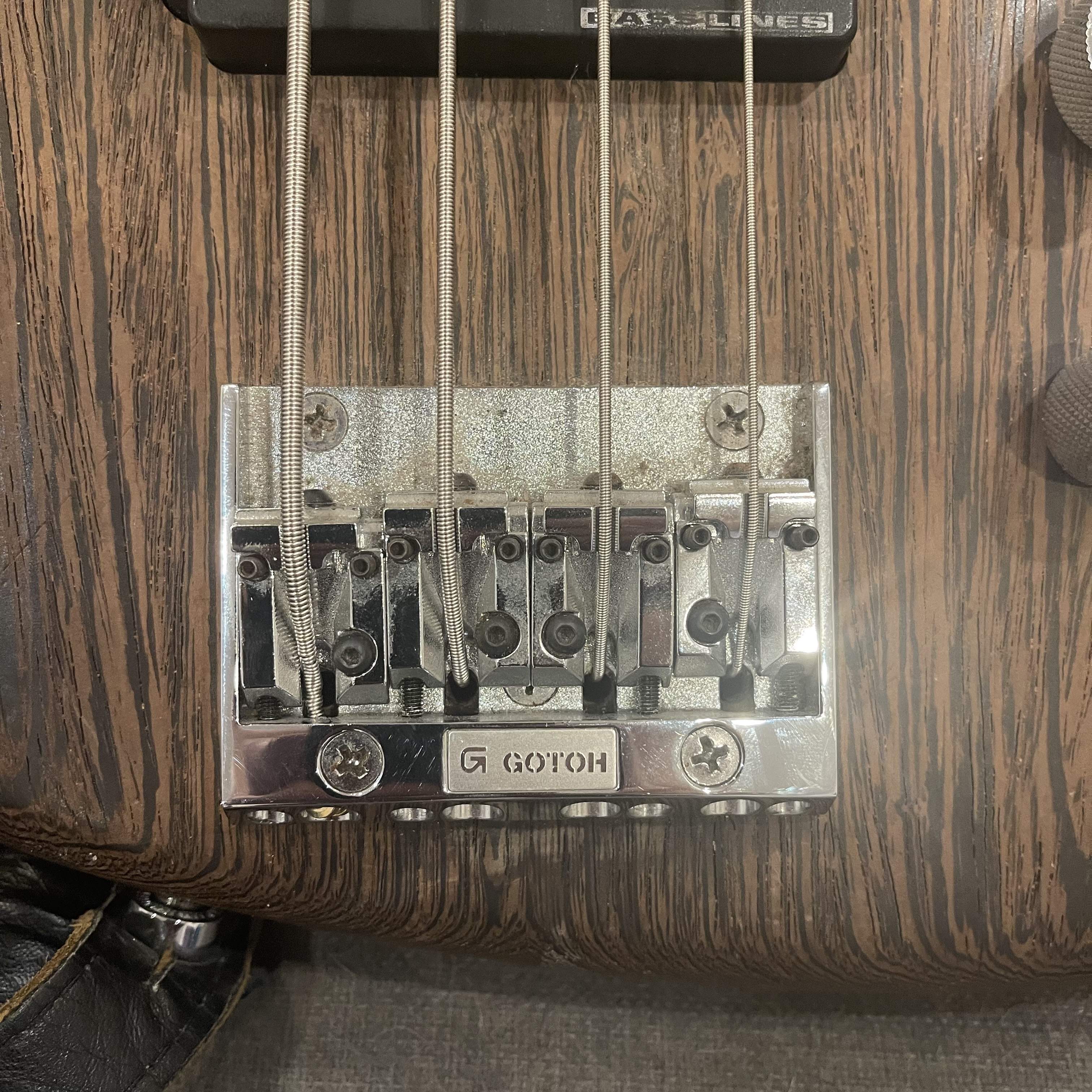


IMG_3911.jpg
 

Attachments

  • IMG_3912.jpg
    IMG_3912.jpg
    827.6 KB · Views: 43
There's barely any room to move if you want to not expose the screw holes, and not a lot more before you fall off the end of the body.

My suggestion would be to fill them and top them with abalone or mother of pearl dots, if plain old wood plugging upsets your aesthetics. Might even add two more under the other strings to make it less obvious what they are covering up, or that they are a cover-up at all, as opposed to a feature.
 
  • Like
Reactions: Max Allstadt
Is the bridge placed correctly? You say partscaster so I’m guessing a FSO and while Fender spec parts nominally interchange some play together better then others. I like to see the G saddle, as far towards the neck as it can go, be at the scale length line. Again guessing Fender spec, 34” from the fretboard side of the nut to the saddle or 17” from the 12th fret.

Did you set the witness points on the strings? That can make a big difference especially with larger strings. Also, do you know if the intonation can be set correctly with “standard” EADG tuning or even BEAD?
 
Is the bridge placed correctly? You say partscaster so I’m guessing a FSO and while Fender spec parts nominally interchange some play together better then others. I like to see the G saddle, as far towards the neck as it can go, be at the scale length line. Again guessing Fender spec, 34” from the fretboard side of the nut to the saddle or 17” from the 12th fret.

Did you set the witness points on the strings? That can make a big difference especially with larger strings. Also, do you know if the intonation can be set correctly with “standard” EADG tuning or even BEAD?


It's warmoth. Jbass body, paddlehead neck. Originally made with hipshot detuners on the E and G string to lower and raise to D and A respectively. Music Man Pickup.

The intonation could be set fine with .105 at D and E.

The G (in this case F) saddle is intonated in this image and isn't all the way forward. But thanks for pointing this out. I didn't think to check and see if moving the bridge back ¼" might make it impossible to intonate the high string. Just checked, plenty of room to move the saddle way further forward.

Witness points? I didn't know that term before today. I usually do that. Didn't do it on this string yet because I was playing with through body vs through bridge stringing. Just tried it, very slight improvement, but nowhere near enough.

This bridge will need to move. I am going to go with the other replier's suggestion to fill the two screw holes with inlay dots, but I'm going to use some kind of chrome to match the rest of the bass, which is entirely chrome and wenge.
 
Last edited:
  • Like
Reactions: Matt Liebenau
There's barely any room to move if you want to not expose the screw holes, and not a lot more before you fall off the end of the body.

My suggestion would be to fill them and top them with abalone or mother of pearl dots, if plain old wood plugging upsets your aesthetics. Might even add two more under the other strings to make it less obvious what they are covering up, or that they are a cover-up at all, as opposed to a feature.
Thanks for the inlay dots suggestion. I'm gonna find something chrome or stainless. I'm sure there's some kind of tiny piece of inexpensive marine hardware that'll do the trick. I think binding barrels with no screw slots are just the thing. "binding barrel" "no drive" on McMaster Carr.
 
Last edited:
  • Like
Reactions: T_Bone_TL
Thanks for the inlay dots suggestion. I'm gonna find something chrome or stainless. I'm sure there's some kind of tiny piece of inexpensive marine hardware that'll do the trick. I think binding barrels with no screw slots are just the thing. "binding barrel" "no drive" on McMaster Carr.


You could use some aluminum rod and polish it. As long as you clear coat it shouldn’t tarnish.
 
You could use some aluminum rod and polish it. As long as you clear coat it shouldn’t tarnish.
My first thought was to do that with stainless. But because the bass is wenge, with very open grain, and I'm a perfectionist, I'm going with the binding barrels because I can drill tiny holes and then the caps on the biding barrels will sit on top and hide any tearout.
 
  • Like
Reactions: Matt Liebenau
This may require individual bridges.
You can always route out the section where the screw holes are and glue in a new block. Design it to look like a feature instead of a repair. That's if it's important to not see filled screw holes.
It doesn't seem like there's a single style of bridge that will accommodate this situation and/or not end up with a corner sticking off the edge of the body. Seems like you will either end up short on the last string or too far away for the first string.
I'd look into individual bridges.
 
Also, I'm wondering if the last string saddle needs to be that much further away than the rest of the strings, if you're almost getting into the next scale length and if you'll have trouble ever really getting it intonated perfectly.
 
The Hipshot B is an oversized “bent plate” bridge with barrel saddles. I’m almost 100% certain it will intonate, just not certain it will cover the holes left by the Gotoh.
 
Before you try anything seriously drastic, have a look at this:
20211231_144246.jpg

I have this bridge too. It's a bit rare and was meant to be a deluxe, high mass bridge from Gotoh. I found it a bit much... hard to dial in, and ultimately, I took the top portion of the saddle off, and only then would it set up properly. I was advised against this move by a very knowledgeable repair pro here on TB, but did it anyway. That was years ago, and I've had no problem with its function. No guarantees you won't, but it may change enough geometry to get your string(s) intonated. Maybe try this?
 
I have a partscaster Jazz-Ray with a gotoh bridge.

I want to tune it down to CGCF, using a .120 for the C, sometimes tuning up to D.

I can't move the low string saddle any further, and intonation is still out by a lot (over 1hz).

Looking for suggestions for how to make this work. Bridge photos below.

Can anyone estimate if I can get enough distance to solve this problem by removing the bridge, filling the screwholes, an reattaching it a little bit further down, without exposing the screwholes on the neck side of the bridge?

If not, could I mod the low C saddle?


View attachment 4523214

You can try turning the saddle, that will give you a few inches