

Enjoy the benefits of a premium membership!
Upgrade Account
-
TalkBass has been independent since 1998. Add your voice.
Create a free account to reply to discussions, view embedded media, and browse with fewer display ads.
Join free Log in
Want zero display ads or expanded classifieds tools? Compare plans.
You are using an out of date browser. It may not display this or other websites correctly.
You should upgrade or use an alternative browser.
You should upgrade or use an alternative browser.
My 4 string bridge won't intonate at low C. Solutions?
- Thread starter Max Allstadt
- Start date
More options
Who Replied?
Ric5
Inactive
- Jan 29, 2008
- 29,772
- 30,452
- Disclosures
- I like 5, 8, 10, and 12 string basses
I have a partscaster Jazz-Ray with a gotoh bridge.
I want to tune it down to CGCF, using a .120 for the C, sometimes tuning up to D.
I can't move the low string saddle any further, and intonation is still out by a lot (over 1hz).
Looking for suggestions for how to make this work. Bridge photos below.
Can anyone estimate if I can get enough distance to solve this problem by removing the bridge, filling the screwholes, an reattaching it a little bit further down, without exposing the screwholes on the neck side of the bridge?
If not, could I mod the low C saddle?
View attachment 4523214
Since it is a parts bass put on a different neck with one more fret ... I am assuming you have 20 frets ... so go to 21 frets.
I did that for this bass here. That gave me an extra 1/2" and even then I am almost maxed out on the low B
Thanks. Very useful info. First thing I'll try, because it's free. Next is taperwounds, after that moving the bridge.Before you try anything seriously drastic, have a look at this:
View attachment 4523755
I have this bridge too. It's a bit rare and was meant to be a deluxe, high mass bridge from Gotoh. I found it a bit much... hard to dial in, and ultimately, I took the top portion of the saddle off, and only then would it set up properly. I was advised against this move by a very knowledgeable repair pro here on TB, but did it anyway. That was years ago, and I've had no problem with its function. No guarantees you won't, but it may change enough geometry to get your string(s) intonated. Maybe try this?

It's 24 frets and the neck is wenge. Pricy.Since it is a parts bass put on a different neck with one more fret ... I am assuming you have 20 frets ... so go to 21 frets.
I did that for this bass here. That gave me an extra 1/2" and even then I am almost maxed out on the low B
View attachment 4523820
View attachment 4523824
Probably not good for tuning up to D.What if you went with a 125 or 130 string?

As the others have said, the best solution is to move the bridge back 1/4". And figure out some neat way to cover up those two forward holes.
But, before you do that, you may be able to modify the C saddle enough to get you there. If the other three strings are okay. You can try reverse-filing the string notch in the saddle. That is, file the notch so it angles down going forward, so the witness point is contacting at the back edge of the saddle. That may gain you 1/8", which may be enough. Make sure the notch widens out like a cone going forward, so you don't get any little buzzes.
Also, you may be able to grind a bit off of the back end of the saddle, and shorten the screw slightly. That may gain you a bit more.
But, before you do that, you may be able to modify the C saddle enough to get you there. If the other three strings are okay. You can try reverse-filing the string notch in the saddle. That is, file the notch so it angles down going forward, so the witness point is contacting at the back edge of the saddle. That may gain you 1/8", which may be enough. Make sure the notch widens out like a cone going forward, so you don't get any little buzzes.
Also, you may be able to grind a bit off of the back end of the saddle, and shorten the screw slightly. That may gain you a bit more.
Ric5
Inactive
- Jan 29, 2008
- 29,772
- 30,452
- Disclosures
- I like 5, 8, 10, and 12 string basses
It's 24 frets and the neck is wenge. Pricy.
You could cut a custom piece of wood to put at the base of the neck and move it about 1 /2" away from the bridge, and then you would need to drill new screw holes for the neck ... this is a pita solution that might work
You could cut a custom piece of wood to put at the base of the neck and move it about 1 /2" away from the bridge, and then you would need to drill new screw holes for the neck ... this is a pita solution that might work
That is a reasonable solution too, although I would only move the neck 1/4". I think 1/2" would be too far, and the other three strings would run out of forward travel.
The fix would be: Drill out the screw holes in the neck to 3/8". Glue in 3/8" maple or birch dowels. Make up a 1/4" thick spacer to go in the back end of the neck pocket. Maybe black plastic or some contrasting wood? Fit the neck back in, line it up, mark and re-drill the screw holes.
Now the neck will be moved forward 1/4". The existing bridge stays where it is, and its saddles move forward 1/4". That should give all the strings plenty of travel for the correct intonation. And they will probably still work if you go back to regular tuning.

Not the best solution by any means, but would grinding away material like this help any? Maybe round over the bottom of the saddle where it's bumping up against the inside radius of the bridge casting. But reducing contact area isn't optimal.
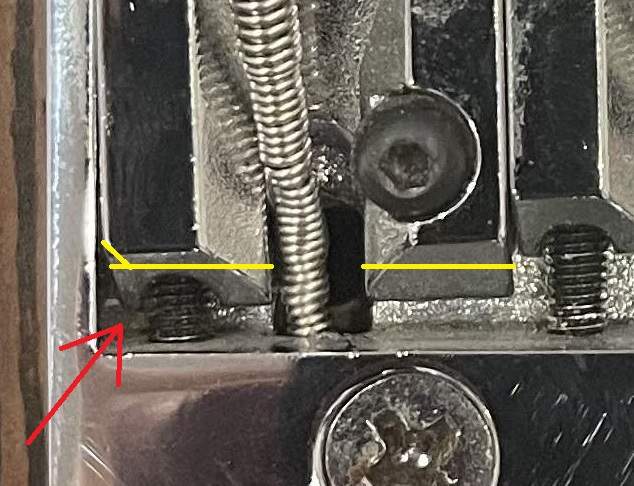
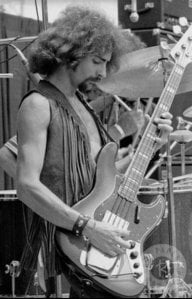
Mount a bridge similar to the one below as far back as possible and run a couple nice chrome oval head screws in the front holes. The thinnest rear vertical piece on a bent plate bridge will give you what looks like a 1/4” or possibly more when compared to the thicker vertical on the Gotoh.
You would also want to look for one with the smallest diameter bridge barrels so you can pull the string contact point as close to the vertical as possible. You might have to cut down the springs or remove the one on the lowest string.
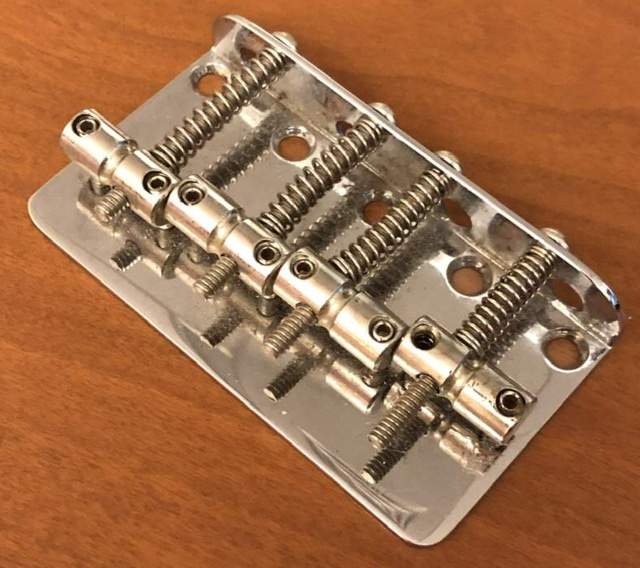
You would also want to look for one with the smallest diameter bridge barrels so you can pull the string contact point as close to the vertical as possible. You might have to cut down the springs or remove the one on the lowest string.


Not the best solution by any means, but would grinding away material like this help any? Maybe round over the bottom of the saddle where it's bumping up against the inside radius of the bridge casting. But reducing contact area isn't optimal.
View attachment 4524356

Either move the bridge or try another style bridge.
You might have enough room to move it to the back edge.
An extreme option would be put on a Dtuner thing, that at least might give you the adjustment you might need.
If the low C is a deal breaker, then consider a 5 string.
And I agree a much larger gauge string would solve it nicely as well.
Good luck.
Dirk
You might have enough room to move it to the back edge.
An extreme option would be put on a Dtuner thing, that at least might give you the adjustment you might need.
If the low C is a deal breaker, then consider a 5 string.
And I agree a much larger gauge string would solve it nicely as well.
Good luck.
Dirk

Maybe swap the "E" and "D" saddles and invert them, if the access to the intonation screw goes through all the saddle?

And if you don't mind permanent alterations to your bridge, some filing on the tail end of the saddle to make it able to move further back?If the adjuster screw is bottomed out in the bore, a couple of tiny washers under the head would effectively shorten it, allowing the saddle to be drawn back further until the back side actually makes contact with the body of the bridge.

JeezyMcNuggles
Inactive
- Feb 23, 2018
- 14,723
- 20,970
- Disclosures
- I suck, but nobody really notices
Get a bridge that doesn't stop 3/4" before the backplate.I have a partscaster Jazz-Ray with a gotoh bridge.
I want to tune it down to CGCF, using a .120 for the C, sometimes tuning up to D.
I can't move the low string saddle any further, and intonation is still out by a lot (over 1hz).
Looking for suggestions for how to make this work. Bridge photos below.
Can anyone estimate if I can get enough distance to solve this problem by removing the bridge, filling the screwholes, an reattaching it a little bit further down, without exposing the screwholes on the neck side of the bridge?
If not, could I mod the low C saddle?
View attachment 4523214
JeezyMcNuggles
Inactive
- Feb 23, 2018
- 14,723
- 20,970
- Disclosures
- I suck, but nobody really notices
Oh, and I use a standard 105 to 50 set of strings. Low C is 105. It works out cherry. 120, is an extra light B string. Just use a heavy E string. You'll probably get better results.I have a partscaster Jazz-Ray with a gotoh bridge.
I want to tune it down to CGCF, using a .120 for the C, sometimes tuning up to D.
I can't move the low string saddle any further, and intonation is still out by a lot (over 1hz).
Looking for suggestions for how to make this work. Bridge photos below.
Can anyone estimate if I can get enough distance to solve this problem by removing the bridge, filling the screwholes, an reattaching it a little bit further down, without exposing the screwholes on the neck side of the bridge?
If not, could I mod the low C saddle?
View attachment 4523214
Not the best solution by any means, but would grinding away material like this help any? Maybe round over the bottom of the saddle where it's bumping up against the inside radius of the bridge casting. But reducing contact area isn't optimal.
View attachment 4524356
I could do that, but there's also a slot underneath that black hex panhead screw on the left side of the saddle. I'd have to mill it pretty carefully, because it's a T-slot with a T-nut in it.
You're seriously asking why a .120 C won't intonate on a 34" neck?
Jeez... Start with a .130, then see where you're at.
If there are 34" scale 5 strings with low Bs, why would a note a half step up be inherently harder to intonate on a 34" scale?
My problem is that I have bridge saddle that doesn't move as far as most do.
Understand that's what clamps it own and the slot is limiting. Maybe drill another simple hole for that screw just 3/16" north of there to relocate that instead of cutting the slot longer in the bridge? EDIT: Yeah, I looked again, that isn't going to work either! At least not without a milling machine to make the half-round flat cut under the screw. Sorry!I could do that, but there's also a slot underneath that black hex panhead screw on the left side of the saddle. I'd have to mill it pretty carefully, because it's a T-slot with a T-nut in it.
Anyway, lots of great suggestions here, as always, I'm sure you'll get it figured out.
EDIT2: OK, maybe if the slot is long enough but the T-nut is hitting you could grind off part of it, too. Just an outside-the-box thought. I have bee told I was never issued a box.
Last edited:


