• TalkBass has been independent since 1998. Add your voice.
    Create a free account to reply to discussions, view embedded media, and browse with fewer display ads.
    Join freeLog in
    Want zero display ads or expanded classifieds tools? Compare plans.

Double Bass My DIY Ultralite 10" rear ported cabinet

Don Kasper

Gold Supporting Member
Dec 30, 2012
7,631
14,564
71
Los Angeles/Burbank, CA
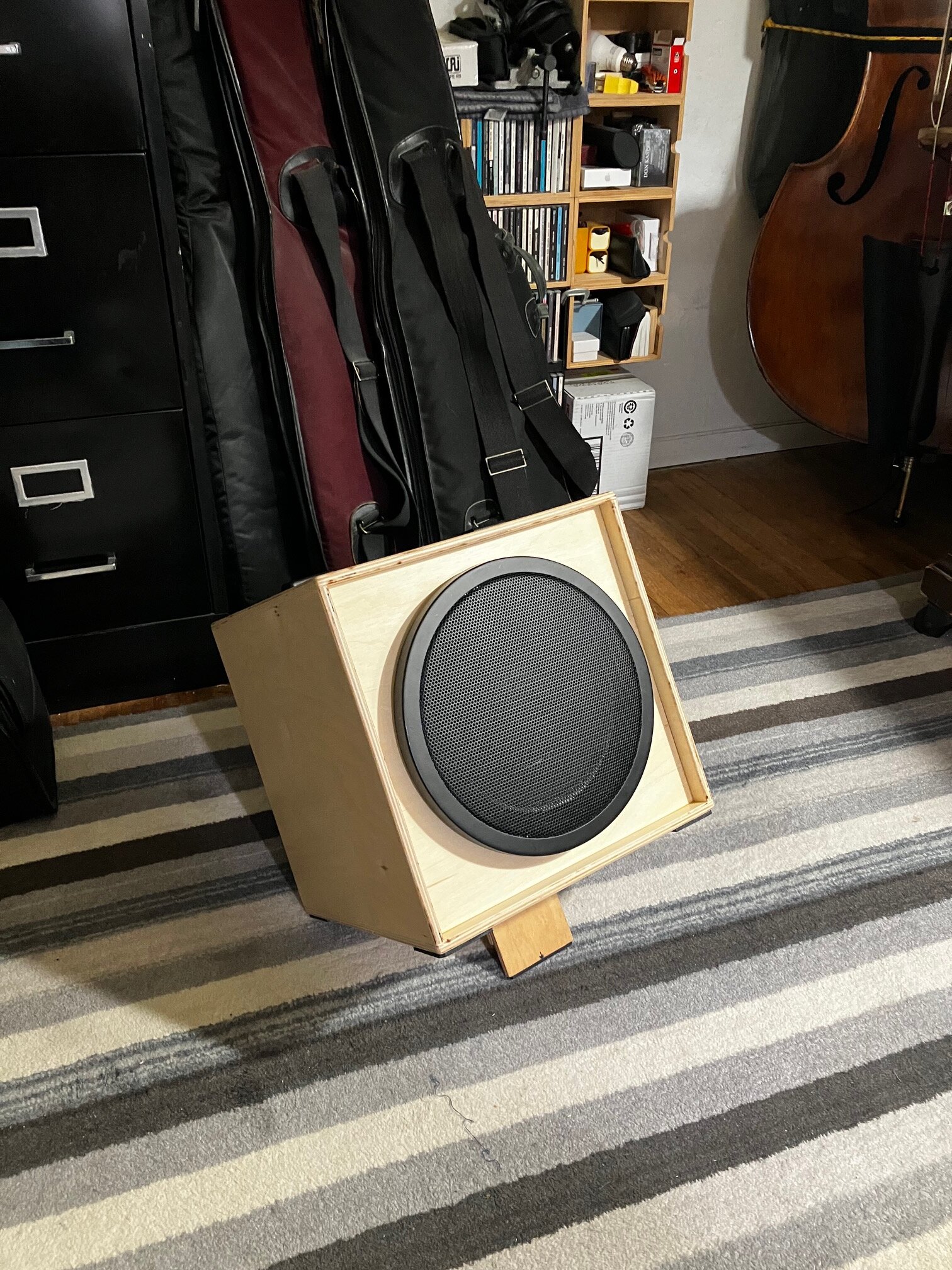
Made from 3/8" cabinet grade Birch plywood, which I'm leaving Au Naturale (3 coats of matte polyurethane for protection.) No More Rat Fur for me.
Contains an Eminence DeltaLite II 2510 speaker, and (2) 2" rear ports.
12.75"H X 12.75"W X 12"D.
Weighs just 14lbs. (!)
I'll be using it with either my EA Doubler or my WW Electacoustic amp for small room, acoustic piano trios/quartet, situations. (No PA, no bashing drummers, just enough to get me in the acoustic mix.)
Thanks.
IMG_5229.jpg
 
Last edited:
Made from 3/8" cabinet grade Birch plywood, which I'm leaving Au Naturale (3 coats of matte polyurethane for protection.) No More Rat Fur for me.
Contains an Eminence DeltaLite II 2510 speaker, and (2) 2" rear ports.
12.5"H X 12.5"W X 11.5"D.
Weighs just 14lbs. (!)
I'll be using it with either my EA Doubler or my WW Electacoustic amp for small room, acoustic piano trios/quartet, situations. (No PA, no bashing drummers, just enough to get me in the acoustic mix.)
Thanks.
View attachment 5329557

Are you getting a blonde bass to go with that?
 
  • Like
Reactions: Don Kasper
Nice looking cab - did you work from a plan? Would be interested if you're up for sharing.
Hi bherman,
No plan - I just drew up the dimensions to be as small and light as possible - I am not looking for massive lowend, just even sound at modest levels. Finding high-quality 3/8" cabinet-grade Birch plywood was critical, as well as testing my construction techniques on such thin plywood (I used #6 wood screws and glue on the buttjoints, counterbored and filled in with wood filler.)
The nice folks at US Speaker helped me out with the port calculation.
I can post my modest drawings & dimensions if you are interested, but The AudioPhile Police may have me arrested...or, attenuated!
Thanks for your interest.
 
Last edited:
Being on this forum with you is stunningly humbling.
1. By all accounts you are an excellent player with an encyclopedic knowledge of theory.
2. Yours is the quickest wit on the board.
3. And now you display more than adequate wood working and audio engineering skills.
Will you be selling tickets to your next brain surgery or rocket scientist project?
 
Is that tilting leg attached to the bottom? Did perhaps find a spring loaded hinge that is low enough profile for that spot?
Nope - it is just a (removable) L-shaped DIY wooden wedge that is held in place by the weight of the cabinet and amp. (There is a mechanical "stop" made of leather, glued to the bottom of the cabinet to keep the wedge from slipping, and the front edge of the wedge has a rubber strip on the edge touching the floor for added "traction".) TMI?
Thanks.
 
Last edited:
The nice folks at US Speaker helped me out with the port calculation.
I can post my modest drawings & dimensions if you are interested, but The AudioPhile Police may have me arrested...or, attenuated!
Thanks for your interest.
No ma'am, we're musicians. ;)

I'm interested. I'll plug the dimensions into my online modeling program and post the link.

Looks great.
 
  • Like
Reactions: Don Kasper
Cool. To dig in a bit more, what did US Speaker say about the ports? Did they recommend specific tubes and lengths, or a tuning frequency? Or are they "simple" ports that are plain holes? The intended tuning frequency is something that gets plugged into my model.
 
Cool. To dig in a bit more, what did US Speaker say about the ports? Did they recommend specific tubes and lengths, or a tuning frequency? Or are they "simple" ports that are plain holes? The intended tuning frequency is something that gets plugged into my model.

Here it is: from US Speaker - 2in. diameter x 4.35in. length. (I have installed 2 on the rear baffle, and lined the 5 interior surfaces with 1/2in. acoustic foam.)

sh-M1701-size225.gif

Thanks, fdeck, for your interest and expertise.
 
Here's what I get, shooting from the hip. I always repeat the caveat that my program is experimental, I'm not a real engineer, and a person contemplating a real design should consult more than one of the design programs to make sure they agree. Importantly, my calculation of the port length is suspect. On the other hand, it gives me a rough clue as to how the speaker should behave.

I threw 100 Watts in there just as a spitball, but you can change that. I think it's tuned to 50 Hz. I modeled equivalent square ports because that's what my program supports.

My impression is that it should work fine for the intended use. It exhibits two generalities about bass speaker designs. The first is that the actual power handling capability can be less than the thermal power rating of the driver, because the box design determines how power is translated into cone excursion, and most bass speakers are excursion limited.

Second, port air speed is slightly scary, rising above 0.1 Mach, the "rule of thumb" limit, but once again, how much power you really need depends on what you're using it for. And I've learned that making really portable bass speakers runs into what I call the "small box crisis." As the box size gets smaller, a port that's actually generous enough to support the excursion limited power rating of the driver, grows to be bigger than the box itself.

My little 8" design exhibits both issues as well, but on stage works just fine.

So I think Don could have spent more time laboring over the precise design parameters, but at the end of the day not squeeze much more performance out of the 2510 driver while retaining decent response for upright bass use.

The big question is how's it sound?

[This invalid link has been removed]
 
The big question is how's it sound?
Thanks for your expertise and experience, fdeck.
I just got back from its maiden voyage, playing in a large living room along with Grand Piano, Drums, Alto/Flute, and Clarinet.
It performed very well at a modest volume - no excursion issues that I could hear. (I used my EA Doubler along with the Red Eye preamp.)
The drummer (a longtime LA Studio veteran...) commented on the evenness,clarity, and warmth of the setup. (I usually play thru a small powered Yamaha(?) PA speaker,(provided backline), which is not to my liking.)
The Red Eye really is critical to the setup - I A/B'd the setup yesterday, (with RE/without RE), and heard a significant improvement in warmth and fullness WITH the RE.
I've built and used my own cabinets over the past 30yrs., and confess I was/am willfully ignorant of the vast amount of Theoretical Scientific Knowledge that surrounds cabinet design. I have generally received positive comments regarding my "sound", both on Slab and Upright.
I may just be Acoustically Fortunate in having stumbled into "designs" that sound relatively "good", but may be Theoretically Suspect.
Also - based on your recent (8in.Faital) build, I am now itching to try the 10" version: the Faital Pro 10PR320 driver, which has almost double the XMax cone excursion of the Eminence! (...and cost about $100 more!)
I really appreciate your time, expertise and decaffinated "tone" regarding my amateur cabinet shenanigans.
I'll report back as I explore and find the Bleeding Edge of this setup.
Thanks.
 
Last edited:
  • Like
Reactions: s0707 and fdeck