OK so I've read quite a bit about torrefaction... not everything, but enough to be dangerous.
I've bought 2 1x3x8 maple pieces from ol' HD. One because it was the straightest I could find, the other because I liked the figuring and it looked like it had some light flaming. The idea is that the latter will be planed flat later for fingerboard(s) so a little initial curve doesn't scare me.
*IF* they survive my experiments, they'll be put to use in my ultra short scale travel bass project, so I've cut both boards down to 8 24" lengths as I won't need anything longer (28.5" scale, 24 frets runs a hair over 21") and if anything, I'm not *COUNTING* on this working... otherwise it wouldn't be an experiment... Also being this short makes it easier to observe changes in shape.
Okay, each board cut in quarters so I have (S)traight 1-4 and (F)igured 1-4 with initial weights, straight after they came home and were cut:
S1: 1lbs 5.4oz
S2: 1lbs 4.2oz
S3: 1lbs 4.4oz
S4: 1lbs 4.4oz
F1: 1lbs 3.1oz
F2: 1lbs 2.8oz
F3: 1lbs 2.6oz
F4: 1lbs 3.0oz
So I find it interesting that the sets are relatively similar in weight in their F or S grouping, but that the F board, which was not as straight from the get-go seems to be lighter. This may not be related at all, but I wanted to baseline my findings before I start testing...
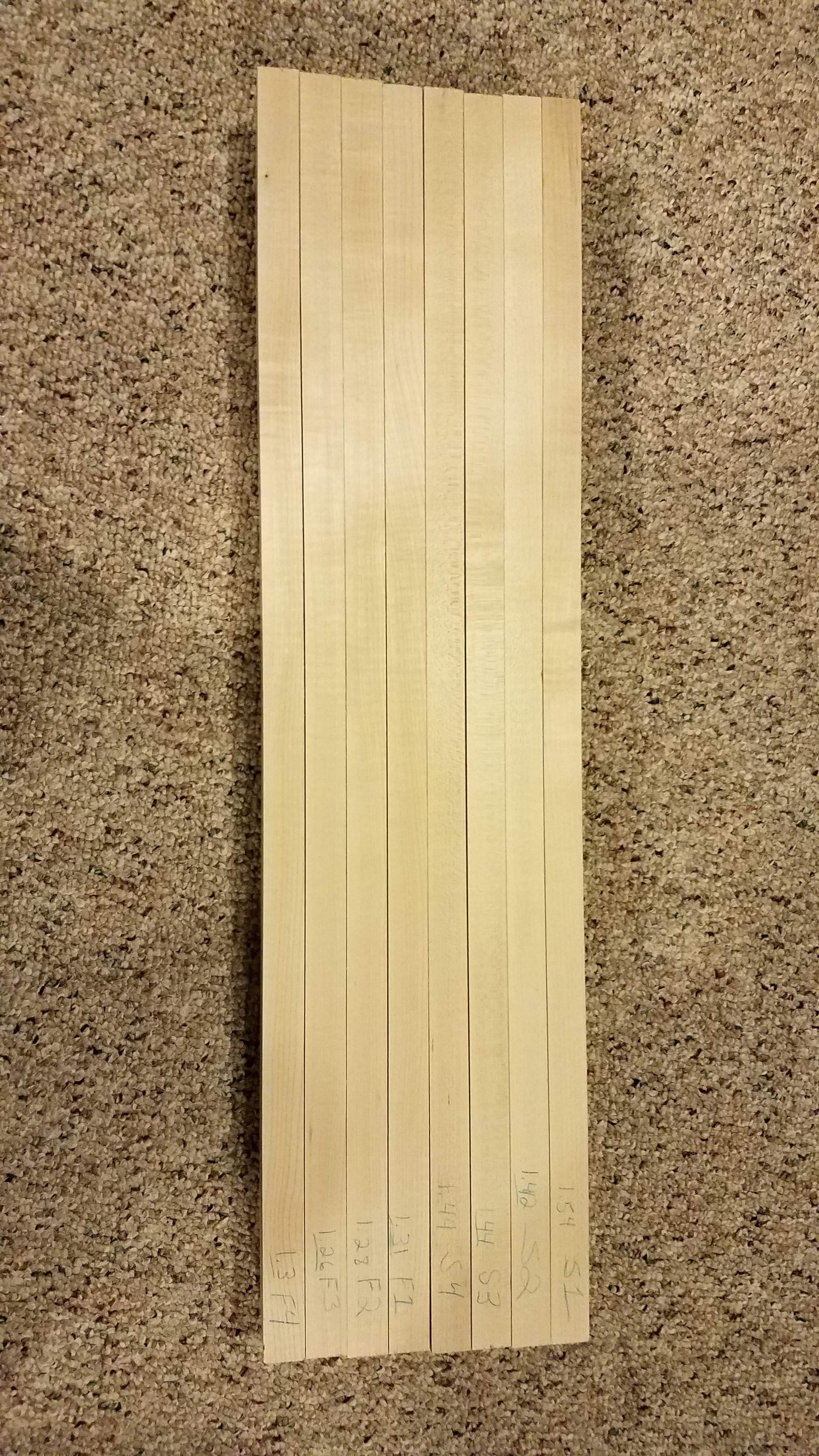
All 8 pieces; fairly uniform in size they looked angled for some reason...
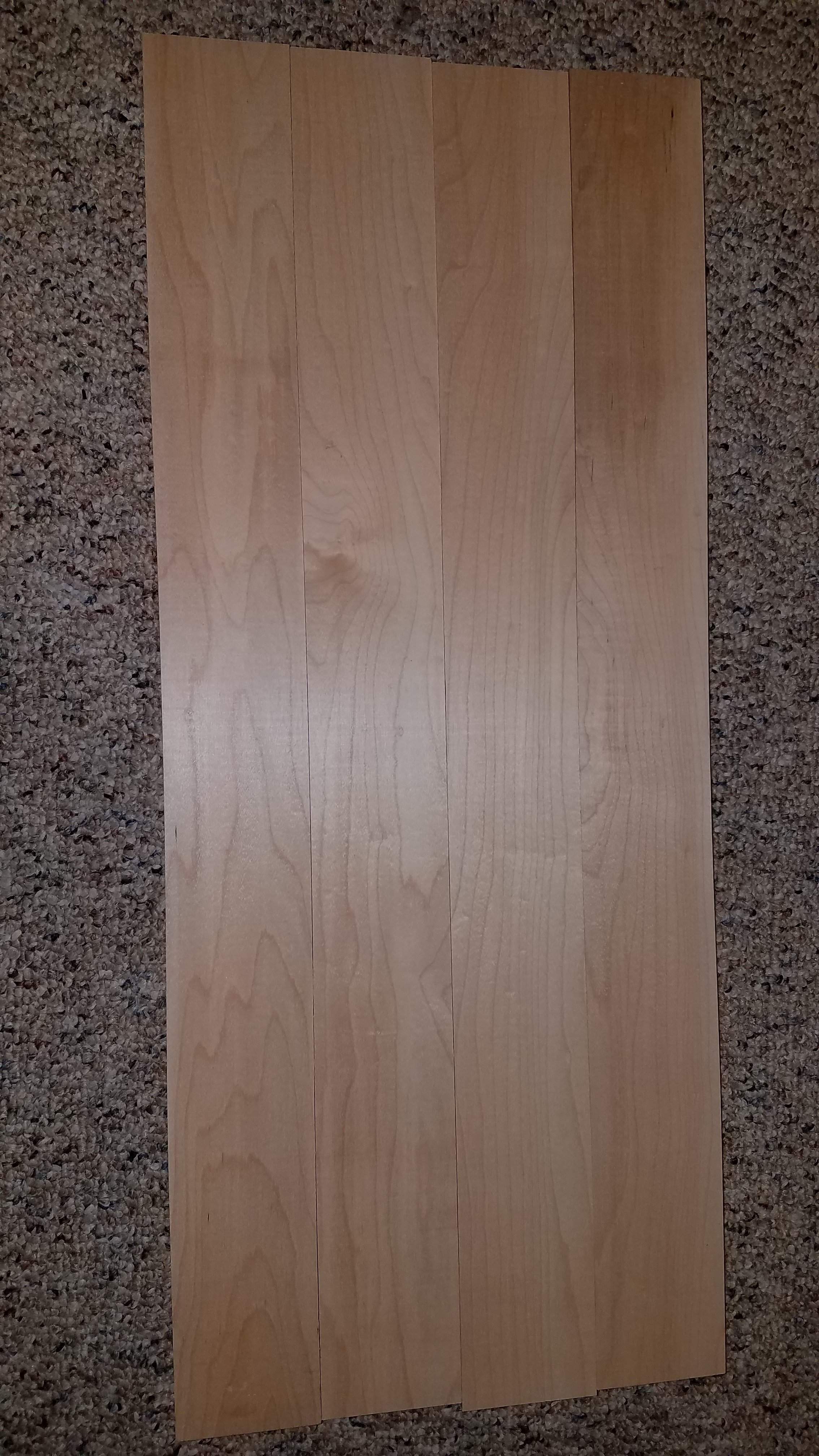
(S)straight board pieces
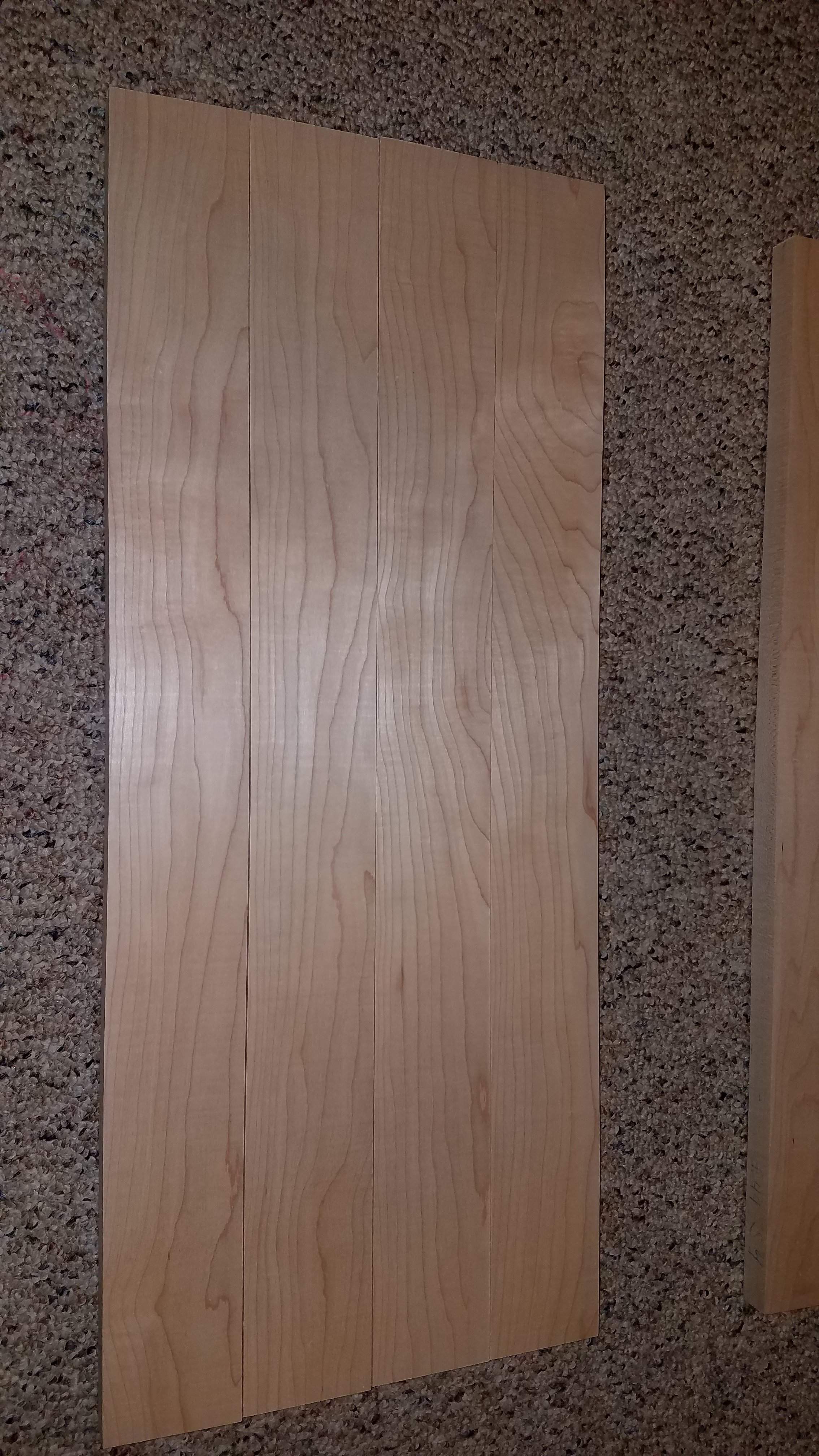
(F)igured board pieces
I will be keeping track of weight changes as I go through this, whether it is simply waiting a week or two or actually popping them in the oven.
My initial plan is to see what happens if I take HD-bought maple and expose it to different temperatures, leading up to hitting ~325f which is the target for roasting/torrefication.
I want to see if, compared to just chucking it in straight at that temperature, getting it to lose some moisture gradually (and then having some time to normalize) would reduce the possibility of warping and or cracking. I know part of the challenge is that moisture escapes from the ends faster than the sides so I want to see if I need to accelerate the drying and if doing so in phases makes a difference.
Granted this is *not* an empirical study, BUT DANGIT, I WANNA MAKE MY HOUSE SMELL LIKE COOKIES!!!!
...hopefully w/o burning it down...
So I have stowed the pieces in my attic, spaced out and I'll check in on them in a little while.
Cheers!
I've bought 2 1x3x8 maple pieces from ol' HD. One because it was the straightest I could find, the other because I liked the figuring and it looked like it had some light flaming. The idea is that the latter will be planed flat later for fingerboard(s) so a little initial curve doesn't scare me.
*IF* they survive my experiments, they'll be put to use in my ultra short scale travel bass project, so I've cut both boards down to 8 24" lengths as I won't need anything longer (28.5" scale, 24 frets runs a hair over 21") and if anything, I'm not *COUNTING* on this working... otherwise it wouldn't be an experiment... Also being this short makes it easier to observe changes in shape.
Okay, each board cut in quarters so I have (S)traight 1-4 and (F)igured 1-4 with initial weights, straight after they came home and were cut:
S1: 1lbs 5.4oz
S2: 1lbs 4.2oz
S3: 1lbs 4.4oz
S4: 1lbs 4.4oz
F1: 1lbs 3.1oz
F2: 1lbs 2.8oz
F3: 1lbs 2.6oz
F4: 1lbs 3.0oz
So I find it interesting that the sets are relatively similar in weight in their F or S grouping, but that the F board, which was not as straight from the get-go seems to be lighter. This may not be related at all, but I wanted to baseline my findings before I start testing...
All 8 pieces; fairly uniform in size they looked angled for some reason...
(S)straight board pieces
(F)igured board pieces
I will be keeping track of weight changes as I go through this, whether it is simply waiting a week or two or actually popping them in the oven.
My initial plan is to see what happens if I take HD-bought maple and expose it to different temperatures, leading up to hitting ~325f which is the target for roasting/torrefication.
I want to see if, compared to just chucking it in straight at that temperature, getting it to lose some moisture gradually (and then having some time to normalize) would reduce the possibility of warping and or cracking. I know part of the challenge is that moisture escapes from the ends faster than the sides so I want to see if I need to accelerate the drying and if doing so in phases makes a difference.
Granted this is *not* an empirical study, BUT DANGIT, I WANNA MAKE MY HOUSE SMELL LIKE COOKIES!!!!
...hopefully w/o burning it down...
So I have stowed the pieces in my attic, spaced out and I'll check in on them in a little while.
Cheers!
Last edited: