
Enjoy the benefits of a premium membership!
Upgrade Account
-
TalkBass has been independent since 1998. Add your voice.
Create a free account to reply to discussions, view embedded media, and browse with fewer display ads.
Join free Log in
Want zero display ads or expanded classifieds tools? Compare plans.
You are using an out of date browser. It may not display this or other websites correctly.
You should upgrade or use an alternative browser.
You should upgrade or use an alternative browser.
My New Studio Build (perhaps overly detailed)
- Thread starter silky smoove
- Start date
More options
Who Replied?


You're all confirming what I had suspected but had been trying to avoid because it requires more video editing, of which I've already done far too much. Point taken though. I'll chop it up. I'm an anomaly in that I would prefer one continuous video. I frequently watch very long YouTube content over several sittings. I go back to my history, pull it up and it resumes where I left off. Works great. Everyone else seems to prefer the smaller videos. My wife agrees with you all as well.

Sub-question to the first: What, for your taste/preferences, is an acceptable length video on YouTube for a tutorial or one that's demonstrating technical content?
My total content length is just over four hours. I could divide it into four videos quite easily, but if I'm dividing things it seems that having hour long YouTube videos misses the point. Perhaps half of that and have eight 30 minutes videos? Obviously the cuts will have to coincide with content so things won't be uniformly distributed, but just as a general content length framework, what do you think?
My total content length is just over four hours. I could divide it into four videos quite easily, but if I'm dividing things it seems that having hour long YouTube videos misses the point. Perhaps half of that and have eight 30 minutes videos? Obviously the cuts will have to coincide with content so things won't be uniformly distributed, but just as a general content length framework, what do you think?
In my mind I don't mind an hour long-ish video. I know it's more editing, and that part sucks (I get it, I do plenty of video editing for my race team) but if you put together a quality intro/outro clip, by the time you cut it up you'll end up with 5 clips...ish. I don't think that's a bad thing. If you're in the ballpark of 45 to 60 minutes I think you're on the right track.
Or do them around 30 minutes and have way more. I'd lean towards the 45-60 minute range myself.
I agree with you that it's easy to just come back to it later and it continues where you left off. But I think you'll find shorter videos will get more views. People tend to not click on the long videos at all.
Or do them around 30 minutes and have way more. I'd lean towards the 45-60 minute range myself.
I agree with you that it's easy to just come back to it later and it continues where you left off. But I think you'll find shorter videos will get more views. People tend to not click on the long videos at all.

An hour is an eternity on YouTube.
There shouldn't be too much work to chop this project up into bite-sized chapters. I'd just create a 15 second intro that can be prepended to each segment.
Also makes rendering and posting quite a bit smoother IMO.
There shouldn't be too much work to chop this project up into bite-sized chapters. I'd just create a 15 second intro that can be prepended to each segment.
Also makes rendering and posting quite a bit smoother IMO.

Your point is well taken. To clarify this is all mixing, so the breakdown would be drums (by far the longest), bass, keys, guitars, vocals, etc.Logical segments such as intro, tracking, mixing, mastering, funny outtakes.
Your point is well taken. To clarify this is all mixing, so the breakdown would be drums (by far the longest), bass, keys, guitars, vocals, etc.
That can get more complicated because they are interdependent. The bass has to mesh with the kick drum, change one and sometimes you have to tweak the other. Keys can overlap frequencies of both. When you mix the bass drum, it has to work within the context of the bass guitar and keys for clarity and lack of muddiness. High passing each at different frequencies can help but some iteration may be needed so you kind of have to show them all one after the next. Guitars and vocals are easier to separate if that makes sense in terms of running time.
It’s not a tutorial, but rather a demonstration of MY mix process. As a result it flows sequentially as I mix with a little back and forth to sort out overlapping areas. I think it will have to be cut up in terms of time rather than content:That can get more complicated because they are interdependent. The bass has to mesh with the kick drum, change one and sometimes you have to tweak the other. Keys can overlap frequencies of both. When you mix the bass drum, it has to work within the context of the bass guitar and keys for clarity and lack of muddiness. High passing each at different frequencies can help but some iteration may be needed so you kind of have to show them all one after the next. Guitars and vocals are easier to separate if that makes sense in terms of running time.

I regularly watch 45-60 minute videos, some even longer. But I do like to consume them in one sitting, so four hours would be a bit much. I don't know how normal I am, though. People keep telling me my students "can't" watch anything longer than 10 minutes or so. ¯\_(ツ)_/¯
Reviewing it now and making notes of where I can cut things. The first segment (mix setup and roughing in the drums) took 34 minutes. That feels about right for a cut. I already had a cool title card at the top and one at the end, so I'll be able to use that, slightly modified, for the cuts.

Great to hear from you again. Stay safe and stay healthy.Reviewing it now and making notes of where I can cut things. The first segment (mix setup and roughing in the drums) took 34 minutes. That feels about right for a cut. I already had a cool title card at the top and one at the end, so I'll be able to use that, slightly modified, for the cuts.
Cutting up segments and I’m already at six parts with a few more to go. Now the question is whether to put them out all at once, or to do them on a release schedule. I’m not monetizing these, so optimizing views isn’t necessary. This was an exercise I did for myself and decided to document the process.
What say all of you? All at once, or incremental releases? If incremental, at what frequency?
What say all of you? All at once, or incremental releases? If incremental, at what frequency?
Excellent point, especially considering that the videos I make are mostly to show potential clients that I know what I'm doing. I'm definitely not doing this as a "I'm a YouTube content creator" type of thing.All at once. If incremental, people might forget to return unless they subscribe.
Just got all of the parts roughed out. For reference, here's what they're going to be for anyone who's interested:
- Intro, Session Setup and Drum Balancing
- Drum Processing
- Drum Parallel Processing
- Bass Guitar
- Keyboards
- Guitars and 2Buss Setup
- Horns
- Vocals, Automation and Finale
When you need three more preamps to get through a session and remember you have an old Mackie Blackbird interface sitting on the shelf in the other room. ADAT out from the Mackie to the ADAT in on the MOTU. A quick update to the routing grid on the MOTU and everything works perfectly. The Mackie Onyx preamps are high quality, but a noticeable step down from the Line Audio 8MP preamps sitting in the rack above the Mackie. I’ll put the less essential stuff on the Mackie and all of the money channels on the Line Audio.
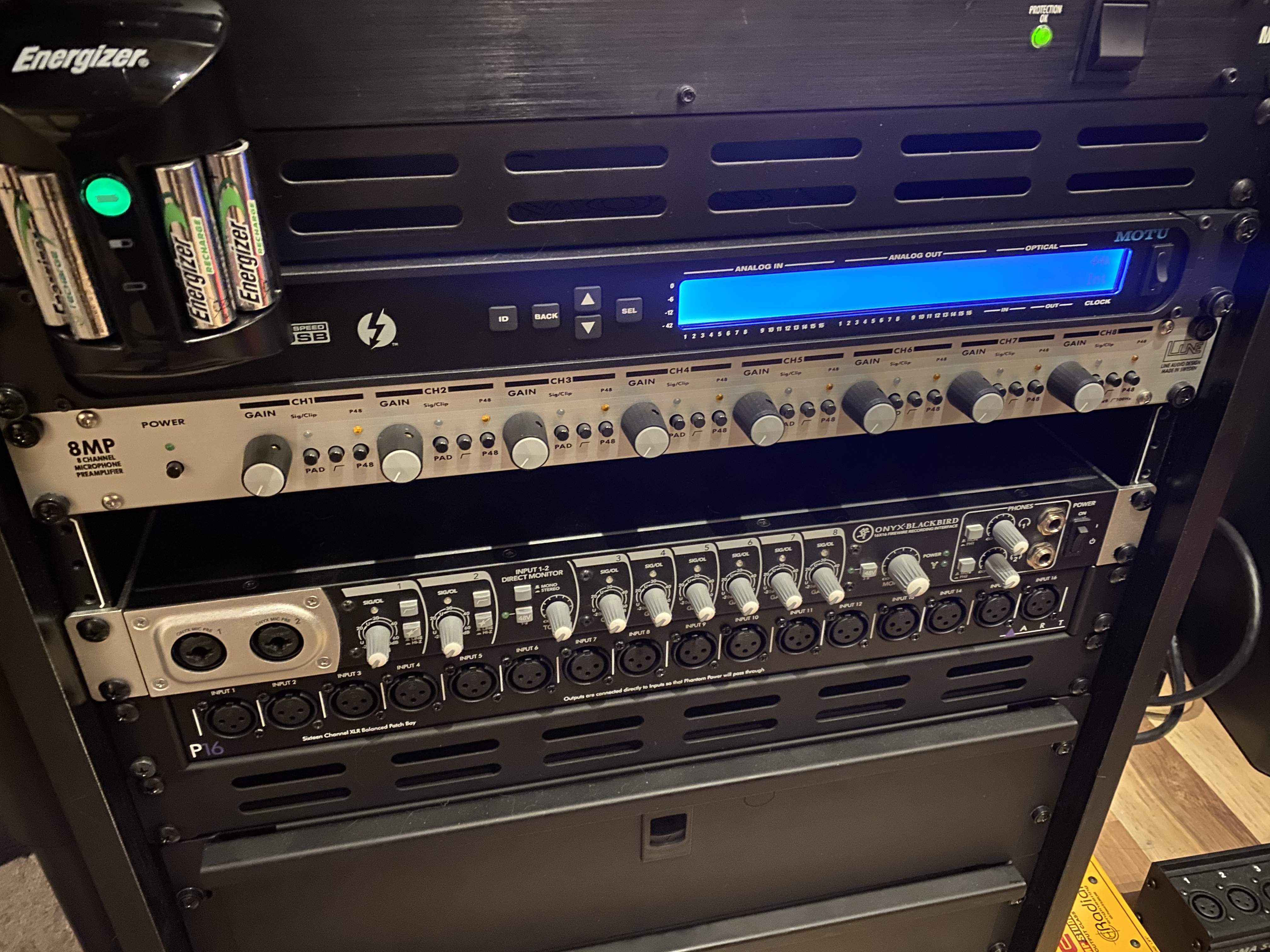
I should amend my previous post by saying that I still intend to add four channels of Neve 1073, and four channels of API 312 (both clones because I’m not made of money) once I finish paying off everything from the studio construction (only $3,500 left!) and buy a new car to replace my current one that I’ve owned new since 2007 which is closing in on 200,000 miles.
That’ll be eight channels of discreet, four channels of Neve transformer/FET flavor, four channels of API transformer/FET flavor, and I’ll still have room to add two more rack spaces worth of preamps with digital outputs (ADAT or TOSLINK) if I want other flavors like a dedicated vocal channel strip, or a tube circuit.
That’ll be eight channels of discreet, four channels of Neve transformer/FET flavor, four channels of API transformer/FET flavor, and I’ll still have room to add two more rack spaces worth of preamps with digital outputs (ADAT or TOSLINK) if I want other flavors like a dedicated vocal channel strip, or a tube circuit.
While that does look like a cool product, I’m all set for converters, especially considering once I get a signal in the box it stays there until the end user pumps it out of their playback system. The converters in my MOTU 16A are shockingly good. It’s a mid level converter package, but in some online comparisons I couldn’t hear a difference until you got up to the likes of a Burl unit which costs many times what the 16A did.


