• TalkBass has been independent since 1998. Add your voice.
    Create a free account to reply to discussions, view embedded media, and browse with fewer display ads.
    Join freeLog in
    Want zero display ads or expanded classifieds tools? Compare plans.

My newest amp creation

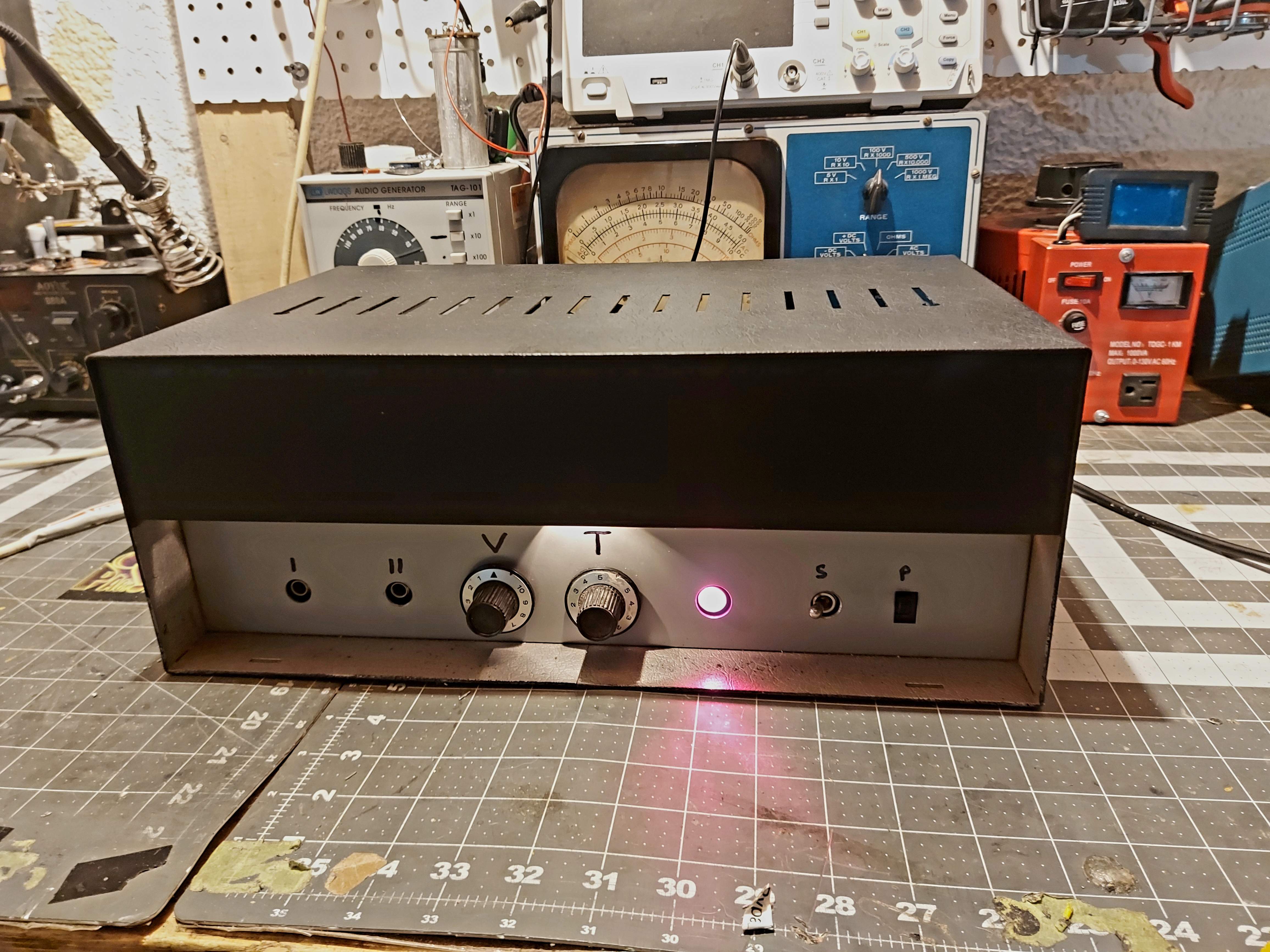
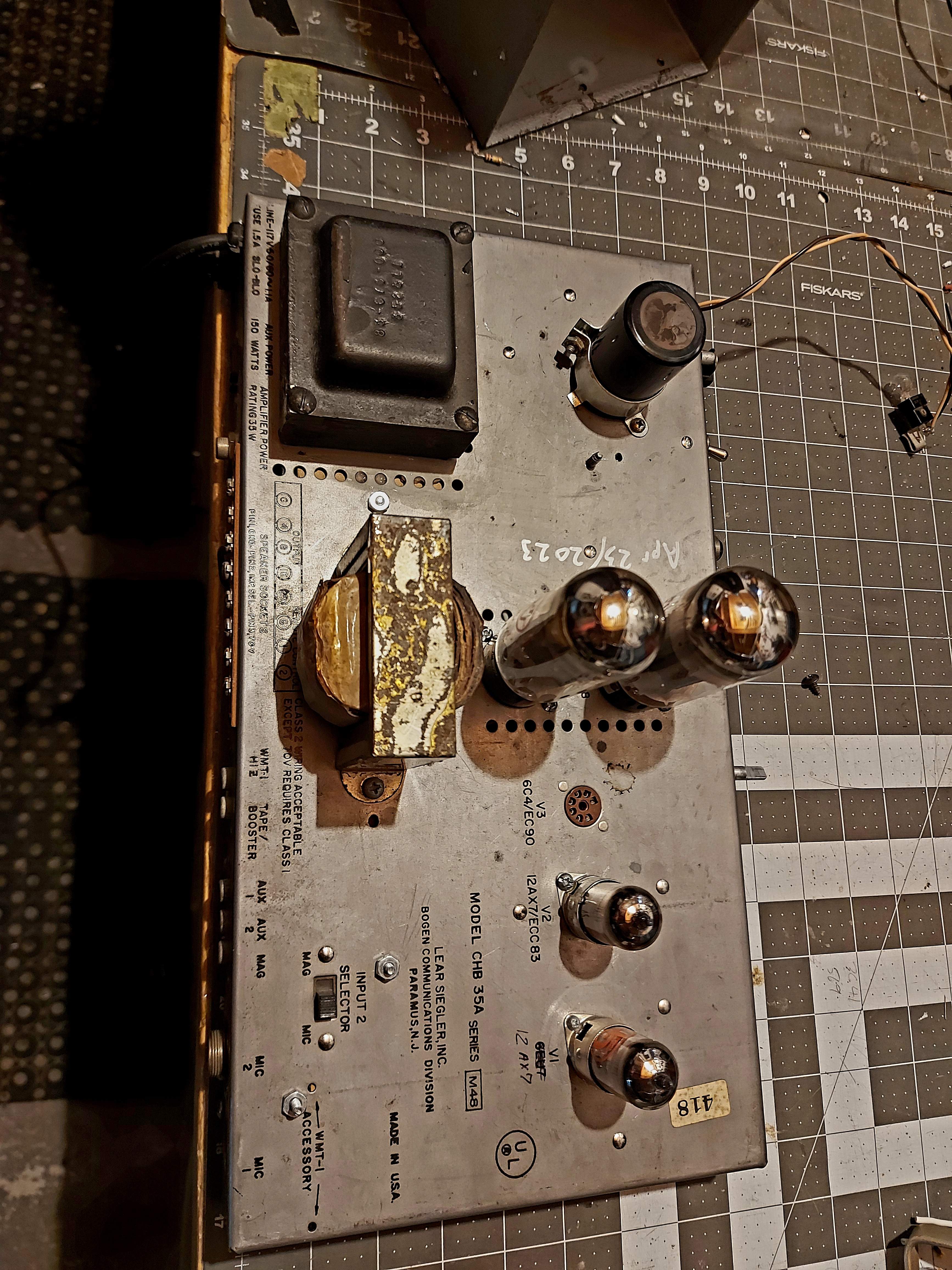
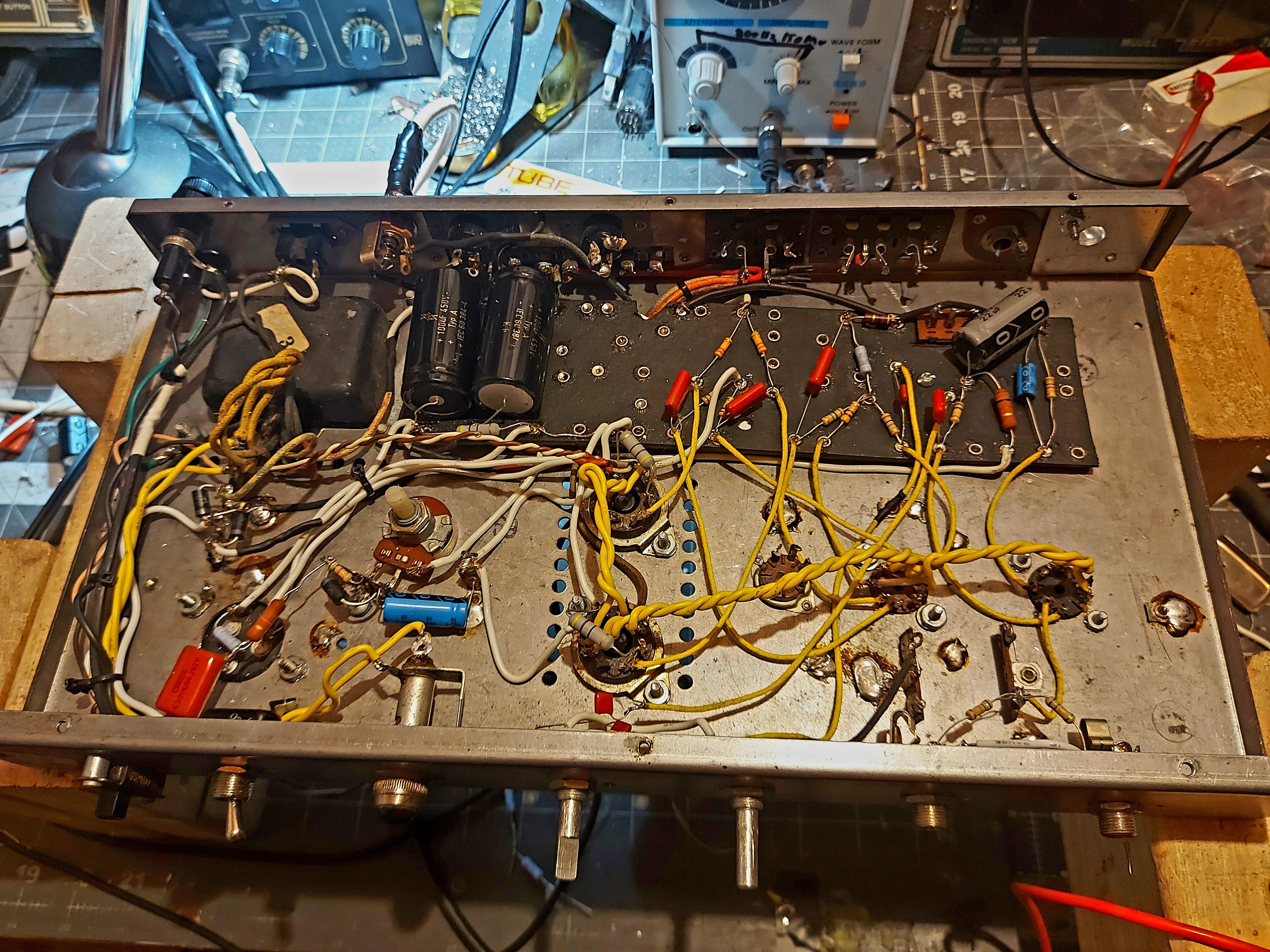
This one's kind of crude... kind of a rat rod of amps haha. I bought an old Bogen challenger PA a couple years ago and it kinda just got benched. I completely gutted it. It originally had a pair of 7868 power tubes, a 6c4 rectifier, a 6eu7 and 12ax7 in the pre amp. I put in a couple octal sockets for a set of 6L6GC's and replaced the 6eu7 socket with a 9 pin for another 12ax7. Used a simple circuit and just a volume and tone control. Used part of an eyelet board from an old fender twin haha. Pretty happy with the sound though. Very tight and punchy. Through it on the scope earlier and it's putting out about 40 watts. Sounds pretty big Through the single 12 cab I have it running through at the moment and it is dead quiet at idle.
IMG_20210320_131826.jpg
20230423_173733.jpg
20230423_174019.jpg
20230423_174042.jpg
20230423_085213.jpg
 
BlacknWhite,

In this kind of conversion, I see the donor amp as providing a chassis, transformers, switches, and connectors, and then you build whatever circuit you want using the donor almost as a "breadboard".

With with all the extra room in your chassis, you could easily play around with your creation to experiment with different circuit designs. Think about how the Ampeg Heritage B 15 can be switched between fixed, and cathode bias.

Those Raulands I posted above have a plethora of XLR connectors, and some substantial iron and tubes. Notice the plug-in input transformers, (the devices marked "Rauland R1002") that plug into octal sockets. I think they allow for matching impedance of whatever is plugged into the XLR input connectors. I have these things stored away at this time, and it may be a while before I do anything with them. (I also have a couple of Masco amps as wel).

It looks like you have a proper workspace to do this. Unfortunately for now, I can't set up a shop at my current location, and have almost no tools here, (even though I have a very good collection).

Is that an Eico 214 VTVM I see behind the amp?

A few years ago, I thought about getting one or two of my Techtronix oscilloscopes calibrated, and since there was nobody local to me I decided to buy a new one, considering the the cost of shipping to and from the cal lab in addition to the calibration fee. I don't have it here to tell you the exact model, but I bought one on eBay that is two channel, bluetooth enabled and that works with Windows, and the Ipad. it has cursers to read time, and voltage, and can store screen shots for less than the calibration for just one scope would have been. I might not depend on it to measure any "life safety" related, or commercial type of work, but for home-brew audio stuff it can't be beat.

Please tell us more about your project.
 
Last edited:
Test equipment can be found at hamfests for very little can serve as a platform for a pre or low power amp. For instance the HP200AB. You get a nice case and chassis, a 5Y3GT tube rectifier and power supply. With some rewiring and an added parts you have an amp. The model is important, the 200C uses a solid state rectifier.

Hewlett-Packard HP-200AB audio generator

IMG_0620.jpeg
 
One thing that bothers me with drastic modifications of certain donor hardware, is if you have obtained something cool in excellent working condition that once you start hacking into it, there is no going back. Someday, will some old engineer who for some reason cherishes old HP signal generators see your very cool creation, and wonder why you ruined a perfectly good piece of test equipment? I am not one of those when it comes to test equipment, and I doubt that anyone collects vintage Rauland PA amps, but I do hesitate when it comes to MI equipment. I have an old Kasino Snake Eyes bass amp (made by Kustom) that is a big heavy duty case, with a 1970s transistorized amplifier in it that sounds terrible. I have thought about gutting the case to repurpose it to house a better amp, and I most likely will, but I will still pause before ripping its guts out.
 
Last edited:
This one's kind of crude... kind of a rat rod of amps haha. I bought an old Bogen challenger PA a couple years ago and it kinda just got benched. I completely gutted it. It originally had a pair of 7868 power tubes, a 6c4 rectifier, a 6eu7 and 12ax7 in the pre amp. I put in a couple octal sockets for a set of 6L6GC's and replaced the 6eu7 socket with a 9 pin for another 12ax7. Used a simple circuit and just a volume and tone control. Used part of an eyelet board from an old fender twin haha. Pretty happy with the sound though. Very tight and punchy. Through it on the scope earlier and it's putting out about 40 watts. Sounds pretty big Through the single 12 cab I have it running through at the moment and it is dead quiet at idle.View attachment 5040640 View attachment 5040641 View attachment 5040644 View attachment 5040645 View attachment 5040646
My dad was an electronics technician and I used to go with him as a child when he would repair the neighbors TV's and Stereo's as a side hustle. Seeing the inside of all these circuits boards brought a tear to me eye. Thanks for a small trip down memory lane.
 
One thing that bothers me with drastic modifications of certain donor hardware, is if you have obtained something cool in excellent working condition that once you start hacking into it, there is no going back. Someday, will some old engineer who for some reason cherishes old HP signal generators will see your very cool creation, and wonder why you ruined a perfectly good piece of test equipment? I am not one of those when it comes to test equipment, and I doubt that anyone collects vintage Rauland PA amps, but I do hesitate when it comes to MI equipment. I have an old Kasino Snake Eyes bass amp (made by Kustom) that is a big heavy duty case, with a 1970s transistorized amplifier in it that sounds terrible. I have thought about gutting the case to repurpose it to house a better amp, and I most likely will, but I will still pause before ripping its guts out.

At one time they went for under $20, they couldn’t give them away. It was bargain just for the tubes. Hams are practical folks, all kinds of stuff gets repurposed. These days, even inexpensive solid state signal generators run circles around the old tube stuff.
 
This one's kind of crude... kind of a rat rod of amps haha. I bought an old Bogen challenger PA a couple years ago and it kinda just got benched. I completely gutted it. It originally had a pair of 7868 power tubes, a 6c4 rectifier, a 6eu7 and 12ax7 in the pre amp. I put in a couple octal sockets for a set of 6L6GC's and replaced the 6eu7 socket with a 9 pin for another 12ax7. Used a simple circuit and just a volume and tone control. Used part of an eyelet board from an old fender twin haha. Pretty happy with the sound though. Very tight and punchy. Through it on the scope earlier and it's putting out about 40 watts. Sounds pretty big Through the single 12 cab I have it running through at the moment and it is dead quiet at idle.View attachment 5040640 View attachment 5040641 View attachment 5040644 View attachment 5040645 View attachment 5040646

Great project. Love the retro look.
 
  • Like
Reactions: BlacknWhite
Test equipment can be found at hamfests for very little can serve as a platform for a pre or low power amp. For instance the HP200AB. You get a nice case and chassis, a 5Y3GT tube rectifier and power supply. With some rewiring and an added parts you have an amp. The model is important, the 200C uses a solid state rectifier.

Hewlett-Packard HP-200AB audio generator

View attachment 5041137

Those HP-200s are AWESOME. I totally want my amps to have a volume knob that big... :woot:
 
BlacknWhite,

In this kind of conversion, I see the donor amp as providing a chassis, transformers, switches, and connectors, and then you build whatever circuit you want using the donor almost as a "breadboard".

With with all the extra room in your chassis, you could easily play around with your creation to experiment with different circuit designs. Think about how the Ampeg Heritage B 15 can be switched between fixed, and cathode bias.

Those Raulands I posted above have a plethora of XLR connectors, and some substantial iron and tubes. Notice the plug-in input transformers, (the devices marked "Rauland R1002") that plug into octal sockets. I think they allow for matching impedance of whatever is plugged into the XLR input connectors. I have these things stored away at this time, and it may be a while before I do anything with them. (I also have a couple of Masco amps as wel).

It looks like you have a proper workspace to do this. Unfortunately for now, I can't set up a shop at my current location, and have almost no tools here, (even though I have a very good collection).

Is that an Eico 214 VTVM I see behind the amp?

A few years ago, I thought about getting one or two of my Techtronix oscilloscopes calibrated, and since there was nobody local to me I decided to buy a new one, considering the the cost of shipping to and from the cal lab in addition to the calibration fee. I don't have it here to tell you the exact model, but I bought one on eBay that is two channel, bluetooth enabled and that works with Windows, and the Ipad. it has cursers to read time, and voltage, and can store screen shots for less than the calibration for just one scope would have been. I might not depend on it to measure any "life safety" related, or commercial type of work, but for home-brew audio stuff it can't be beat.

Please tell us more about your project.

Hey HCM,

This project was out of pure boredom haha and totally flying by the seat of my pants. I repair and restore vintage amps as a side gig. Loved having the bogen as a platform because there was so much room to work with. I actually started out with Cathode biased 6V6's and a circuit similar to the Traynor bassmate. It sounded good but I wanted to push it for a bit more power. So I re-wired for the 6l6GC's. I switched the phase inverted circuit to a long tailed pair and just left the pre amp pretty basic. The inputs are the Fenderish high/low going into a 12ax7 with 100k plate resistor, 1.5k cathode resistor with 15uf bypass cap. I used .02 uf coupling cap going to the PI . I left it at one gain for now. With the single control tone circuit I didn't really need a 2nd. I probably will add one and maybe a master volume at some point. I'm pretty happy with the tone though. Also yes that is an EICO 214 you spotted haha.. I saw it on FB market place for like 30 bucks and couldn't pass it up. Brought it home replaced all the caps and resistors, calibrated it and it now lives in my workshop. I have an old Kikusui scope, but I mainly use my Digital one now. Like you said it's got all the features and voltage whatnot displayed right on the screen. Can't really beat that. Hope you get to start on your projects somewhere down the road! Make sure you post if you start on them. Here's a pic of my current shop as well.
20230128_200931.jpg
 
Hey HCM,

This project was out of pure boredom haha and totally flying by the seat of my pants. I repair and restore vintage amps as a side gig. Loved having the bogen as a platform because there was so much room to work with. I actually started out with Cathode biased 6V6's and a circuit similar to the Traynor bassmate. It sounded good but I wanted to push it for a bit more power. So I re-wired for the 6l6GC's. I switched the phase inverted circuit to a long tailed pair and just left the pre amp pretty basic. The inputs are the Fenderish high/low going into a 12ax7 with 100k plate resistor, 1.5k cathode resistor with 15uf bypass cap. I used .02 uf coupling cap going to the PI . I left it at one gain for now. With the single control tone circuit I didn't really need a 2nd. I probably will add one and maybe a master volume at some point. I'm pretty happy with the tone though. Also yes that is an EICO 214 you spotted haha.. I saw it on FB market place for like 30 bucks and couldn't pass it up. Brought it home replaced all the caps and resistors, calibrated it and it now lives in my workshop. I have an old Kikusui scope, but I mainly use my Digital one now. Like you said it's got all the features and voltage whatnot displayed right on the screen. Can't really beat that. Hope you get to start on your projects somewhere down the road! Make sure you post if you start on them. Here's a pic of my current shop as well.
View attachment 5041619


Leo Fender’s workbench looks a lot like yours only his was more messy.

IMG_0627.jpeg


IMG_0625.jpeg