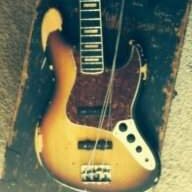
There are quite a few fender custom shop basses at the GC in Hollywood, where I happen to live. Right across the street is Mesa Boogie and they stock Nash guitars. So I get the unique perspective of playing 4 or 5 Fender CS and A/Bing against 4 or 5 Nash basses. Let me preface this by saying that I am a Fender guy, but a vintage Fender guy. I my opinion the Nash's have got the vintage feel and sound all over the Fender CS's and at substantially less money. However, I do wish they would do non-relic bodies

Enjoy the benefits of a premium membership!
Upgrade Account
-
TalkBass has been independent since 1998. Add your voice.
Create a free account to reply to discussions, view embedded media, and browse with fewer display ads.
Join free Log in
Want zero display ads or expanded classifieds tools? Compare plans.
You are using an out of date browser. It may not display this or other websites correctly.
You should upgrade or use an alternative browser.
You should upgrade or use an alternative browser.
NASH GUITARS? Thoughts?
- Thread starter Gbass75
- Start date
More options
Who Replied?
I had a Nash PB-57 and my experience was mixed...
It played and sounded fine (Lollar PU) but the body finish was awful - .......
The neck finish color was way off as well, much too "orange", not a proper vintage amber tint.
This is the issue I was referring to earlier in the thread- Is it "standard" for Nashes to have that colour on the back of the neck?

Unless they have changed it, the pickup position isn't period correct on the 60's type j's. That to me is kind of whack. They look ok otherwise.

This is the issue I was referring to earlier in the thread- Is it "standard" for Nashes to have that colour on the back of the neck?
The orange-y neck tint I was referring to was regarding the front of the neck and the headstock. The backside of the neck on mine and all the Nash basses I've handled were sanded. A lot. It felt good but didn't look like natural wear since the entire playing surface was sanded as if done with a sander. Fender is doing pretty much the same thing with the MIM Road Worn guitars and basses but those have a thin satin clear poly topcoat. The Nash neck backsides are plain wood, which feels more natural.
Regarding the Nash paint finishes, it seems to have been the solid color ones that looked less than great. The sunburst ones seem to be better and the see-through blonde ones were very nice. Please understand that this was back in 2009-2010, maybe the QC is better now. As I mentioned, mine was a very good player. It just didn't look like a $1700 bass.
The thing is, you can buy a clean used Custom Shop Fender for the same money which will have MUCH higher resale value.
I agree with most people posting here that Nash basses are not the prettiest instruments.
The sunburst I have is really yellow and might be one of the worst sunburst I have seen.
The magic of these basses is in the way they play, feel and sound. To me these are the most important factors. I like pretty basses too but playability and tone is what matters to me and Nash excels at that. I have the feeling the Lollar pickups they get must be to their specs because I have owned a set of regular Lollar purchased new directly from Lollar and they sounded nothing like what's on my Nash. Tone is driven by the whole instrument, naturally, but still they sound a lot better than the Lollar's I tested on my Fenders.
I certainly see that Nash basses are not for everybody but they feel and sound better than the Roadworn Fenders I have played. They sit somewhere between a new instrument and a vintage instrument. Compared with the $6,000 to $9,000 1962 to 1966 P basses I played they are very compelling.
I noted that some pros are keeping their vintage instruments at home and touring with Nash instruments. Glenn Hughes mentions in Bass Guitar Magazine (UK publication) of June 2014 that "Bill Nash creates basses that are astronomically brilliant" and that he tours with them.
I recommend reading the following article which I thought was quite interesting and gives an insight to these types of instruments:
http://www.premierguitar.com/articles/5_Pre_CBS_Inspired_Bass_Builders_You_Should_Meet
Again, what I look in an instrument is playability. More precisely, I want the bass to stay out of the way of my thinking. A great bass is a bass I don't have to think about when I play. If my hands are flowing, the music flows and magic happens. If I have to fight the instrument then I sound bad.
Nash lets me create the music, they kind of disappear when I play them and that's exactly what I love. For that I think they are a musician's instrument.
The sunburst I have is really yellow and might be one of the worst sunburst I have seen.
The magic of these basses is in the way they play, feel and sound. To me these are the most important factors. I like pretty basses too but playability and tone is what matters to me and Nash excels at that. I have the feeling the Lollar pickups they get must be to their specs because I have owned a set of regular Lollar purchased new directly from Lollar and they sounded nothing like what's on my Nash. Tone is driven by the whole instrument, naturally, but still they sound a lot better than the Lollar's I tested on my Fenders.
I certainly see that Nash basses are not for everybody but they feel and sound better than the Roadworn Fenders I have played. They sit somewhere between a new instrument and a vintage instrument. Compared with the $6,000 to $9,000 1962 to 1966 P basses I played they are very compelling.
I noted that some pros are keeping their vintage instruments at home and touring with Nash instruments. Glenn Hughes mentions in Bass Guitar Magazine (UK publication) of June 2014 that "Bill Nash creates basses that are astronomically brilliant" and that he tours with them.
I recommend reading the following article which I thought was quite interesting and gives an insight to these types of instruments:
http://www.premierguitar.com/articles/5_Pre_CBS_Inspired_Bass_Builders_You_Should_Meet
Again, what I look in an instrument is playability. More precisely, I want the bass to stay out of the way of my thinking. A great bass is a bass I don't have to think about when I play. If my hands are flowing, the music flows and magic happens. If I have to fight the instrument then I sound bad.
Nash lets me create the music, they kind of disappear when I play them and that's exactly what I love. For that I think they are a musician's instrument.

I recommend reading the following article which I thought was quite interesting and gives an insight to these types of instruments:
http://www.premierguitar.com/articles/5_Pre_CBS_Inspired_Bass_Builders_You_Should_Meet
Thanks for the link! Great reading from all of the builders who took part. Bill is definitely an interesting guy.
Yep. I think that after several years of trying to figure it out, he broke the code.
It's like everything, there is a learning curve and there is definitely more to it than aging parts and sanding necks.
I can't figure what he does but the results speak for themselves.
It's like everything, there is a learning curve and there is definitely more to it than aging parts and sanding necks.
I can't figure what he does but the results speak for themselves.

I really like the brighter yellow on the Nash basses..especially the sunburst on the 63p...It may not be the exact authentic colour..but it is a very cool interpretation....To each their own,I guess.I agree with most people posting here that Nash basses are not the prettiest instruments.
The sunburst I have is really yellow and might be one of the worst sunburst I have seen.
The magic of these basses is in the way they play, feel and sound. To me these are the most important factors. I like pretty basses too but playability and tone is what matters to me and Nash excels at that. I have the feeling the Lollar pickups they get must be to their specs because I have owned a set of regular Lollar purchased new directly from Lollar and they sounded nothing like what's on my Nash. Tone is driven by the whole instrument, naturally, but still they sound a lot better than the Lollar's I tested on my Fenders.
I certainly see that Nash basses are not for everybody but they feel and sound better than the Roadworn Fenders I have played. They sit somewhere between a new instrument and a vintage instrument. Compared with the $6,000 to $9,000 1962 to 1966 P basses I played they are very compelling.
I noted that some pros are keeping their vintage instruments at home and touring with Nash instruments. Glenn Hughes mentions in Bass Guitar Magazine (UK publication) of June 2014 that "Bill Nash creates basses that are astronomically brilliant" and that he tours with them.
I recommend reading the following article which I thought was quite interesting and gives an insight to these types of instruments:
http://www.premierguitar.com/articles/5_Pre_CBS_Inspired_Bass_Builders_You_Should_Meet
Again, what I look in an instrument is playability. More precisely, I want the bass to stay out of the way of my thinking. A great bass is a bass I don't have to think about when I play. If my hands are flowing, the music flows and magic happens. If I have to fight the instrument then I sound bad.
Nash lets me create the music, they kind of disappear when I play them and that's exactly what I love. For that I think they are a musician's instrument.
FWIW, here's what my Nash PB-57 looked like after the Guitar Mill nitro refinish, lightly reliced. I went with Dakota Red instead of the original (alleged) Fiesta.
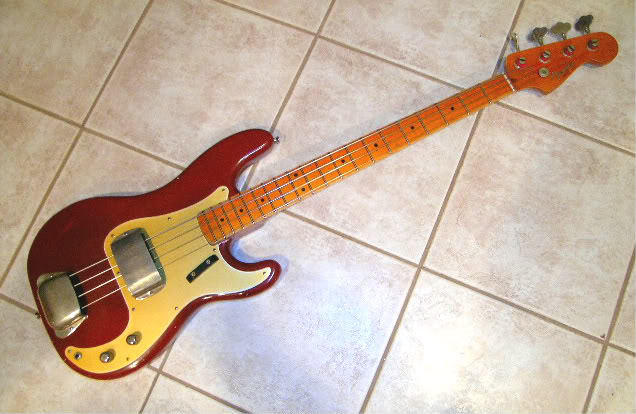
The nitro tinting on Nash guitars render the unpainted areas an unatural orange color that announces loudly "This is not vintage."
Part of the allure of a Nash bass is the feel of the neck, which is sanded. I have a used Hoppus body with a Squier CV Precision neck that feels great. I plan on sanding the back of the neck to get that vintage feel. Total cost of bass after sanding? $300.
I have never played a John K bass but from what I have read and the pictures I have seen, If I was ordering my bass again, I would have went with John K's work.
Part of the allure of a Nash bass is the feel of the neck, which is sanded. I have a used Hoppus body with a Squier CV Precision neck that feels great. I plan on sanding the back of the neck to get that vintage feel. Total cost of bass after sanding? $300.
I have never played a John K bass but from what I have read and the pictures I have seen, If I was ordering my bass again, I would have went with John K's work.
Last edited:

- Jun 30, 2010
- 49,589
- 221,970
- Disclosures
- musician/artist/owner - Gildaxe
Buy a basic MIM, hit it with a belt sander and swap the pup's......



The nitro tinting on Nash guitars render the unpainted areas an unnatural orange color that announce loudly "This is not vintage."
Part of the allure of a Nash bass is the feel of the neck, which is sanded. I have a used Hoppus body with a Squier CV Precision neck that feels great. I plan on sanding the back of the neck to get that vintage feel. Tiotal cost of bass after sanding? $300.
I have never played a John K bass but from what I have read and the pictures I have seen, If I was ordering my bass again, I would have went with John K's work.
Love that neck feel.

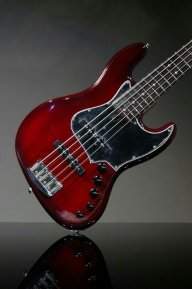
Have a 2 tone tobacco burst (avatar picture) and this one looks great to me... Who is all I care about on my instrument
Do agree that not every one I see works as well aesthically.... But Damn they do play great
Do agree that not every one I see works as well aesthically.... But Damn they do play great

The magic of these basses is in the way they play, feel and sound. To me these are the most important factors. I like pretty basses too but playability and tone is what matters to me and Nash excels at that. I have the feeling the Lollar pickups they get must be to their specs because I have owned a set of regular Lollar purchased new directly from Lollar and they sounded nothing like what's on my Nash. Tone is driven by the whole instrument, naturally, but still they sound a lot better than the Lollar's I tested on my Fenders.
This. I've owned a few Nash basses, and my PB-57 is now my only one. But it will stay with me for a long time. Nothing plays or sounds like it. Yes, the relic'ing is kind of comic book-like...but form factor, neck, weight, Lollar pickups - it just works.
Last edited:

I got a Nash PB-57 about 4 years ago. I went on a quest to find the perfect P-bass and played a lot of them in music stores around Seattle. I found it at Bass NW and bought it because I liked how it felt, and especially how it sounded. I have a few other Fender Ps which are fine instruments, but the Nash is in a class by itself.

I've played more than a few Nash basses. Never found one that made a good impression.
I'm on the fence about distressed finishes. I get that legit old instruments have a cool vibe. But to take a nice new instrument and try to make it look old turns me off in a way not entirely dissimilar to my feeling about fake boobies. They look ok if you don't look directly at them.
I'm on the fence about distressed finishes. I get that legit old instruments have a cool vibe. But to take a nice new instrument and try to make it look old turns me off in a way not entirely dissimilar to my feeling about fake boobies. They look ok if you don't look directly at them.

I've played more than a few Nash basses. Never found one that made a good impression.
I'm on the fence about distressed finishes. I get that legit old instruments have a cool vibe. But to take a nice new instrument and try to make it look old turns me off in a way not entirely dissimilar to my feeling about fake boobies. They look ok if you don't look directly at them.
But it's not just about how they look, but about how they feel; plus, "reliced" fake boobies seem to be over-the-top....
Last edited:


