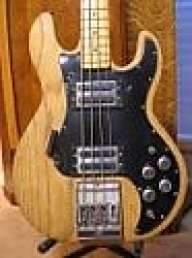
Happy to be the proud new owner of an early Ash body Super Ferrite Peavey Fury. This bass dates to 1984 and is the older brother to my 1994 white split-P Fury. I knew there were some cosmetic differences between these two basses but I was unaware how deep the differences went. So much more than pickups and knobs changed in these basses in a 10 year period. Here is a pic of the bass from the original ad. The intonation was way out of whack but other than that it was a real gem. Some minor bumps and bruises from 30 years of what appears to be a gentle life but nothing too serious.

It's a real nice bass and plays well now that I have fixed the intonation and added a set of Chromes.
Since I have both of these basses I thought I would do a detailed comparison of the two. What I found was some very surprising differences between these two generations of Furys. First the details and then I'll post some comparison pics detailing what I found.
Ash Fury - Made in USA
S/N 01855883 - dates to 1984
Weight 9.0 lbs
Gloss neck and headstock/satin or oiled finish body
Truss Rod Cover
2 piece solid neck, no board, maple
Width at nut = 43 mm
Width at 12th fret =56 mm
Width at 22nd fret = 62 mm
String spacing at bridge = 19 mm
Beefier tuners – 2 screws on back, nut over post on front
Tapered tuning posts
1 screw mounted triangular string tree (D and G strings)
Larger diameter saddles - fully adjustable
3 ply pickguard - different shape
More angular body and headstock shape
Body approx 1 inch longer
Blended elbow cut back
2 mm thicker neck through entire taper - C shape
Custom Peavey knobs
White Fury - Crafted in USA
SN 07654738 - dates to 1994
Weight 9.0 lbs
Satin neck and headstock with gloss board
No truss rod cover
Single piece neck with board - maple
Width at nut = 38 mm
Width at 12th fret = 55 mm
Width at 22nd fret = 61 mm
String spacing at bridge = 19 mm
Lighter tuners - 4 screws on back
Straight tuning posts
2 screw mounted cylinder string tree (A, D and G strings)
Medium mass bridge with 5 smaller mounting screws
Smaller diameter saddles - fully adjustable
Single ply pickguard - different shape
Smoother body and headstock shape
Body approx. 1 inch shorter
Angular elbow cut back
2 mm thinner neck through entire taper - D shape
Standard knurled P knobs
I'll highlight some of the more interesting differences in pics to come.
Clearly the later version has been affected by some cost cutting measures but both instruments play extremely well and are keepers. But if I was forced to sell one, the white one would go first.
It's a real nice bass and plays well now that I have fixed the intonation and added a set of Chromes.
Since I have both of these basses I thought I would do a detailed comparison of the two. What I found was some very surprising differences between these two generations of Furys. First the details and then I'll post some comparison pics detailing what I found.
Ash Fury - Made in USA
S/N 01855883 - dates to 1984
Weight 9.0 lbs
Gloss neck and headstock/satin or oiled finish body
Truss Rod Cover
2 piece solid neck, no board, maple
Width at nut = 43 mm
Width at 12th fret =56 mm
Width at 22nd fret = 62 mm
String spacing at bridge = 19 mm
Beefier tuners – 2 screws on back, nut over post on front
Tapered tuning posts
1 screw mounted triangular string tree (D and G strings)
Larger diameter saddles - fully adjustable
3 ply pickguard - different shape
More angular body and headstock shape
Body approx 1 inch longer
Blended elbow cut back
2 mm thicker neck through entire taper - C shape
Custom Peavey knobs
White Fury - Crafted in USA
SN 07654738 - dates to 1994
Weight 9.0 lbs
Satin neck and headstock with gloss board
No truss rod cover
Single piece neck with board - maple
Width at nut = 38 mm
Width at 12th fret = 55 mm
Width at 22nd fret = 61 mm
String spacing at bridge = 19 mm
Lighter tuners - 4 screws on back
Straight tuning posts
2 screw mounted cylinder string tree (A, D and G strings)
Medium mass bridge with 5 smaller mounting screws
Smaller diameter saddles - fully adjustable
Single ply pickguard - different shape
Smoother body and headstock shape
Body approx. 1 inch shorter
Angular elbow cut back
2 mm thinner neck through entire taper - D shape
Standard knurled P knobs
I'll highlight some of the more interesting differences in pics to come.
Clearly the later version has been affected by some cost cutting measures but both instruments play extremely well and are keepers. But if I was forced to sell one, the white one would go first.