• TalkBass has been independent since 1998. Add your voice.
    Create a free account to reply to discussions, view embedded media, and browse with fewer display ads.
    Join freeLog in
    Want zero display ads or expanded classifieds tools? Compare plans.

NBD: Fender Precision 1971 sunburst - where's the mojo?

Vintage is not better than new and new is not better than vintage , it's a matter of player , bass , strings , speaker and amp and the acoustics of the room ............other than that , it's that "MOJO THING " . :woot:
 
I've had '76 and '78 Les Pauls, definitely variable quality in that era! My '76 Deluxe was nice although it was very heavy.
I was working in a large music store that moved a lot of gear in the year that I worked there 75/76 so I got to see a lot of new Fender, Gibson, Epiphone, Ibanez, etc. guitars and basses. I saw just as many used instruments get traded in. The new Fenders seemed fine, the Gibsons seemed not great. At the time (age 16) I was way more interested in used because I could buy traded in gear a lot cheaper.
I was playing guitar at that point and wanted an SG or a Les Paul because the used Stratocaster I bought was not great and I sold it.
At this point, I have three basses left (after selling a dozen) and the keepers are two Yamaha Attitude basses.
I have one more nice 1989 Peavey Fury to sell and I like that bass better than any Mexican made Fender Precision or Jazz I've ever had or checked out. I plan to keep the two Yamahas until I'm too old to pick them up anymore.
 
Last edited:
FWIW, Fender was sold to CBS in 1965, and many feel that began a decline in quality.
Most of the vintage "mojo" I have read / heard about usually refers to "pre-CBS" Fenders.

But I'm willing to be there are winners and stinkers form every year
Yes, the decline took several years. I think 1965-1970 were still built better than what came after.
 
It's a bit of luck to get that magic bass , the last one I played was a 1962 PB that must have weighed 6.5 pounds and was a dream to play and tone for days and cost $$$$$$$$$$ .........I was tempted . Have not heard a PB that was close to that bass ..........still looking . You can't look for MOJO , it's one of those .....be at the right place at the right time things . :drool:
I totally agree. In fact, I call my '66 P the "magic bass" because sitting down with it I'll start playing and forget what I'm playing (as in, getting lost in playing) and it will remind me of how it sounds, how it inspires me. When I walked into the shop that it was at, I saw what looked like "mojo", and after sitting down and playing it (plugged into a Fender guitar amp!) I suddenly realized - this is an exceptional instrument. I waited a week before I returned to buy it (luckily it was still there!) and frankly didn't pay stupid money for it and I do not regret spending what I did. From the start I've felt I'm its guardian until the next player owns it.
 
Unpopular opinion, but I suspect the talk about "mojo" of vintage basses is just people convincing themselves they didn't just burn a ton of money.

that's certainly a reason, but not only with "vintage money", because I know a lot of players that overreact when someone uses or like "cheap" instruments, because they spent a lot of money in expensive basses and guitars, and can't accept that someone who plays professionally uses something that costs at least 500/600$.

however, the "vintage mojo" and all those things are more related, IMHO, to the fact that we associate those instruments to famous records, famous musicians from those eras, as the aforementioned Freddie Washington and his early 70's P-bass (with a Badass :P ), forgetting that those instruments, in those days, were just "standard production" as it would be now.

not being an important music scene today, we go back to our favourites and look at those instruments because we don't see many young/recent players using contemporary production instruments.

"James Jamerson used a '62 Precision bass, that's the sound of Motown".

fun fact: Stroke's bassist uses a late 90's/early 2000's Fender Jazz Bass USA Standard, and the only change he made was to put a tort pickguard instead of the white one.
a LOT of Stroke's fan think that that's a vintage Jazz, while it's nothing more than an USA Standard from a recent period (considering when they started).
 
just to add: yesterday I rehearsed with my punk band Ferox, brought the '71, plugged in the rig (Ampeg SVT-5 and Ashdown MAG 115 cab), played a few notes, and liked the sound immediately in flat, it's a bit more "rounded" compared to other Precision I've owned, maintaining a homogeneous sound string to string.

here's a little rec I did in a speaking moment :D just a few notes. strings are D'Addario nickel 45-105 used and re-used mounted by my friend who sold it to me. yesterday I mounted a fresh set of Fender 7250m for tomorrow gig.


I found that the round and chunky neck is something I really love, it was a pleasure to play 2 hours straight, and tomorrow I'll gig it at a punk festival (probably handcuffing the case Blues Brothers style ahahah! :D ).
it's lightweight, balanced, with the big neck, and it stays in tune.
 
The good news here is of course that people still go nuts over vintage Fenders (even the not-so-great ones) so if you want to, you can probably sell it without taking a loss. Or maybe even make a profit. Depending on how much you actually paid for it of course.

It seems like it has started to grow on you though. And if that's the case, keep it, play it, enjoy it!:thumbsup:
 
It's a CBS Fender. Old doesn't mean great. My '61 Jazz plays great and sounds great. But it's still just a very good bass… the best of my otherwise economy level collection. No magic. Doesn't make me a better player. I prefer using my MIM Classic 50s P, which doesn't sound awesome solo, it even sounds underwhelming, but in the mix it punches like Tyson: like magic.
 
  • Like
Reactions: WWilliam
It seems like it has started to grow on you though. And if that's the case, keep it, play it, enjoy it!

my political view is that an instrument should be played for some time before selling it, except for those that are actual crap :D

this one will see a couple of stages, this saturday and september 20th, with two different bands (a raw punk band and a blues brothers big band with brass ensemble).

as I was saying, for what concerns the physical comfort, this is a really good Precision for my taste, take a look at the neck profile. I like when the neck has some wood, because I find it easier to press the strings, obviously because of how my thumb stays at what for me is a better distance from the other fingers.
with slim necks I tend to feel fatigue.

attached there's a picture with my beloved Mike Dirnt :D my longest running Precision so far. the Dirnt's neck is a bit slimmer, and with 9.5" radius, but the feel is perfect. is also light and balanced, and I play it a lot.

this two specific basses have a different sound, however, because the Dirnt is more on the aggressive side, with more hi-mids and sparkly tone.
 

Attachments

  • IMG_8886.JPG
    IMG_8886.JPG
    861.5 KB · Views: 18
  • IMG_8899.jpg
    IMG_8899.jpg
    961.7 KB · Views: 15
Beautiful bass and glad you are starting to bond to it!

I feel like many variables can affect if we feel the "mojo" with an instrument. I had a Stingray Special 4H that I thought I'd fall in love with, never did bond with it.

Ironically my favorite bass to play as of now is a Roadworn 50's Precision I acquired from a member here.
 
I feel like many variables can affect if we feel the "mojo" with an instrument. I had a Stingray Special 4H that I thought I'd fall in love with, never did bond with it.

I needed five different Stingrays to find my "keeper", an 99% of the mojo is in the colour (a trans red, maple fretboard) :P

however, friday, the day before a gig, I mounted a set of Rotosound RS66LD, and wow... they just feel perfect for this bass. I only hope that the frets can handle steel strings
 
here's some pics from last staturday's live :D

this bass is growing on me, however I went back to Fender nickel strings, because the Rotosound didn't match it as I wanted, ironically nickel strings sound a bit more "metallic" and bright on the highs compared to Rotos, that are more powerful on the mids.

however, with a Markbass Blackline and Harke 4x10 the stage sound was woody and big. outside it went through a DI (not the Markbass one), and the sound was big and full, but still clear on the melodic passages (with a pick).

what I notice is that the sound is similar to the American Standard I've had (four in the last 10 years :P ), a bit more compressed and without much spark on the highs.
it's different from every "reissue" I've had (AV62, AV63, Classic 50 and Vintera 60), because the reissue usually are brighter and with a wider spectrum.

this bass sounds more like the AS (in particular my experience is with models from the 2008-2015 period), smoother on the highs and more pronounced on the mids.

it's also very different from my Mike Dirnt Road Worn, which is overpowered on the hi-mids and with a lot of spark compared to other Precisions.

what I can say is that this bass it's more of a "working bass", similar in sound to the AS production, but with the "vintage look":

- TV Logo
- 70's tuners
- brighter/lighter sunburst with more wood seethrough
- vintage bridge (in the 70's position, with the longer G screw)
- chunkier profile on the neck

the actual weight stands between 3,7kg and 3,8kg, so it's lighter than my friend (the seller) told me, and it's perfectly balanced even with the small strap.


I'll forward this post with an in-depth of the neck heel I was talking about some posts ago.
 

Attachments

  • DSC03261.JPG
    DSC03261.JPG
    699.5 KB · Views: 30
  • DSC03271.JPG
    DSC03271.JPG
    636.8 KB · Views: 25
  • DSC03318.JPG
    DSC03318.JPG
    720.5 KB · Views: 24
  • Like
Reactions: MtManiac
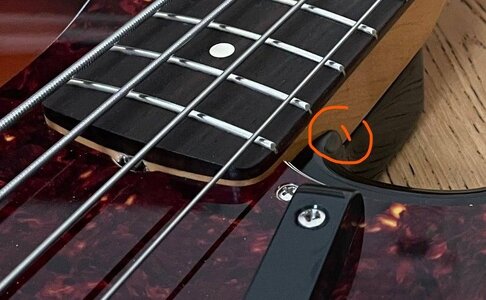
as you can see in this pictures, the neck heel on the 71 (this thing is common with all the 68-73 models, as far as I've seen) is higher, or actually the thing is that the body top is thinner.
I can't recall the actual measure right now, but I measured the lower part of the body, where the screws goes in, and it's identical to other Fender basses; the upper part is a little thinner, so the neck heel goes out a bit more.

in this bass I don't need to remove the pickguard to reach the truss rod screw, and the saddles, even with my usual low action, still have a lot of height. and can go so low that the G string touches the frets.
there ain't no shim under the neck.

on all these other basses I've pictured (all mine, photographed by me), the G saddle is totally flat on the bridge plate, and the action can't go lower. these 68-73 models had this little feature that helps if you're using heavier strings or want a lower action.
 

Attachments

  • p71 tacco 1.jpeg
    p71 tacco 1.jpeg
    362.6 KB · Views: 14
  • vintera tacco.jpeg
    vintera tacco.jpeg
    223.2 KB · Views: 29
  • am standard tacco.jpeg
    am standard tacco.jpeg
    129.1 KB · Views: 27
  • av63 tacco.jpeg
    av63 tacco.jpeg
    239.8 KB · Views: 26
  • am standard acero tacco.jpeg
    am standard acero tacco.jpeg
    100.7 KB · Views: 25
  • p50 tacco.jpeg
    p50 tacco.jpeg
    83.7 KB · Views: 32
  • p71 tacco.jpeg
    p71 tacco.jpeg
    173.2 KB · Views: 27
  • Like
Reactions: Hillbilly Sam
here's some pics from last Saturday's live :D

this bass is growing on me, however I went back to Fender nickel strings, because the Rotosound didn't match it as I wanted, ironically nickel strings sound a bit more "metallic" and bright on the highs compared to Rotos, that are more powerful on the mids.

however, with a Markbass Blackline and Harke 4x10 the stage sound was woody and big. outside it went through a DI (not the Markbass one), and the sound was big and full, but still clear on the melodic passages (with a pick).

what I notice is that the sound is similar to the American Standard I've had (four in the last 10 years :P ), a bit more compressed and without much spark on the highs.
it's different from every "reissue" I've had (AV62, AV63, Classic 50 and Vintera 60), because the reissue usually are brighter and with a wider spectrum.

this bass sounds more like the AS (in particular my experience is with models from the 2008-2015 period), smoother on the highs and more pronounced on the mids.

it's also very different from my Mike Dirnt Road Worn, which is overpowered on the hi-mids and with a lot of spark compared to other Precisions.

what I can say is that this bass it's more of a "working bass", similar in sound to the AS production, but with the "vintage look":

- TV Logo
- 70's tuners
- brighter/lighter sunburst with more wood seethrough
- vintage bridge (in the 70's position, with the longer G screw)
- chunkier profile on the neck

the actual weight stands between 3,7kg and 3,8kg, so it's lighter than my friend (the seller) told me, and it's perfectly balanced even with the small strap.


I'll forward this post with an in-depth of the neck heel I was talking about some posts ago.
A sunburst Fender Precision, with rosewood fretboard, and tort guard still always looks great.
I really like your new bass. :bassist:
 
Last edited:
  • Like
Reactions: Pier_
as you can see in this pictures, the neck heel on the 71 (this thing is common with all the 68-73 models, as far as I've seen) is higher, or actually the thing is that the body top is thinner.
I can't recall the actual measure right now, but I measured the lower part of the body, where the screws goes in, and it's identical to other Fender basses; the upper part is a little thinner, so the neck heel goes out a bit more.

in this bass I don't need to remove the pickguard to reach the truss rod screw, and the saddles, even with my usual low action, still have a lot of height. and can go so low that the G string touches the frets.
there ain't no shim under the neck.

on all these other basses I've pictured (all mine, photographed by me), the G saddle is totally flat on the bridge plate, and the action can't go lower. these 68-73 models had this little feature that helps if you're using heavier strings or want a lower action.
I cannot understand why Fender has not made their truss rod access at the heel better on all their basses for the last 30+ years.
Vintage reissue or not, providing a bass that can be adjusted easily and repeatedly is just the right thing to do. They have plenty of examples... from the Ernie Ball wheel at the heel or Yamaha's small route in the body up against the heel, or plenty of others to copy.
I prefer the adjustment point to be at the heel but even the truss rod access above the nut can work great when done right.
That buried plus sign + was never good and should forever be abandoned. ....in my opinion.
 
however, friday, the day before a gig, I mounted a set of Rotosound RS66LD, and wow... they just feel perfect for this bass. I only hope that the frets can handle steel strings


I've been using RS66LC strings on my trans red + maple board StingRay for 35 years, and there's barely any fret wear: you'll be fine.

Heck, given that my StingRay is 38 years old, and has never needed a dressing to its nickel frets, I'm confident I could get 60+ years out of the high profile stainless steel frets on a modern StingRay Special, with Rotosound RS66 strings.
 
  • Like
Reactions: Pier_
I've been using RS66LC strings on my trans red + maple board StingRay for 35 years, and there's barely any fret wear: you'll be fine.

I know, and the fun thing is that I use them on a lot of other basses that shows no real wear, but I'm caring for this Precision like an holy relic :D the first weeks will probably go like this, then I'll leave it on the floor with barbed-wire strings :D

joking apart, I'm probably going to try some other sets, like Rotosound Jazz77 ( I love that old 70's punk/post punk sound of a Precision with Roto flats, and also Roger Waters'es early 70's P at some point) and Fender flats, and see how it responds.
I'm more oriented, on this bass, to roundwounds, for a more "modern" punk/rock sound, buy who knows, we are wheels always turning around and around, changing tastes and ideas.
 
I cannot understand why Fender has not made their truss rod access at the heel better on all their basses for the last 30+ years.
Vintage reissue or not, providing a bass that can be adjusted easily and repeatedly is just the right thing to do. They have plenty of examples... from the Ernie Ball wheel at the heel or Yamaha's small route in the body up against the heel, or plenty of others to copy.
I prefer the adjustment point to be at the heel but even the truss rod access above the nut can work great when done right.
That buried plus sign + was never good and should forever be abandoned. ....in my opinion.
If Fender did that, a lot of people would complain that it's not a true AVRI and sales would go down. Guaranteed.

I do agree that the wheel at the base of the neck is the best type of adjustment.