• TalkBass has been independent since 1998. Add your voice.
    Create a free account to reply to discussions, view embedded media, and browse with fewer display ads.
    Join freeLog in
    Want zero display ads or expanded classifieds tools? Compare plans.

NBD: Fender Precision 1971 sunburst - where's the mojo?

This is a great question.

I agree, and I guess that the "mojo" is something everybody experience in a different way, probably for small things like some different nuances in the pickup sound, some different measure in the neck profile, a particular color.

for example, I've had 5 different Stingrays over the years, two of them were Standard, three were Classic: the last one I bought, a 2004 Standard, didn't felt much different from the others, except for the slab body of the Classics (also I don't find much difference in the 3-EQ or 2-EQ, small nuances I can avoid...), but it has something...
it weights around 4kg, perfectly balanced (as every Stingray), the neck has some flame and it slept 20 years under the owner's bed, so the unfinished wood was immaculate, and I oiled the neck so that it shows it's beauty, with some flame.
also it's a trans-red coloured body, my favourite color ever, and this "combo" of specs just made me fell in love :P it was then strung with GHS Brite Flats 49-108, and it's a real keeper.

70's Fenders were kinda frowned upon, now they're the hottest thing ever. When did it change or is my memory just wrong?

as far as I remember, it's not "70's fender", but some specific periods. let me explain:

early 70's Fender, used on many records back in the days, and coming from the near CBS passage (1965/66) were still considered good instruments with "value" from the Fender brand.
you can recognize them because the body is still alder, the rosewood is a nice chunk of wood, the tortoise pickguard is always gorgeous, and the finger-rest was still under the G string.

the "bad period" started (for "common knowledge") in 74/75, up until the early 80's years, before Fender started producing the "reissue" models.

in the second half of the 70's CBS started using ash (mostly not dried enough and too heavy, to produce more in less time and less money), lowered the quality control, started using overwound pickups, and ironically created a series that now is looked for because it was particular and with a different sound :P

in that case, when you find a late 70's Fender that weight less than 5kg, it's already good, if you were looking for a bass with a middier and sparkier sound.
 
Had exactly the same bass and sold it three yrs ago. 71, S/B, R/W all original, weighed 9Ibs with lots of player wear. The one thing that felt good about it was that thick neck profile but the tone was soft and deep, everything that one 'doesn't want' in a P bass.

In the closet I had a damaged, early SQ VM P bass that I simply thght was no good because it was, well, a VM P bass! Seems I was totally wrong and after fixing it, its now my main playing bass. Light weight, resonant, punchy and bursting with upper low mid tone....In a sentence, it totally smokes that lovely old 71 I had which is sad cause I too was looking for some early Fender 70's vibe.
 
I remember when I started playing not so long ago (like 10-12 years ago) 70's Fenders were kinda frowned upon, now they're the hottest thing ever. When did it change or is my memory just wrong?

Beautiful bass, btw. Just put those covers on :)

Not just you, it happened with Gibsons too. The "Norlin" era was considered junk until the pandemic rush made all the prices skyrocket and Norlins became the oldest affordable models. Now people pretend they're great, even though they were objectively worse built and lower quality guitars.
 
I had two early 70's P basses back in the day (mid - later 70's), when the band I was in was playing clubs on the road 3 - 6 nights a week. Both were three color sunburst with red tort PG's just like yours in the photos, which I thought then were fugly with the tort PG (not so much now), but at that point in my life I didn't have the coin to replace them. First was a used '71, second was a practically brand new '73. This was still in the era where they were just ordinary old used Fenders not the supposed collectors items they seem to be now. The '73 was a basically new instrument that belonged to the husband of a woman who worked with my mother. He'd bought it new because he wanted to learn, ended up sticking it in the closet when he didn't. He's heard me play, knew my mom, and wanted me to have it so made me what at the time seemed to be a pretty good deal on it and hey, it was like basically brand new....

Had to sell the '71 and work a sideline job to afford the '73, which I wanted because it was "new". Each saw plenty of play time before I parted with them. My recollection is that the '71 was a better built instrument while the '73 had the gaps around the neck heel common to that era post-Fender CBS Fenders but otherwise was a solid player. Both sounded and played like basically any other P bass I've ever played or owned since - good solid working man's bass but nothing particularly special.

I've owned (and still own) Squiers that were/are at least as good an instrument and currently own a 2023 a Mex P that (IMO) is a much better built bass than those were. I'm of the view that while there may be some mojo to some of the older pre-CBS Fenders, generally speaking you can get a new or newer one that does the job equally well without the "vintage" pricing. Hindsight being 20-20 I do wish though that I'd just kept the '71.
Agree with the gist of the message in this post. Please don't crucify me, but almost all e-basses are essentially strung slabs of wood with microphones in them so I try not to get carried away. Fender is a mass produced product. Neck feel is the main thing I think. Along the lines of this post, my 20 yo MIM '60s Jazz is better built than my '66 Jazz was. But boy is it heavier. A Fender will stay reliably in tune and sits properly in the mix if you don't mess with it too much. Set it and forget it. My wood cello gives me enough to fuss with 😀.
 
  • Like
Reactions: EdO.
It's my experience with Fenders from all through the '60's and 70's that there are some great ones, some ok ones and some real dogs. I've learned my lesson in that I would never buy one without getting my hands on it first - not that I need another bass anyway. I've been lucky to come across a couple of really good old ones that I still have in my possession.

You can't really tell anything from appearance, specs or weight either. I sometimes work with a guy (not mainly a bass player) who owns a rosewood FB '74 P-bass. It's on the heavy side, it hasn't been well maintained and it doesn't emit much of a vibe, but sound wise it blows away almost any P-bass I've ever played, including my '62.
 
  • Like
Reactions: andymac
I had a '62 P for a while. It was nice to play, it sounded great, it had the vintage look from years of wear, but at the end of the day it was just a nice Precision. There's no amazing experience with vintage solid-body instruments imo, I'd bet even a '59 Les Paul isn't really that special over a later one. Almost all of my instruments were made this century.
 
  • Like
Reactions: DJ Bebop
70s Precisions, in particular, are variable. There are some which really are magical. Some of them are just pretty OK P basses, and a few are real duds.

Like everyone here, I have wondered about the mojo thing. In my experience, it IS real, but only sometimes—why?

My personal theory is that you need a well-built bass + enough age. The 70s (or 60s or 50s) Fenders were not built in some magical way that is somehow lost to time. It's easy to find basses today built just as well or better. But if a bass starts out well-built (e.g. some 70s Fenders, most 60s Fenders, late 70s early 80s Ibanez...), then age can do its magic.

You need well-built and age both. Those crap early 70s Japanese basses are now just old and crap, for the most part.

I don't really know what the magic of age is. Drying out wood? Parts settling together? Oven-roasted necks, while not quite as nice as really good vintage necks, do have some of the same sound/feel to them, so I am guessing drying/weathering is part of it. My personal theory is also that the parts of the bass need to settle together; I have never had a good experience with a bass newly cobbled together out of (good) old pieces.

There's also something to being played: my experience is that a "closet queen", that has been in a case under someone's bed for fifty years, is rarely a good player. There's some bias in there: of course the great players are going to more often be heavily played. But often the closet queens never got a chance, they were a christmas present that never got picked up or whatever. So I think there is something about being, not only old, but having being continuously played for that time.
 
  • Like
Reactions: ad9000
Welcome to the club!
I bought beautiful 68 all original Precision few years ago and had the experience exactly the same as You. Sold it recently and now I have my peace. If you think old instruments are something special, you have to own one and see for yourself. Some find ''mojo'' in them and some don't. Maybe it's down to particular piece, but I'm not sure about that anymore.
From my current point of view, I would choose any Custom Shop or American Standard before the vintage one any day.
I have various basses that I regard as having "mojo" regardless of vintage or worth, but I can attest than my '66 P (above) has 'it' and other seasoned players who have played it agree. I could conjecture why but that gets into weeds that are based purely on conceptual opinion. But, I agree with you that a bass being vintage/valuable having 'it' is not a given.
 
  • Like
Reactions: MrRobert and _Obra_
Not every old bass has mojo. But some certainly do.
...and not every new bass has mojo. But some certainly do.

For me, "mojo" would just be (new or old):
- A perfect neck shape, with perfectly level frets that accept a VERY low setup with absolutely zero buzz whatsoever, even at 2/64ths action
- No finish defects, especially the nut, neck pocket, etc. (although this can be forgiven if everything else feels perfect)
- Perfect tone with the strings I like (Chromes, LaBella)
- Not too heavy (under 9 lbs.) with perfect balance (no/minor neck dive)
- Aesthetically perfect when I hold it (very dark rosewood if not maple, body color/pickguard looks great, etc)

This could be a MIM, MIJ, MIA, vintage or new Fender. I don't care.
 
Last edited:
There's no amazing experience with vintage solid-body instruments imo, I'd bet even a '59 Les Paul isn't really that special over a later one. Almost all of my instruments were made this century.
I can say that all the 60's Les Pauls/SG's I ran across were far better than the new ones we were getting in 1975/76.
I think Norlin did more damage at Gibson than CBS did at Fender.
 
  • Like
Reactions: RandomKaren
It's a bit of luck to get that magic bass , the last one I played was a 1962 PB that must have weighed 6.5 pounds and was a dream to play and tone for days and cost $$$$$$$$$$ .........I was tempted . Have not heard a PB that was close to that bass ..........still looking . You can't look for MOJO , it's one of those .....be at the right place at the right time things . :drool:
 
Unpopular opinion, but I suspect the talk about "mojo" of vintage basses is just people convincing themselves they didn't just burn a ton of money.

If there is something like mojo, it may merely be the result of a bass just hitting my personal taste in terms of sound and handling. So a vintage bass is neither more nor less likely to have "it" than a decent modern one.
 
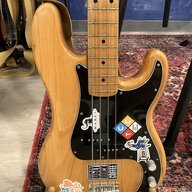
"Hey, I use a 1973 Fender Precision bass. Used it on Forget Me Nots. Mine does have a Badass bridge."

IMG_3281.jpeg
 
Unpopular opinion, but I suspect the talk about "mojo" of vintage basses is just people convincing themselves they didn't just burn a ton of money.

If there is something like mojo, it may merely be the result of a bass just hitting my personal taste in terms of sound and handling. So a vintage bass is neither more nor less likely to have "it" than a decent modern one.
yes and no, no and yes