• TalkBass has been independent since 1998. Add your voice.
    Create a free account to reply to discussions, view embedded media, and browse with fewer display ads.
    Join freeLog in
    Want zero display ads or expanded classifieds tools? Compare plans.

NBD: Rickenbacker 4003S

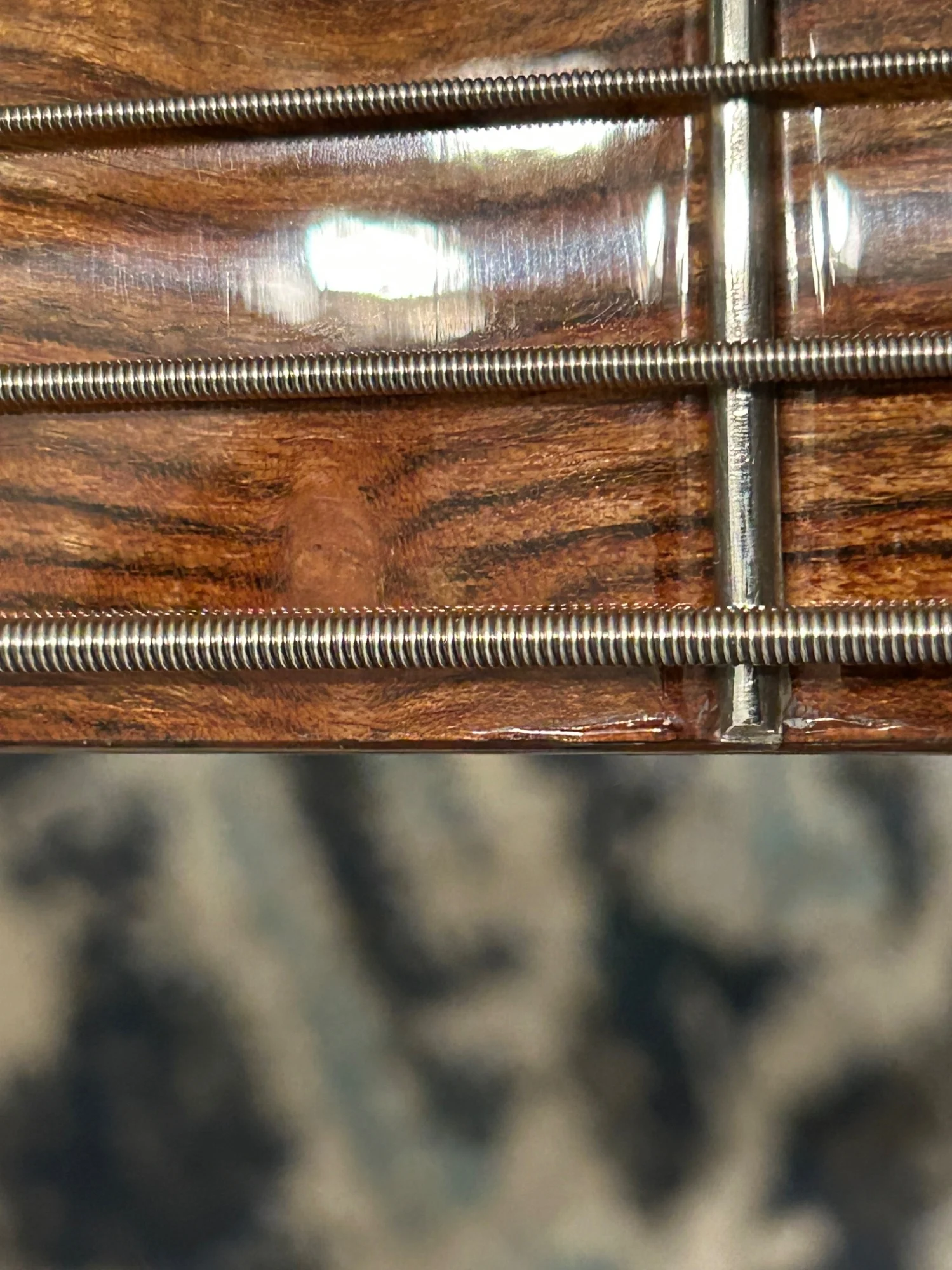
Are the frets really this poorly finished when seeing them in person? Or is it an exaggerated camera artifact? Looks like someone forgot to polish them. The goopy finish on the fretboard edge...I guess you'd have to not be too surprised at that from Ric. Regardless, that kinda stuff (plus whatever else might be wrong with the bass) makes it seem almost crazy that people would pay $2000+ for one like that. It reflects poorly on both Rickenbacker and Sweetwater.

That said, if I had to have a new Ric I'd for sure get it from Willcutt Guitars in KY, even if it cost a couple hundred more than from the big box joints.

1768696621028.png
 
  • Like
Reactions: woodyng2
That last photo is a good illustration of the downsides of a heavily laquered board. Notice how Ric just files the fret tops flat, which they have to do because doing a traditional domed fret crown would bite into the laquer that's ramping up onto the fret. In theory that spreads the intonation out into a kind of "schmear" across the fret tops, with different frets having ever so slightly different points of contact with the string. In practice you'd need a Peterson Strobe tuner to find the differences, but it does make the fret wear from rounds more obvious, and in this case pretty much 100% confirms this is a used or "open box" bass that's been played long enough to accumulate a bit of fret wear.
 
That last photo is a good illustration of the downsides of a heavily laquered board. Notice how Ric just files the fret tops flat, which they have to do because doing a traditional domed fret crown would bite into the laquer that's ramping up onto the fret. In theory that spreads the intonation out into a kind of "schmear" across the fret tops, with different frets having ever so slightly different points of contact with the string. In practice you'd need a Peterson Strobe tuner to find the differences, but it does make the fret wear from rounds more obvious, and in this case pretty much 100% confirms this is a used or "open box" bass that's been played long enough to accumulate a bit of fret wear.
I think those pics are so close and in such detail that they might be a bit misleading. It's like when super high-def came out and we got to see what our favorite actors and newscasters really looked like IRL. Some things are just not meant to be examined in such extreme close-ups.

Regarding the lacquer doming, if memory serves me, my '72 4001 had domed lacquer between the frets. It was one of the things that gave the board it distinctive look, especially set off the shark's tooth inlays. Had absolutely no effect on sound or playability, since the frets on the Rick are pretty humongous compared to the other basses I've owned. Of course, somebody is probably going to argue with this, that at 71, memory doesn't serve me anymore? I only get served at the counter at Norm's?
 
My 78 4001 had the laquered board and flat fret tops, in those days they were shipping them with flats, and I got the obligatory lecture about rounds voiding the warranty. Like everyone else, I put Rotosound Swing 66 stainless rounds on mine, which ATE the soft fretwire they were using. Rounds wear on normally crowned frets too, it's just harder to see on the hairline apex of the domed fret. I must be a freak, I look at my basses that close all the time while building them, though these days i need my Techno-Specs to do it.
 
Rickenbacker released an updated bridge in 2020, I believe. It has individually adjustable saddles and rollers that go side to side, in case you want to adjust string spacing. It also has a couple more screws (or maybe just repositioned screws) to correct the problem a lot of people had on the older bridges where the tail would lift up under tension. For some reason, they didn't get rid of the horrible built in mute, or at least make it less terrible to use.
My 2002 4003 has no tail lift to speak of. I think something good was happening at the factory then. It seems so much different than the 2015 4003s i have. Also, the upper horn isnt too skinny for me, i think it looks cool.
 

Attachments

  • IMG_20250329_094010.jpg
    IMG_20250329_094010.jpg
    500.2 KB · Views: 10
My 2002 4003 has no tail lift to speak of. I think something good was happening at the factory then. It seems so much different than the 2015 4003s i have. Also, the upper horn isnt too skinny for me, i think it looks cool.
That looks identical to my '72 4001, same color, same finish. Bridge might be a little different, I don't have pics and cannot really remember. I thought 4003s didn't have binding? Anyway, beautiful.

I've seen Mike Huckabee play one exactly like that. He's actually a pretty good player.
 
That looks identical to my '72 4001, same color, same finish. Bridge might be a little different, I don't have pics and cannot really remember. I thought 4003s didn't have binding? Anyway, beautiful.

I've seen Mike Huckabee play one exactly like that. He's actually a pretty good player.
Thats my COY Burgundy 4003 (2002) Thanks
 
Last edited:
Surprised to see that lacquer mess!

But I just popped in to say '"The S is THE BEST" 🌞

I have lost count of how many times I have bought the BOUND 4001/4003 only to sell them the next week after remembering how much that binding annoys my wrist... seems I fall for that about every seven years or so...
 
  • Like
Reactions: Wyrdlow
I'm not bothered by binding the way a lot of bassists are, and I realized it's because I hold my wrist fairly straight when I play instead of curling it up, so my forearm almost never rests against the edge anyway. It hurts me to play with my arm like this:
curled.jpg


I look more like this when I play, except I don't use my thumb:
straight.jpg
 
That one's been played a bit, evidently. It's no biggie though - just a natural side-effect of clothes vs finish. Just get some WE Hill & Sons conservation wax for the body scuffs and you'll be all good for a bit. Unlike other polishes, you won't need to worry about it reacting; it's designed for antique violin varnishes, which are incredibly finicky.

Also, it's hard to tell on the frets, given how zoomed in you are - the in-camera sharpening and noise reduction "kludge" is not helpful. Does it play in tune? If so, all good.
 
  • Like
Reactions: Rezdog