• TalkBass has been independent since 1998. Add your voice.
    Create a free account to reply to discussions, view embedded media, and browse with fewer display ads.
    Join freeLog in
    Want zero display ads or expanded classifieds tools? Compare plans.

NBD - Squier CV Bass VI

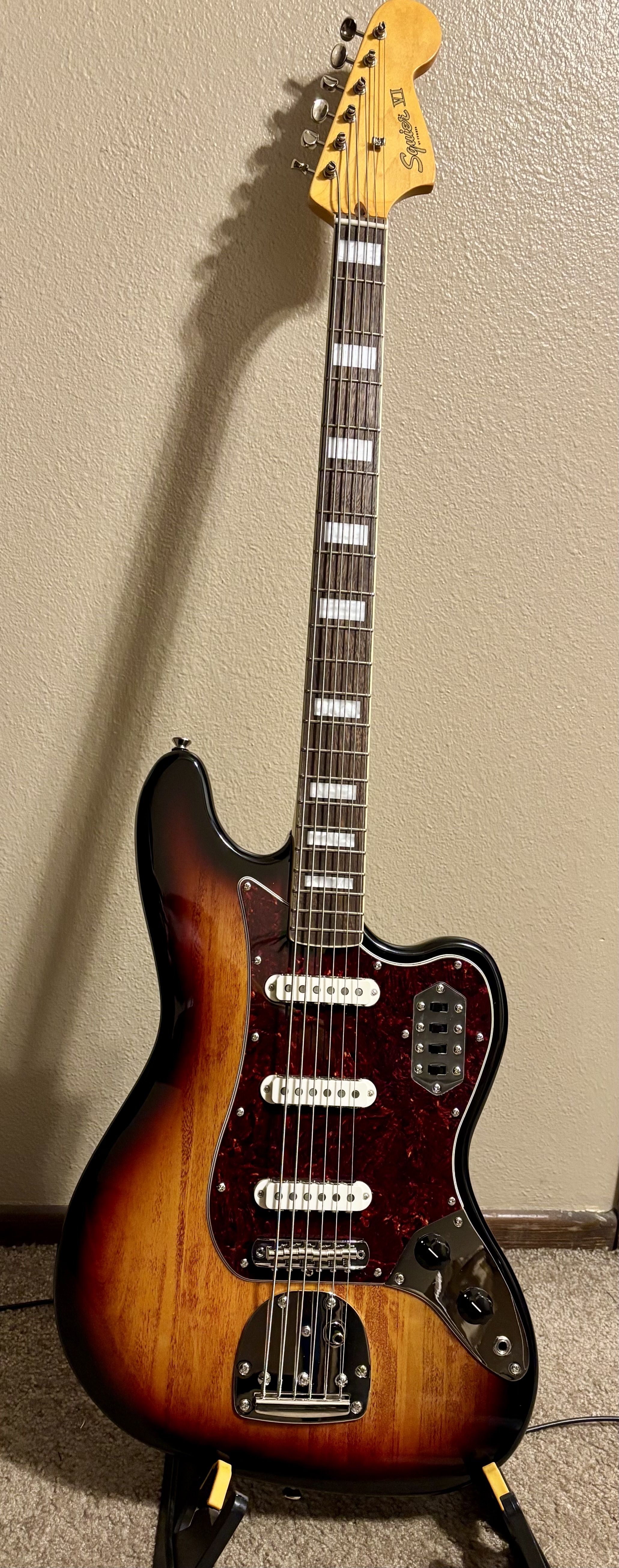
I walked into my local music shop with a problem. Granted, it was a good problem to have. I'm an elementary school teacher, and the adults of my students chipped in before winter break to get me a generous gift card for said music shop. My problem - I don't need anything! I've got all the gear I need, and have actually sold off some instruments recently. I looked around the store, there were lots of cool pedals and used guitars and basses. I had considered upgrading my rig; I have a Fender Rumble 100, and while it doesn't have an incredible sound, it suits my needs. The only nicer amps they had were considerably bulkier and heavier, so I started looking at their new basses. I have always been curious about a Bass VI, but never felt the NEED for one. I've also read reviews of the Squier models saying that they needed upgrades to play and sound their best. They had a new Squier Classic Vibe Bass VI on the wall, classic sunburst finish. Serial number shows it was made in 2024. I pulled it off the wall and played it unplugged. It's a bit heavy, but plays very nice. I plugged it into a bass amp and really enjoyed messing with the different pickup configurations and tonal options. I imagined playing it through my EHX HOG2 Harmonic Octave Generator and said what the heck, I've gotta buy something! After the $400 gift card, I walked out the door with it for 80 bucks. Looking forward to making some noise and having some fun!

It's a pretty standard looking axe, and I'm no Ansel Adams, but like they say - no pics, no bass!

Let me know if there are settings or uses you've found for your Bass VI.
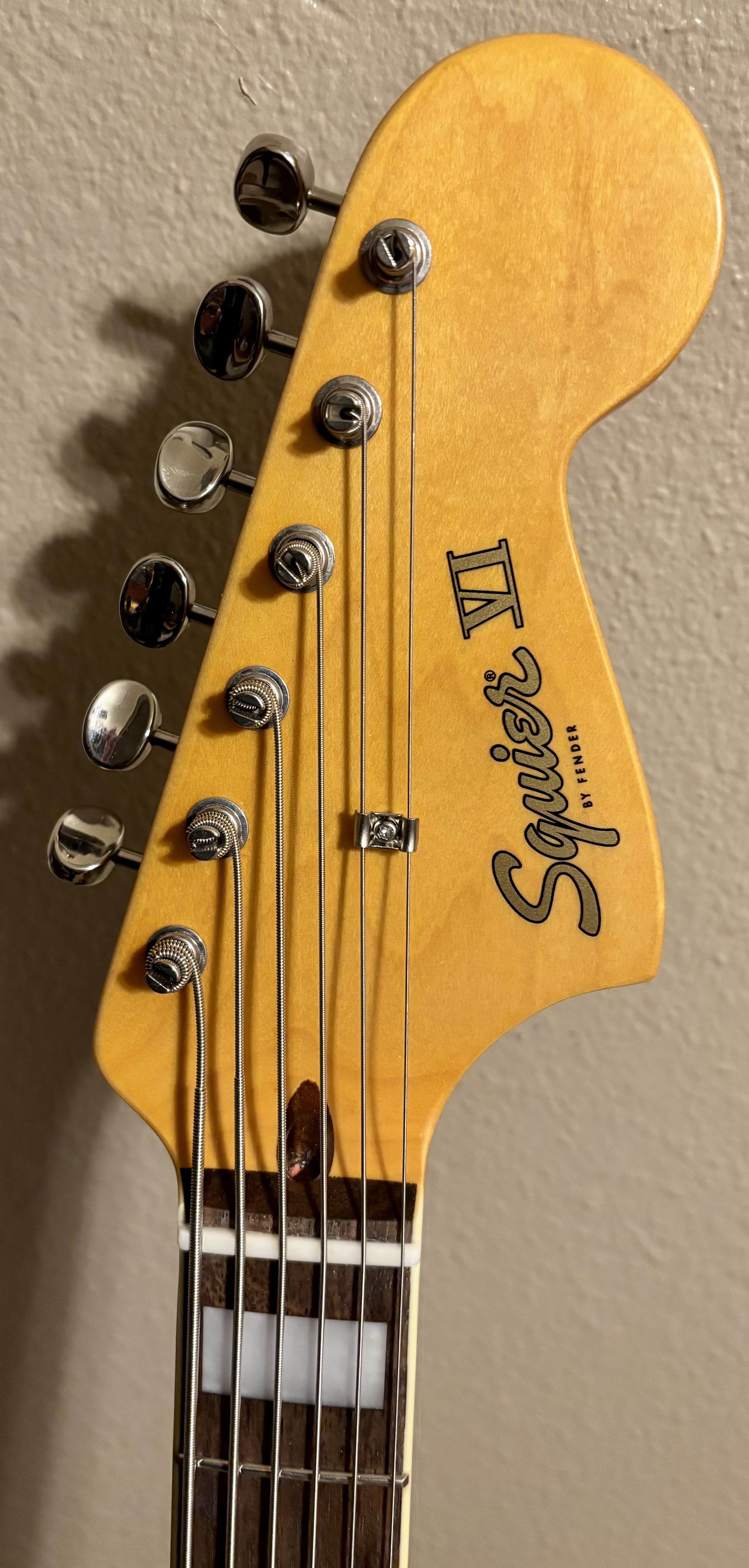
IMG_2681.jpg
IMG_2682.jpg
IMG_2683.jpg
 
Congrats.

A Squier VI is one of my main basses. I gig it all the time.

I'm very picky about quality, and very knowledgable and experienced with repairs and modding. I also have a huge collection of basses, a vast majority of which are high quality "vintage" instruments.

The reason I stress the above is not to brag, but to give emphasis to the following statement: I play my Squier VI bone stock.

It's a high enough quality bass that once I gave it a proper setup, I didn't feel it needed anything else...at least not until it breaks...and so far, nothing has broken.

I think people who feel they should be modded are just people who are generally mod-happy anyhow. My example is an excellent instrument, that, in the real world of playing gigs, holds its own just fine alongside basses almost 10X as expensive.

The main key to a proper setup is a high bridge. This makes your action high so the notes sound clearly (as the VI has essentially a slack-key feel), and increases the string tension over the saddles, making the bridge behave well most of the time.

As for uses...anything a 4-string bass can do, and so much more. It has more pickups, a vibrato, and a bass cut switch. It gives you a vast tonal range, using nothing but onboard switches and knobs. But it does regular electric bass stuff just fine.

I mostly use mine for standard bass playing, but the extra features of the six allow me to occasionally incorporate different parts and techniques than I'd use on a 4-string, such as power chords or bar chords using guitar fingerings, ultra-twangy sounds, a very high range for a bass, or mild vibrato.

As for what the instrument "is" – which is a common question – don't overcomplicate it. It's fundamentally just a sub-octave guitar. Guitar string spacing. Tuned to guitar intervals. Just one octave down.
 
Last edited:
I have the exact same model, and I like it a lot, and I’m trying to find cool places to use it. Obviously it’s cool for recording, and I enjoy using more as a low guitar (playing higher string chords and little lead parts and riffs). It’s a riff machine for sure.

The E string is a bit floppy and weirdly intonated stock, but I’ve heard that there is a different set of Fender brand strings that go a long way in helping that.
 
  • Like
Reactions: tallulahsdaddy
Congrats.

A Squier VI is one of my main basses. I gig it all the time.

I'm very picky about quality, and very knowledgable and experienced with repairs and modding. I also have a huge collection of basses, a vast majority of which are high quality "vintage" instruments.

The reason I stress the above is not to brag, but to give emphasis to the following statement: I play my Squier VI bone stock.

It's a high enough quality bass that once I gave it a proper setup, I didn't feel it needed anything else...at least not until it breaks...and so far, nothing has broken.

I think people who feel they should be modded are just people who are generally mod-happy anyhow. My example is an excellent instrument, that, in the real world of playing gigs, holds its own just fine alongside basses almost 10X as expensive.

The main key to a proper setup is a high bridge. This makes your action high so the notes sound clearly (as the VI has essentially a slack-key feel), and increases the string tension over the saddles, making the bridge behave well most of the time.

As for uses...anything a 4-string bass can do, and so much more. It has more pickups, a vibrato, and a bass cut switch. It gives you a vast tonal range, using nothing but onboard switches and knobs. But it does regular electric bass stuff just fine.

I mostly use mine for standard bass playing, but the extra features of the six allow me to occasionally incorporate different parts and techniques than I'd use on a 4-string, such as power chords or bar chords using guitar fingerings, ultra-twangy sounds, a very high range for a bass, or mild vibrato.

As for what the instrument "is" – which is a common question – don't overcomplicate it. It's fundamentally just a sub-octave guitar. Guitar string spacing. Tuned to guitar intervals. Just one octave down.
Really great info, I appreciate it!
 
I have the exact same model, and I like it a lot, and I’m trying to find cool places to use it. Obviously it’s cool for recording, and I enjoy using more as a low guitar (playing higher string chords and little lead parts and riffs). It’s a riff machine for sure.

The E string is a bit floppy and weirdly intonated stock, but I’ve heard that there is a different set of Fender brand strings that go a long way in helping that.
Good to know, thanks!
 
I have one also. The string spacing was a little difficult to get used to, and I play it with a pick. I've also discovered it sounds better coming out of a bass cab, but others may differ on that. Fun instrument!
 
  • Like
Reactions: tallulahsdaddy
I walked into my local music shop with a problem. Granted, it was a good problem to have. I'm an elementary school teacher, and the adults of my students chipped in before winter break to get me a generous gift card for said music shop. My problem - I don't need anything! I've got all the gear I need, and have actually sold off some instruments recently. I looked around the store, there were lots of cool pedals and used guitars and basses. I had considered upgrading my rig; I have a Fender Rumble 100, and while it doesn't have an incredible sound, it suits my needs. The only nicer amps they had were considerably bulkier and heavier, so I started looking at their new basses. I have always been curious about a Bass VI, but never felt the NEED for one. I've also read reviews of the Squier models saying that they needed upgrades to play and sound their best. They had a new Squier Classic Vibe Bass VI on the wall, classic sunburst finish. Serial number shows it was made in 2024. I pulled it off the wall and played it unplugged. It's a bit heavy, but plays very nice. I plugged it into a bass amp and really enjoyed messing with the different pickup configurations and tonal options. I imagined playing it through my EHX HOG2 Harmonic Octave Generator and said what the heck, I've gotta buy something! After the $400 gift card, I walked out the door with it for 80 bucks. Looking forward to making some noise and having some fun!

It's a pretty standard looking axe, and I'm no Ansel Adams, but like they say - no pics, no bass!

Let me know if there are settings or uses you've found for your Bass VI.
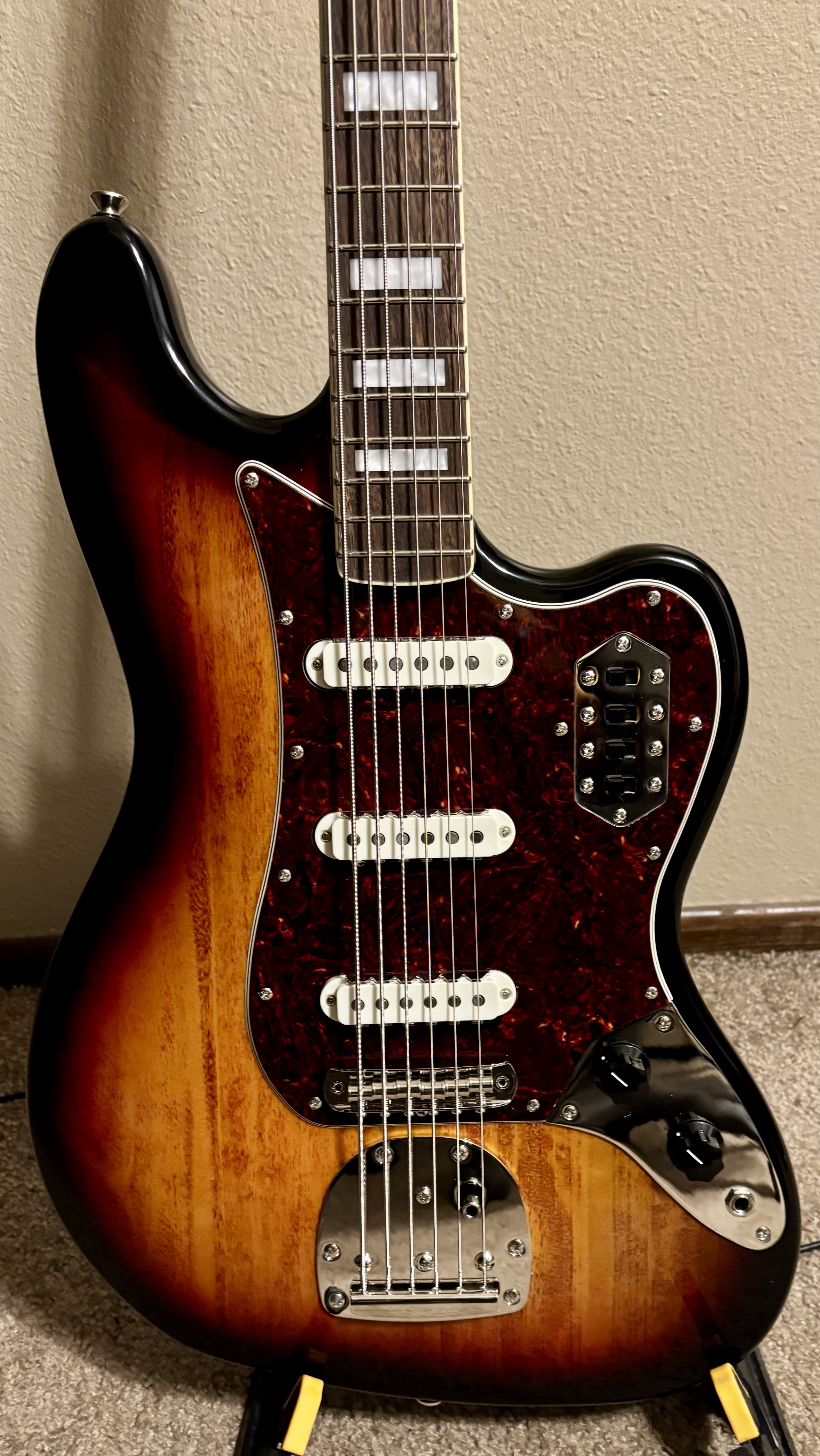
View attachment 7122092View attachment 7122093View attachment 7122094
Cool! Set your witness points (esp. the 4 lowest strings at the headstock). Get a locking tremolo (drop-in replacement). Your ears will thank you.

BBB
 
  • Like
Reactions: tallulahsdaddy
Cool! Set your witness points (esp. the 4 lowest strings at the headstock). Get a locking tremolo (drop-in replacement). Your ears will thank you.

BBB
The "locking" vibrato is greatly misunderstood.

It is designed to allow you to quickly return the remaining strings to proper tune in the event of a string break.

This has the side effect of making the vibrato "dive only." But this is not what it was designed to do.

It does not improve anything about the vibrato's behavior, because the vibrato does not behave badly in the first place...if it is set up and used as intended.

All problems with Jazzmaster-style instruments are caused by two things: 1) Insufficient tension on the saddles, and 2) string contact with the hardware (rear of bridge plate, and screws on vibrato). There are several reasons why these cause problems, but I'll assume they're obvious enough to skip covering.

Both of these problems are solved with a proper setup. You don't need to buy replacement parts.

Setting the bridge high and/or using heavier tension strings handles the issues with 1. But because of issue 2, you can only go so high before the strings contact the rear of the bridge plate.

The first step is to set the bridge as high as it will go without string contact with the bridge plate. Then you shim to achieve the desired action. Finally, if contact with the vibrato screw/s remain, you can remove any one of the two offending screws (but not both, as the vibrato needs 2 our of 3 of the screws to be in place). You can also file one down, or use a lower profile screw. That said, I've always been able to avoid this contact simply by raising the bridge.

In some cases, you may need to file slight notches in to the rear lip of the bridge plate, to clear the strings.

The aftermarket vibrato and bridge market for Jazzmaster style is unnecessary. Stock Squier hardware will perform excellently, if you just know how to set it up.
 
  • Like
Reactions: tallulahsdaddy
The "locking" vibrato is greatly misunderstood.

It is designed to allow you to quickly return the remaining strings to proper tune in the event of a string break.

This has the side effect of making the vibrato "dive only." But this is not what it was designed to do.

It does not improve anything about the vibrato's behavior, because the vibrato does not behave badly in the first place...if it is set up and used as intended.

All problems with Jazzmaster-style instruments are caused by two things: 1) Insufficient tension on the saddles, and 2) string contact with the hardware (rear of bridge plate, and screws on vibrato). There are several reasons why these cause problems, but I'll assume they're obvious enough to skip covering.

Both of these problems are solved with a proper setup. You don't need to buy replacement parts.

Setting the bridge high and/or using heavier tension strings handles the issues with 1. But because of issue 2, you can only go so high before the strings contact the rear of the bridge plate.

The first step is to set the bridge as high as it will go without string contact with the bridge plate. Then you shim to achieve the desired action. Finally, if contact with the vibrato screw/s remain, you can remove any one of the two offending screws (but not both, as the vibrato needs 2 our of 3 of the screws to be in place). You can also file one down, or use a lower profile screw. That said, I've always been able to avoid this contact simply by raising the bridge.

In some cases, you may need to file slight notches in to the rear lip of the bridge plate, to clear the strings.

The aftermarket vibrato and bridge market for Jazzmaster style is unnecessary. Stock Squier hardware will perform excellently, if you just know how to set it up.
I agree. I've owned (and set up) 3 Bass VIs. I found the locking feature quite convenient, though, especially when playing single note basslines. I must say that this vibrato always gave me better performance (staying in tune) than any Strat whammy bar.

BBB
 
  • Like
Reactions: tallulahsdaddy