I picked this up in a trade with a fellow TBer. The G&L family sure is growing 'round here!
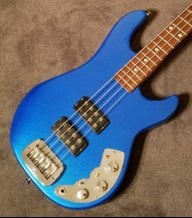
It's a 1981 L2000 Series E. It's a high quality refin. The color is pretty close to Lake Placid Blue, just a touch darker. I'd say it's somewhere between LPB and G&L's Midnight Blue Metallic, but definitely closer to LPB. At any rate it's beautiful in person. The neck is nicely yellowed after 36 years of low end bolsterhood, and it has some nice checking in the finish on the front of the headstock and the back of the neck.
It arrived Friday afternoon. A quick setup, and I was off to a gig with my new-to-me bass in hand. I brought along an '83 SB-2 as my backup/drop-tune bass, but, man, it was hard to put this one down.
Today I adjusted everything to my exact liking, with new strings, a fresh tweak of the truss rod, saddle height, intonation, pickup height, and pole pieces. It plays like half melted butter and sounds like thunder.
Of course, I adjusted the slotted poles so that they all face the same way. The bass sounds MUCH clearer with the slots in a horizontal orientation. (No it doesn't. It sounds exactly the same regardless of slot orientation.)
I put it next to my '82 L2000 E and, unsurprisingly, they sound pretty darn similar. Pics!


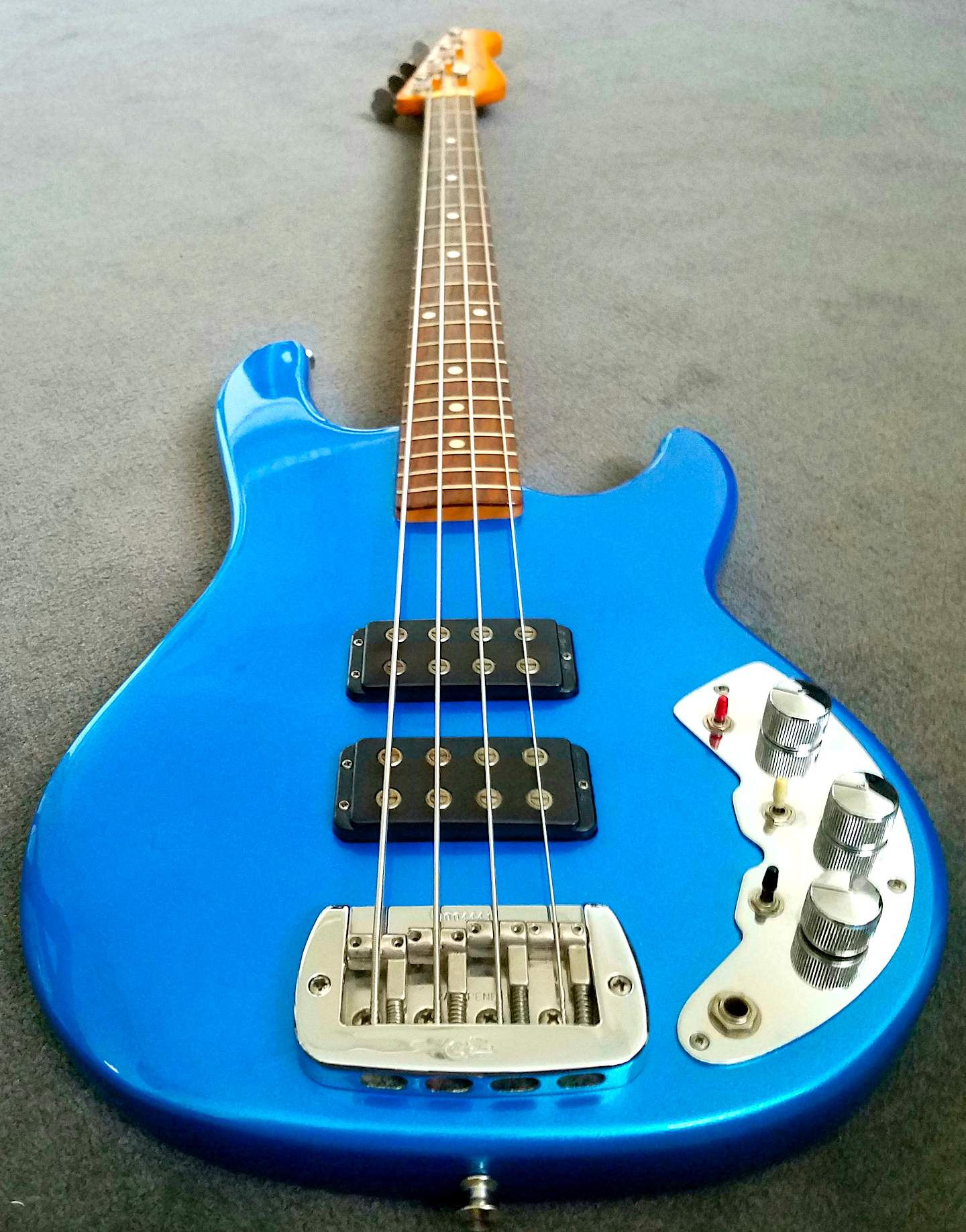
It's a 1981 L2000 Series E. It's a high quality refin. The color is pretty close to Lake Placid Blue, just a touch darker. I'd say it's somewhere between LPB and G&L's Midnight Blue Metallic, but definitely closer to LPB. At any rate it's beautiful in person. The neck is nicely yellowed after 36 years of low end bolsterhood, and it has some nice checking in the finish on the front of the headstock and the back of the neck.
It arrived Friday afternoon. A quick setup, and I was off to a gig with my new-to-me bass in hand. I brought along an '83 SB-2 as my backup/drop-tune bass, but, man, it was hard to put this one down.
Today I adjusted everything to my exact liking, with new strings, a fresh tweak of the truss rod, saddle height, intonation, pickup height, and pole pieces. It plays like half melted butter and sounds like thunder.
Of course, I adjusted the slotted poles so that they all face the same way. The bass sounds MUCH clearer with the slots in a horizontal orientation.
(No it doesn't. It sounds exactly the same regardless of slot orientation.)I put it next to my '82 L2000 E and, unsurprisingly, they sound pretty darn similar. Pics!



 But then, El Toro...