• TalkBass has been independent since 1998. Add your voice.
    Create a free account to reply to discussions, view embedded media, and browse with fewer display ads.
    Join freeLog in
    Want zero display ads or expanded classifieds tools? Compare plans.

Neck finish?

Hi, noobie here..
I just bought an Ibanez SR300E and I have to say I'm blown away by how much guitar I got for how little money! I haven't been able to put it down.. Anyway, my question to those in the know; how is the neck and fretboard finished? I love it, and I'm soon gonna get my vintage Strat refretted and refinished (it's currently laquered, & sticky..) I'd like my luthier to finish it more like this bass, which seems barely to have any finish atall, but it's super smooth & fast.. Is it oiled? Or just a micro thin matt finish of some kind? (My Strat is a maple neck, & I've read elsewhere that oiling isn't such a great idea with harder wood like maple, because it won't soak in so well?) Thank you for your patience!
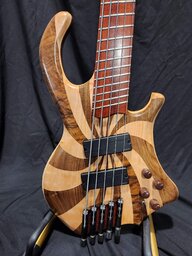
 
I am not familiar with the finish on that instrument, but my go to finish for the back of necks is Tru Oil, which ends up with a hard, glossy finish. Once it's dry I knock the shine down with 600 grit sandpaper then put wax on it. The result is a hard, fast finish that never gets sticky.

Generally speaking fretboards have some kind of hardened finish on them. Non-oily woods (like maple) are usually coated in a finish similar to what's on the body. In the past I have just put lemon oil on oily woods like rosewood, but I have learned here (and elsewhere) that the pros put an oil coating on that hardens, it's a light coating though and not shiny at all.

I don't know if any of that helps.
 
I am not familiar with the finish on that instrument, but my go to finish for the back of necks is Tru Oil, which ends up with a hard, glossy finish. Once it's dry I knock the shine down with 600 grit sandpaper then put wax on it. The result is a hard, fast finish that never gets sticky.

Generally speaking fretboards have some kind of hardened finish on them. Non-oily woods (like maple) are usually coated in a finish similar to what's on the body. In the past I have just put lemon oil on oily woods like rosewood, but I have learned here (and elsewhere) that the pros put an oil coating on that hardens, it's a light coating though and not shiny at all.

I don't know if any of that helps.
Thanks Jisch. Yeah the laquer on the fretboard is crazed now.. which kinda doesn't look out of place on a '72 Strat, but I thought next refret I'll just get it refinished while I'm at it. Either way I want the back of the neck done, so I'll pass on yr thoughts to my guy when it goes in to be done.. Cheers!
 
My Jazz bass's neck has a satin polyurethane finish on the back and it is nothing but smooth. I love it because I don't like glossy finishes on the necks of my basses.
 
You could leave the fingerboard unfinished, ive ben using the Stewmac Fingerboard Oil, which is like a thinner version of Tru Oil. It dries really fast and can be buffed ups to a satin sheen. Its Penetrating oil, so it seals the pores and keeps crud out. Straight Tru Oil is great on the neck backs. Those SR basses are awesome, really fast neck, well balanced, ergonomic, etc.
 
You could leave the fingerboard unfinished, ive ben using the Stewmac Fingerboard Oil, which is like a thinner version of Tru Oil. It dries really fast and can be buffed ups to a satin sheen. Its Penetrating oil, so it seals the pores and keeps crud out. Straight Tru Oil is great on the neck backs. Those SR basses are awesome, really fast neck, well balanced, ergonomic, etc.
Thanks gilmourisgod! I wanted an 'unfinished' look; between the crazed lawyer on the fingerboard and the sticky gloss finish on the back, I wanna totally go the other way, so I'll take your advice.
Just been watching some Bobby Vega on YouTube.. Wow! I'm primarily a guitarist, so it's heartening to see such an amazing and funky bass player using a pick, which is a lot more familiar technique to me than the 'walking fingers'.. Anyway, thanks for the tip! ; )
 
  • Like
Reactions: Gilmourisgod
Just for reference, your Ibanez is almost certainly finished in IR curing polyester. Almost all modern mass-produced instruments are done in IR polyester because it's really fast, least labor. It's a tough hard finish, which can be left high gloss or scrubbed to a satin sheen. But, doing an IR Polyester finish at home is advanced-level stuff.

If you are having your Strat refinished by a pro, let them recommend what they are comfortable with. If it was originally done in nitro lacquer, then redoing it in nitro lacquer would be the most authentic. He could put it on thin and scrub it satin, if that's what you want. But nitro lacquer is expensive (in labor) and takes a long time, and it's kind of fragile. Not real durable or able to withstand weather.

Most likely, he'll recommend refinishing it in a modern polyurethane. Faster, less expensive (in labor) and very tough and durable. It can also be buffed up to high gloss, or scrubbed to satin, whichever you prefer. It can be put on thick or thin.

If you want to refinish it yourself, and just want a simple ambered wood look, then Tru-Oil is a reasonable choice. It's not the toughest finish around, but it's really simple to apply with a rag and build up to the thickness you want. It's also very easy to touch up and repair. It also can be brought up to a gloss, or scrubbed to a satin sheen.

As you can see, there are many choices, and most of them can get you there. A thin, satin finish is more about how you do the finish, than which finish chemistry you choose. The term Oil Finish is commonly used to describe any finish that's put on thin and scrubbed satin.
 
Thanks a lot guys! The option of just taking the gloss finish off the current high gloss (& sticky) finish with super fine wet & dry never occurred to me.. I assumed to take all the old finish off & start again. But I'll suggest just smoothing off the existing laquer. If it doesn't suit, we can still go the whole hog. I kinda wondered about factory finishes not being so achievable in a workshop too, so that answers that one.. Thanks for all the input! :bassist: