"Lose the dovetail. Under string torque it acts as a splitter." -- Arnold Schnitzer, in your other thread.

TalkBass has been independent since 1998. Add your voice.
Create a free account to reply to discussions, view embedded media, and browse with fewer display ads.
Join free Log in
Want zero display ads or expanded classifieds tools? Compare plans.


2. The sides of the mortise and tenon are nearly parallel.
You guys should all thank kungfu for the link. I had heard about it for years and been searching under Mr Rogers visits the Kay factory; Mr Rogers Engelhardt factory popped right up on google with my first try yesterday!
Vintage Harold Jaeger c. mid 1920s mortice and tennon neck joint still holding incredible after 90+ years on left. Factory original Kay dovetail and block on right, c. 1947; broken block, 3/16" gap and no glue from factory on endgrain....'nuff sed....
With all that has been said- and generally agreed upon about old Kay neck joints, I'd still like to make one clear point: rebuilt properly, the old Kays still represent an great bass for the working musician. There is an awful lot of Kaybashing around here among a certain few elitists. You just have to be aware of what you are getting yourself into and make sure you find a luthier who knows how to pimp one out right. There are a LOT of gig nights where I'll leave my fancy fully carved bass, my cool vintage aluminum bass, and a rack full of customers basses in need of honest test drives sitting idle at home and don't even question when I reach for a hotrodded old Kay to take out and pound the daylights out of it in a club at loud volumes where the whole room is filled with ladies bumpin' and grindin' all night long to the iconic thumpity thump thump of an old Kay strung with guts pumping through my 1000 watt amp!
j.
www.condino.com
www.kaybassrepair.com


I have been reading all sorts of items. The best is glued to all sides if you can mange it.I know this is a very old thread...but I'm hoping someone will answer anyway. Is the neck block glued to the back of the bass? To the the top?
I'm adding a neck block to an ancient Chezch bass where there wasn't on before, so that's reason for the superodd question. So...does the block get attached to the back and top with hide glue or just attached to the shoulders? Seems prone to buzzing if not attached to the back and top. Though James Condino's pic shows no residue to the back of the block...
thank you everyone for understanding my dilemma...and pardoning if this is a stupid question.
You are welcome. I assume the back and sides are maple and top is spruce but you really never know.Considering that it ancient ,what type wood was the bass made of? It really sounds interesting.thanks...
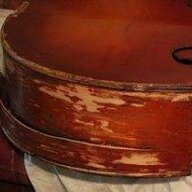
I know how you feel. I am trying to make a neck block myself. I bought a Compound saw sliding 12". It frustrating. The bass in my photo that I a trying to restore was attacked by something or someone. HA!!Pretty sure spruce on top. It's an 1870-80 student bass...that's it in my sig. I mounted a neck block where there wasnt one but it failed. I go to buy another bass tomorrow...then I'll have free time to repair this again slowly. Though pretty disheartened. Ugh.
Invalid Link RemovedPretty sure spruce on top. It's an 1870-80 student bass...that's it in my sig. I mounted a neck block where there wasnt one but it failed. I go to buy another bass tomorrow...then I'll have free time to repair this again slowly. Though pretty disheartened. Ugh.
I am still trying too. I think it takes a long time to learn. But there many places online where people show you how . Some sell them for $60 some for $300.But they might not fit.I saw those amazing photos of yours...I never would have attempted had I not seen them. Thank you so much for posting. I made a configured "block" as you did for the top. Clamp went underneath. It failed, but WHEN I can face it, I will double down on my efforts. I got so close...
I saw those amazing photos of yours...I never would have attempted had I not seen them. Thank you so much for posting. I made a configured "block" as you did for the top. Clamp went underneath. It failed, but WHEN I can face it, I will double down on my efforts. I got so close...