• TalkBass has been independent since 1998. Add your voice.
    Create a free account to reply to discussions, view embedded media, and browse with fewer display ads.
    Join freeLog in
    Want zero display ads or expanded classifieds tools? Compare plans.

Neck lamination separation. What to do?

Ricky Caboverde

Supporting Member
Feb 26, 2004
2,753
2,700
Miami, FL
www.youtube.com
Hey all,
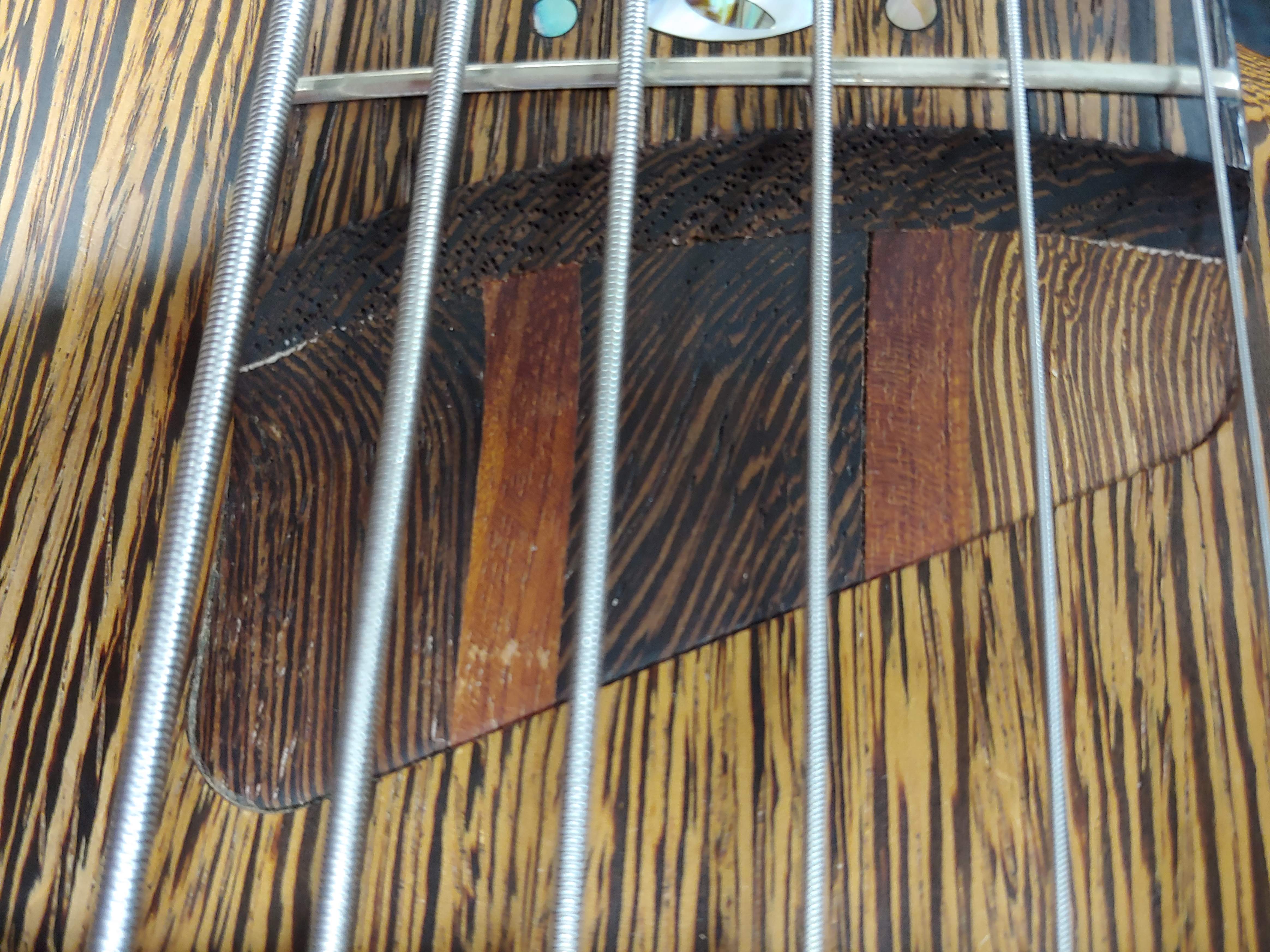
I recently purchased an Ibanez bass with an Atlas neck (wenge/bubinga/wenge*bubinga/wenge) from someone in California; and I just noticed that there is slight separation (*) between one of the laminates. It is only visible from the front not extending much further from where the neck meets the fretboard. Is this simple to remedy, i.e. by re-humidfying? If so, I live in Miami and would imagine that a year in this climate might be enough. Or do you suspect this would require a more direct approach requiring the intervention of some local luthier?
20180905_114652.jpg
 
What does the front edge of the heel look like? And the bottom of the heel? You'll have to take it apart to inspect it (if you haven't already). Off the top of my head, looks like something you could wick some thin CA glue into and then clamp it up. Depends on what it looks like from front edge and bottom... :)
 
  • Like
Reactions: Ricky Caboverde
Thanks so much for chiming in, guys! I haven't taken it apart as I preferred to leave well enough alone. I didn't see separation on the back of the neck past the heel so I figured it wasn't spreading (not to mention the bolts and tight neck pocket). But I'll take it apart tomorrow if y'all think it important enough. Here's a look at the back of the neck (about 2 inches from where the fretboard begins):

20180905_190546.jpg
 
That's basic wood shrinkage. Over the time since it was built the bubinga and/or the wenge strips have continued drying out and shrinking in side-to-side width. The fingerboard is trying to keep the whole stack from getting narrower. That glue joint happened to be weaker than the others, so it opened up. With a silent sigh.

Not really much to worry about, unless the delamination continues forward beyond the neck joint. You aren't going to be able to clamp it back together. The wood strips have gotten narrower, and they are going to stay narrower. And they are still glued along the top to the fingerboard.

But, it's a good idea to push some glue down in there. Titebond or similar woodworking glue. The reason for that is to seal up the inner surfaces of the crack against moisture. Humidity from the air or beer spray from the audience could soak in there, causing the wood to temporarily swell, prying the crack wider apart.

Put a drop of glue on the crack and push it down in with your thumb. Add a drop and push. See how much you can squeeze down in there. Wipe off the excess with a moist towel and let it dry. It would be better to do this with the neck off the body, but you don't have to. You're not going to glue the neck to the body doing this. It will still come apart.
 
I don't think you have a problem.

"Rehumidifying" will not fix that gap. Seems either glue failed or there wasn't enough to start with originally. The humidity may swell the area diminishing the gap.

I normally work in metal, and dabble with being a luthier. I always wonder about expansion rates in different species of woods. Heck even the same woods with grain spacing that is wildly different. Then again, wood that is sealed isn't likely to do much.

The thinned glue is a great idea but I'm not a fan of the super glues for a repair where some type of shear has happened.

Don't think you have anything but a cosmetic issue.

Very nice bass though.
 
  • Like
Reactions: Ricky Caboverde
What Bruce Said^^^^^ only caveat, I'd probably use the Titebond "Dark Wood" glue, dries to a brownish tone that would blend in well with the wenge.

Thanks so much for the help guys! This is what I was hoping to hear. This plays and feels so alive, I knew it didn't have integrity issues or anything of that nature. Sealing the crack sounds very wise, so I'll order some Titebond today.
 
This is one of the reasons I started using exclusively heat treated woods for the neck - they will look a lot darker, sound somewhat brighter, be easier to cut and they will not lead to issues like these that happen in (maybe) extremely dry environments.

Rest assured, though, this is just a cosmetic issue, slight humidity change in the woods has caused them to delaminate in parts. It can't go any further than that.
 
  • Like
Reactions: Ricky Caboverde
My only concern with wicking glue in there would be inadvertently gluing the neck into the pocket.

I wouldn't worry about that. It's only a tiny bit of glue. Even if a little bit seeped into the neck/body joint, it wouldn't stick very well to the oil-finished surfaces. But, it would be safer to take the neck off.
 
  • Like
Reactions: Ricky Caboverde
Considering that I will be pushing some Titebond II between wenge and bubinga, would it be at all helpful if I were to clean the neck and wet the crack with some naptha (and let dry)?

No need for it. There shouldn't be any oil finish down inside the crack. The finish was applied after it was glued up and before it cracked. Also, the reason for adding the glue is to seal up the crack, to keep moisture from getting down in there, swelling the wood, and making the crack worse. It's not really going to glue the crack back together. It's just a rubbery seal to fill the gap.
 
Would it be a bad idea to use "super glue" in a crack like that?

I wouldn't call it a bad idea, but it's not the best choice for this situation. Superglue (aka CA glue) is very thin. It will sink into the wood, creating a coating on the walls inside the crack. That's better than doing nothing, but I'd rather fill the gap with a rubbery glue like Titebond, to make a real sealing barrier.
 
  • Like
Reactions: rwkeating
What about the allmighty epoxy? That would be my choice.

Well, yeah, if it were here in my shop, I'd fill the crack with West Systems epoxy. That would be the the best repair, structurally and in sealing it up. But, most folks don't keep good marine epoxies at home.
 
  • Like
Reactions: rwkeating