• TalkBass has been independent since 1998. Add your voice.
    Create a free account to reply to discussions, view embedded media, and browse with fewer display ads.
    Join freeLog in
    Want zero display ads or expanded classifieds tools? Compare plans.

Double Bass Neck repair the wrong way

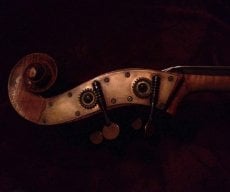
I bought a Menzel Chinese bass that had been sitting in a shop basement for over 10 years. The bridge, tailpiece, strings, and tuners were all missing but the body was pristine so I payed $300 for it. After refitting it, a very fine crack in the neck half way up the knee appeared. The last repair (to my 1966 Kay) was $1400.00 from a shop near Seattle for a new bridge and setup so a pro fix was OUT OF THE QUESTION! I removed the fingerboard but I'm not equipped to remove the top! What to do? All the info on line says DO NOT use metal screws. A woodworking buddy took a look and advised a GRK RSS lag screw. I did pre-drill a 6" hole from under the fingerboard side with a 3/16" by 12" bit and cranked in the 6 inch RSS screw which settled in nicely. Those screws are SPECIALLY DESIGNED TO DRAW TWO PIECES OF WOOD TOGETHER. Watch the manufacturers pitch on YouTube. The heel is now under compression top to bottom by a REINFORCING CASE HARDENED STEEL SCREW. NOTE: I would NOT have attempted this fix with a valuable bass. My only alternative was to take it to the dump..! Wish me luck...I'll report back in 6 months... Bass repair 016.JPG Bass repair 017.JPG Bass repair 018.JPG Bass repair 019.JPG Bass repair 020.JPG
 
This is one of those things like super glue; nobody wants to admit they have it, but everyone has some tucked under the counter. Shops that service a lot of schools will do this to keep an old instrument alive for a school on a low budget. Good work. I would have liked to have seen some glue worked into the crack first if possible.
 
What kind of adhesive did you use to glue the crack? I do a repair like that on a lot of school basses. It's cheaper than a new neck, and honestly very effective. I actually use 3 screws instead of one, and use a high performance epoxy.
 
This is one of those things like super glue; nobody wants to admit they have it, but everyone has some tucked under the counter. Shops that service a lot of schools will do this to keep an old instrument alive for a school on a low budget. Good work. I would have liked to have seen some glue worked into the crack first if possible.
Thanks for the replys John and Joey. My attempt to insert glue was a disaster. I cut a wedge to make the button area of the back parallel to the neck and glued a nonskid rubber to one side. I didn't want to try the clamp before applying glue because it would close up what little opening there was. I rubbed in hot hyde glue and tried to put on the clamp but my wedge effort just slid off the back. If I could do it over, I would try low viscosity glue and quickly tighten the RSS screw the last 3 inches. The fracture line is not flat. It's "hill and valley" so there should not be any lateral movement. I'll leave it alone and hope it is stable...
 
That's a lot of torque...the last one I did I pulled the butt end of the neck heel, hide glued them and let it set a few days before I reset the neck.

This was in August, and the repair failed. When I redid it, I ran a countersunk lag bolt laterally through the heel. As far as I know it's held.