• TalkBass has been independent since 1998. Add your voice.
    Create a free account to reply to discussions, view embedded media, and browse with fewer display ads.
    Join freeLog in
    Want zero display ads or expanded classifieds tools? Compare plans.

Neck Shimming Question

This may be a stupid question, but can you shim a neck at a forward angle to simulate falloff? I'm getting the high end fretting out on a P bass (14+) and I've already created some falloff in the frets but I don't want to shave them down to nothing in that pursuit (been there before).

I'm guessing at a certain point it would start acting like excessive forward bow, but would it be okay as long as it's not too much?

A picture of the bass in question because she's purdy:
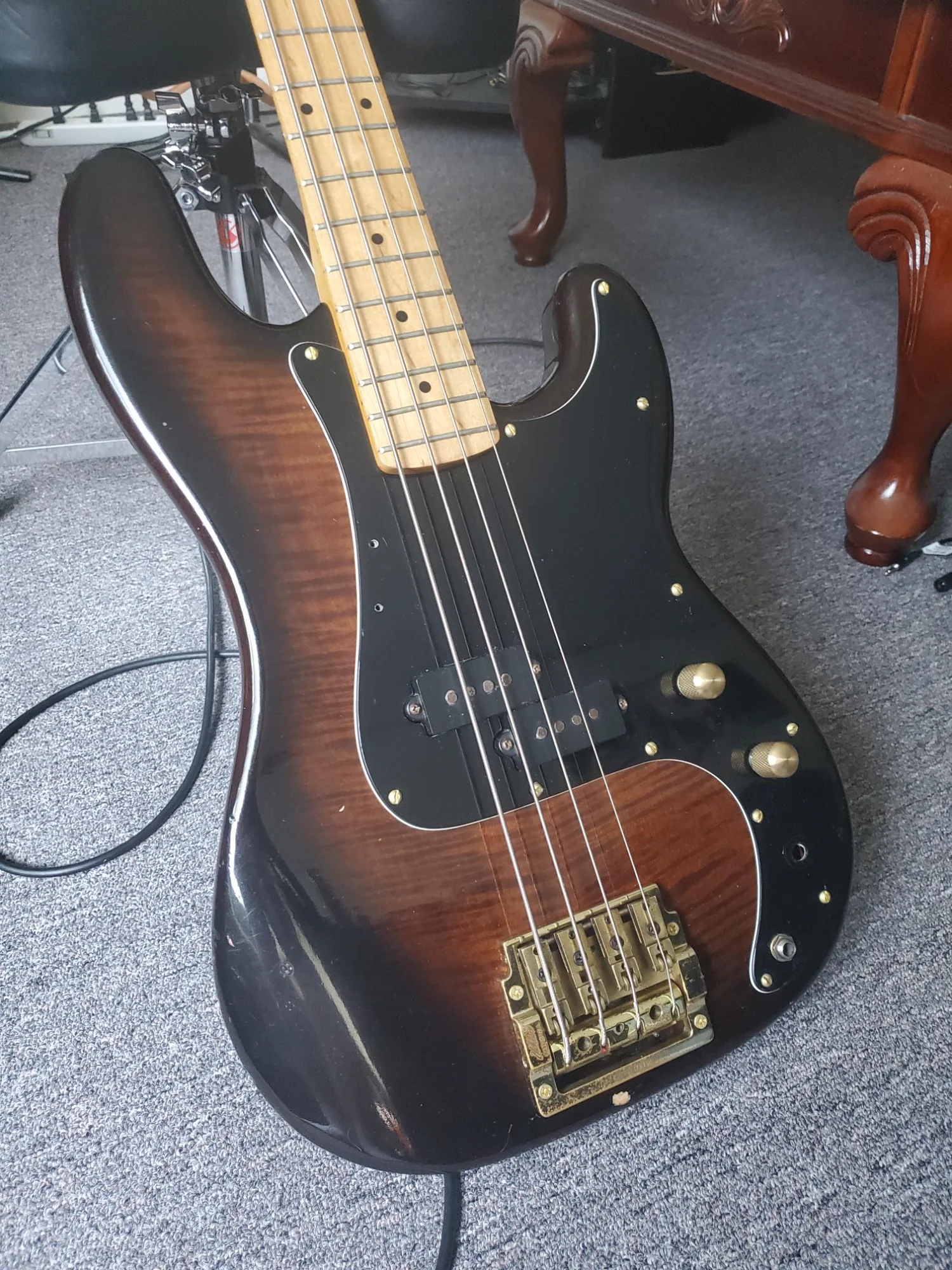
20260813_184900.webp
 
As I understand it - it wouldn't really do anything different than raising the bridge saddles, as far as angle of attack the strings are making.

Two reasons why I *would* go the shim route:
-- The saddles are getting close to maxed out
-- The pickup can't be raised any further, and so raising the bridge saddles put them at a less than optimal distance from the strings.

Just out of pure curiosity - is it drop-off you're going for on the high frets, or are we dealing with a ski-jump situation?

ETA: ALSO - Yes that sure is Purdy 😁
 
Last edited:
As I understand it - it wouldn't really do anything different than raising the bridge saddles, as far as angle of attack the strings are making.

Two reasons why I *would* go the shim route:
-- The saddles are getting close to maxed out
-- The pickup can't be raised any further, and so raising the bridge saddles put them at a less than optimal distance from the strings.

Just out of pure curiosity - is it drop-off you're going for on the high frets, or are we dealing with a ski-jump situation?

ETA: ALSO - Yes that sure is Purdy 😁

Yeah, I guess it would be the same once you get the action back to the same height because it wouldn't change the curve of the neck.

I guess it's a ski jump. The truss rod is maxed out and I've got about 2/64" of relief at the 8th fret. I have heard that too much relief can act like a ski jump, and tightening it did seem to help, but not solve it. I received the guitar with the TR maxed out, but maybe years of excessive forward bow before that curved the neck all the way to the highest frets? It does seem that the relief is across the whole neck, and doesn't end at the 12th.

I tried to get a picture (not easy!) but here was the best one.

It looks more dramatic here than to the naked eye but it does seem like a ski jump:

20260823_012253.webp


I guess since it's a bass and I won't be bending notes up high, it wouldn't really matter if I filed the high frets down to almost nothing.
 
Yeah, I guess it would be the same once you get the action back to the same height because it wouldn't change the curve of the neck.

I guess it's a ski jump. The truss rod is maxed out and I've got about 2/64" of relief at the 8th fret. I have heard that too much relief can act like a ski jump, and tightening it did seem to help, but not solve it. I received the guitar with the TR maxed out, but maybe years of excessive forward bow before that curved the neck all the way to the highest frets? It does seem that the relief is across the whole neck, and doesn't end at the 12th.

I tried to get a picture (not easy!) but here was the best one.

It looks more dramatic here than to the naked eye but it does seem like a ski jump:

View attachment 7563442

I guess since it's a bass and I won't be bending notes up high, it wouldn't really matter if I filed the high frets down to almost nothing.
Definitely looks like ski jump to me. I'd pop the neck off and send it to someone who can heat treat it to properly correct it - any other "fix" is going to be a band-aid at best. warpedneck.com appears to be down, at least at the moment. It was affiliated with skyguitars.com and their site is still up. They fixed the badly ski-jumped neck on my El Toro after it had been unplayable for decades.
 
How would that do anything about fretting out in the upper register? Shimming affects the angle of the entire neck, not just certain frets.

It would certainly make your bass play like garbage. Fretboard leaning away from your arm, saddles in the dirt...

I can tell from the way the Kahler is set up that your neck could actually benefit from being angled the OTHER way.

Hard to tell from your pic whether the whole neck has an even upbow across the length, or if it's just a ski ramp.
 
The very short answer is “yes” you can “forward shim” a neck and it’s not a rare or unusual thing to do when necessary.

One of the fundamental purposes of an adjustable height bridge is to compensate for anomalies in the other parts of the bass.

-The top of the body (surface where the bridge sits) and the floor of the neck pocket should be parallel.

-The plane of the top of the frets (with zero relief) and the heel of the neck should be parallel.

If these planes / surfaces are parallel, when the neck is attached to the body, the plane of the top of the frets (neck still with zero relief) will be parallel with the plane of the top of the body (where the bridge sits).

If any of these surfaces aren’t parallel, the adjustment range of the bridge saddles usually takes care of the variance(s). When the bridge adjustment range is insufficient to overcome the “out of parallel” condition, shimming between the floor of the neck pocket and the heel of the neck is a method to “fix” the anomaly.

Getting all the parallel surface issues out of the way is just the starting point, and a shim is sort of a clean fix for those problems.

Next is neck relief (I think “string relief” is a more accurate description) and it comes with a whole new potential batch of anomalies; high frets, low frets, ski jumps, low nuts, high nuts, un-correctable excessive relief, <—-(you are here), etc. A shim can help with these problems sometimes, but it’s usually not a clean fix, just a compromise.

So you have a maxed out truss rod, more neck relief than a nickel, and ski jump of some degree. Shimming the neck forward or back probably can’t do a thing to help your situation. @Turnaround and @rojo412 have ID’d the problem and suggested a solution. A new neck should at least be on the list if you want to play this attractive instrument.
 
Next is neck relief (I think “string relief” is a more accurate description) and it comes with a whole new potential batch of anomalies; high frets, low frets, ski jumps, low nuts, high nuts, un-correctable excessive relief, <—-(you are here), etc. A shim can help with these problems sometimes, but it’s usually not a clean fix, just a compromise.
A shim is not an effective way to deal with any of these problems. It can do nothing to compensate for high frets, ski jumps, low nuts, high nuts or excessive relief. If your bridge is adjusted to the extreme either up or down and still needs to reach further, a shim is an effective way to deal with it. You could also effectively use a shim to change the amount of space between the string and the body to allow better access for string popping, or to change the break angle of the strings over the saddles. Using a shim to compensate for other conditions will only introduce problems in other areas.
 
A shim is not an effective way to deal with any of these problems. It can do nothing to compensate for high frets, ski jumps, low nuts, high nuts or excessive relief. If your bridge is adjusted to the extreme either up or down and still needs to reach further, a shim is an effective way to deal with it. You could also effectively use a shim to change the amount of space between the string and the body to allow better access for string popping, or to change the break angle of the strings over the saddles. Using a shim to compensate for other conditions will only introduce problems in other areas.
I fully agree a shim is generally an ineffective way to deal with frets, humps, jumps, etc. I’ve seen shims used to make an essentially unplayable bass play on all frets very poorly; not a real solution, but an attempt that some players will use to keep from scrapping a neck. It was the reason I added this;
Shimming the neck forward or back probably can’t do a thing to help your situation.
 
One of the first things I do when a client brings a bass in for a setup/ refret, or anything related, is to carefully remove the neck. On custom metallic finished basses, I don't do that, as I have had the paint chip at the pocket/ neck because of the finish on the body sticking to the finish on the neck. If I can remove it, I do so. The next step, is to remove any shim in the pocket. Fender, and a lot of owners put shims in the back of the neck pocket. This makes an inherent jump at the worst place, the end of the fingerboard. To help with the issue, I make a maple shim, the width of the distance in between the neck screws, usually about the thickness of the fender rust colored ones- and then I scrape it from one end to the other, ending in a feathered end. I put this in-between the screw holes, with the feathered edge facing the back of the pocket. I put a single drop of titebond to keep it in place during assembly. I'm taking a SMALL drop. This way, it can be easily removed. This allows the end of the neck to be drawn down lower than the area at the 15th. fret. If you re-attach the neck, and apply normal- not Gorilla torque to the neck screws, this will keep the desired height, and facilitate drop off. It does not always work, but it's a lot better than having the shim at the end of the neck pocket. I've had good results with this method for a long time.
 
  • Like
Reactions: moles
Definitely looks like ski jump to me. I'd pop the neck off and send it to someone who can heat treat it to properly correct it - any other "fix" is going to be a band-aid at best. warpedneck.com appears to be down, at least at the moment. It was affiliated with skyguitars.com and their site is still up. They fixed the badly ski-jumped neck on my El Toro after it had been unplayable for decades.

I've never heard of that, how much does it cost?

Just fixed a similar issue for @timendous with a maxed truss on a maple neck from about the same era. Heat treated and it came out wonderful!
If you have some clamps, a heating pad, a table, and patience, it can be a simple job.

View attachment 7563494

Interesting, so you're not using anything to bend the neck, just the heat to re-set the memory of the wood?

I found this video from Erlewine where he does it without heat. Worth a shot?


The TR was so tight when I got it I was afraid it would snap when I loosened it! I actually used a breaker bar!
 
  • Like
Reactions: moles
Interesting, so you're not using anything to bend the neck, just the heat to re-set the memory of the wood?
I elevate the body, clamp it to the table, use another clamp to back bow the neck at the headstock (also using the table), then wrap it in a heating pad on high for 3 hours.
Turn it off, leave it wrapped, let it cool like that basically overnight.

If that does the trick, easy.
Needs more? Repeat it with the neck more bowed.
Needs less? Repeat it upside down.
 
Well so far only moderate results. Looking like about .020" right now. Once you release the clamp, the truss rod doesn't hold the backbow very well. You can see the same thing in Erlewine's video; the headstock moves forward quite a bit when he releases it. The thing is, how do I judge the right amount of backbow to clamp it at? It's a bit scary seeing the neck backbow that much. Though I suppose I've seen much worse forward bow at Guitar Center without the neck snapping... :laugh:

It's surely not helping that it's a slim neck, .810" at the 1st and .960" at the 12th.