
Because they're louder, easier to maintain and easier to tune.
Not to mention, they look so much cooler.

TalkBass has been independent since 1998. Add your voice.
Create a free account to reply to discussions, view embedded media, and browse with fewer display ads.
Join free Log in
Want zero display ads or expanded classifieds tools? Compare plans.
Because they're louder, easier to maintain and easier to tune.
The confounding factor in comparing bolt on and neck thru is often neck stiffness.
The majority of bolt on necks are one piece, the majority of thru necks are multi piece laminates.
I realized the difference the first time I played a bolt on laminate neck. It had all the tone and sustain characteristics I previously associated with neck-thru only.


If I say yes, can we move on?Is that objective, based on a spectrum analyser?

just hunt for a used one of the same bass you tried out for that price range .Hey all,
The other day I had the opportunity to play an Ibanez BTB1805E at GC, and I was blown away by the lovely sustain and rich harmonic tones this instrument produced. The low notes seemed to have richer, more complex frequencies than any other bass I've played. I think I grasped what some TB-ers mean when they describe a bass's tone as "piano-like".
Having only ever owned 34" and 30" bolt-on neck basses, having never played a 35", and having never paid much attention to neck-thru vs. bolt-on, I am now wondering whether this great difference in tone is more likely derived from the neck-thru construction of the Ibby, or from its 35" scale. I'm sure both aspects have something to do with it, but I'm wondering whether one might contribute more greatly to the tone I'm talking about than the other.
The reason I'm asking is that I have small hands, and am therefore hesitant to purchase a 35" bass. So I'm wondering if a 34" neck-thru bass is likely to get me closer to this kind of sustain and rich tone, or whether the 35" scale might be what's making the big difference here. I'm sure the Aguilar pickups and zero fret have something to do with it as well, but the richness of tone and sustain seemed to be more of a physical thing that I could feel in the vibrations of the instrument, even when unplugged.
Even with my small hands I might end up springing for a less expensive BTB model (under $1000, hopefully closer to $500) in the same series, but if a 34" neck-thru bass (like an SR model) with similar pickups might get me closer to this rich harmonic content and sustain, I'm likely to opt for that.
Anyway, thanks for the input! Much appreciated!

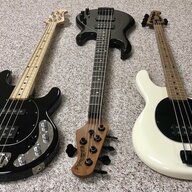

It's usually a combination of many things. None of which are really required if the other things are great. I've had a lot of great basses; stingray 5s, neck through and bolt on made in Germany warwicks, various other bolt on and neck through 34"scales, neck through 35", and my main player now is a dingwall thats 34-37" fan fret bolt on. I think the scale makes a much bigger impact if it's more dramatic. For example 37" low b sure there's def a noticable difference especially with feel and the fundemental being much more prominent, 34-35 other things factor in and I think they are similar enough that simply changing string gauges can make up most of the difference of 34-35" especially when it comes to how the string tension feels. Aguilar does make pretty good pickups. Neck stiffness and design is a big deal as well. There's pros and Cons to everything. For example necks that are 5or 6 pieces glued together can be really strong but can also sound more compressed and I've heard some people describe them as individuals pieces of wood resonate at different frequencies which causes some phase cancelling. Necks that aren't strong don't cut it either though. Maple is a pretty strong wood and the quartersawn maple necks imo are a decent compromise. Wenge necks can have nice warm 2nd and 3rd harmonic response. The crazy exotic stuff like carbon fiber, graphite, and aluminum necks are usually pretty punchy/ piano like. I've heard some basses that you'd think would suck like 32-33" scale basses with low B strings that actually sounded great (fodera and Benevente) but yeah I think it's a big combination of things. And you're likely to get different answers based on people's own experiences because of the particular basses they've owned.Hey all,
The other day I had the opportunity to play an Ibanez BTB1805E at GC, and I was blown away by the lovely sustain and rich harmonic tones this instrument produced. The low notes seemed to have richer, more complex frequencies than any other bass I've played. I think I grasped what some TB-ers mean when they describe a bass's tone as "piano-like".
Having only ever owned 34" and 30" bolt-on neck basses, having never played a 35", and having never paid much attention to neck-thru vs. bolt-on, I am now wondering whether this great difference in tone is more likely derived from the neck-thru construction of the Ibby, or from its 35" scale. I'm sure both aspects have something to do with it, but I'm wondering whether one might contribute more greatly to the tone I'm talking about than the other.
The reason I'm asking is that I have small hands, and am therefore hesitant to purchase a 35" bass. So I'm wondering if a 34" neck-thru bass is likely to get me closer to this kind of sustain and rich tone, or whether the 35" scale might be what's making the big difference here. I'm sure the Aguilar pickups and zero fret have something to do with it as well, but the richness of tone and sustain seemed to be more of a physical thing that I could feel in the vibrations of the instrument, even when unplugged.
Even with my small hands I might end up springing for a less expensive BTB model (under $1000, hopefully closer to $500) in the same series, but if a 34" neck-thru bass (like an SR model) with similar pickups might get me closer to this rich harmonic content and sustain, I'm likely to opt for that.
Anyway, thanks for the input! Much appreciated!

Thanks guys!
Hmmm... so I'm getting that there's not much consensus on this! I've heard a lot of different opinions and perspectives based on lots of different experiences, some of which contradict one another. So I know that the tone of any instrument comes from lots of different things construction-wise (and obviously electronics-wise as well), and that much of this can be subjective, and can also vary from instrument to instrument (enter the influence of mojo!). I guess I just need to get an instrument I like with lots of mojo; and if it has the sound I want, it has it!
I'm sure I'll keep wondering which of its characteristics make the sound so special though!


I believe not all that is real can be measured by science. So just because science or engineering hasn't produced data to back "it" up doesn't necessarily meant "it" isn't real.
A synthesizer is an electric instrument, a bass is the same as a piano, both an acoustic source but amplified differently. Bass guitar simply IS an acoustic instrument where it's amplified via magnetic transference of the acoustic energy. A piano uses it's wooden box as the amplifier. Put magnetic pickups on a harpsichord and you get a Clavinet!Pianos and spinets are acoustic instruments. Electric bass guitars are not. So your analogy is comparing apples to oranges.
I can take a short scale bass and likely give you a subjectively bassier sound than I can get from my 35" scale Spector. Because when it comes to solidbody instruments, the magnetic pickups and strings you've got installed combined with the amp and cab you're plugged into will make up virtually all of that you'll be hearing. There may be some small additional contributions to the tone and timbre resulting from the construction and materials used in the bass. But at normal performance levels - and especially at stage volume - it's doubtful they'll be noticeable.

instrument where it's amplified via magnetic transference of the acoustic energy.
 So let's compromise and call it an electro-acoustic instrument and let it go at that.
I read a very scientific article once testing neck-thru vs bolt that determined there was no diff. But I'd swear my SRX700 and now BTB846 had/have better sustain.
But then again ... my SR800 sustains for days and just vibrates beautifully.
Now I'm confused.
A synthesizer is an electric instrument, a bass is the same as a piano, both an acoustic source but amplified differently. Bass guitar simply IS an acoustic instrument where it's amplified via magnetic transference of the acoustic energy. A piano uses it's wooden box as the amplifier. Put magnetic pickups on a harpsichord and you get a Clavinet!
Since a bass string can only vibrate as low as it's fundamental which is present on any scale, it can be eq-ed into any shape. But your perception of the fundamental might be clearer on a longer scale, or at least more defined. "Piano like" isn't just about the low end.
"Normal performance levels", wow, I'm having an argument in favor of "normal" performance volume with someone right now, and while I say low end loudness is good, everything above 600hz 110db is admittedly probably causing damage and requiring protection. In the recording studio, the performance volume thing goes away, so specific tones can be heard. I don't see it as a valid argument to say "it doesn't matter when we play loud."
When the power goes off we're back to acoustic instruments anyway, maybe a gas generator could run your amp at the show. There'll be a line of cables running outside, one generator for every instrument, one for the lights, one for the furnace, and all together they will produce a 140db 40hz rumble and lots of smoke, can your amp cut through that? I speak of loosing power because this winter I lucked out and have not lost power, but thousands around here have, and I have in the past. It's always been temporary. so far.