• TalkBass has been independent since 1998. Add your voice.
    Create a free account to reply to discussions, view embedded media, and browse with fewer display ads.
    Join freeLog in
    Want zero display ads or expanded classifieds tools? Compare plans.

Double Bass Need a recommendation for low tension jazz strings

If there is nobody to play with you, you don't need to tune on pitch but can tune a half or wholetone lower (or even a bit more). That makes it easier to play and some strings even have that kind of tension with your downtuned steel core strings.

Good idea for a quick fix. Thanks.


The top sanding method is only used to shape the bridge feet to the top, not for lowering the string height. You do that by removing wood from the top.

Aha! that sound important. So I should sand off the top instead? I am happy with the bridge feet for now. There is one tiny gap on one foot, but I am not a perfectionist.

7 mm is OK for the G, but you should use a difference of 1.5 mm first, so 7-8.5-10-11.5 mm before you might want to go lower on the lower strings.

If I understand this correctly, then I have to sand the top of the bridge so that the G is 3.5mm higher than the E. is that right?
 
Right, now I can frame your situation.
Nevertheless, if you're in the fortunate situation that you can receive mail, you are not really limited, in 2017. Well, you're limited to what Thomann, Gollihur, String Emporium, TB classified's, ... can deliver, which is pretty much everything there is.
The strings you linked to are for slap, and I (& others) do not prefer them for jazz. Various strings are more suitable & will give a more rewarding sound, but your upper limit of $100 will be a challenge. The other limiting factor could be the instrument that you have, I believe you mentioned somewhere that it came from China and came delivered with cheap factory strings. It might be a cheap plywood bass with a thin top (if it's ply, can you measure the thickness with a calliper please?), in which case running higher tension strings like Thomastik Spirocore medium (a standard for jazz, 127kg @105cm) is not advisable. In that case Invalid Link Removed, de-tuned Invalid Link Removed, or D'Addario Zyex lights would be better, but new those are all above your budget. Within your budget, the Artino's are the cheapest rope core strings (113kg @105cm), and they sound quite good, but can feel a little stiff for their tension. In solid core, the GEWA's are good in their class, and are good value for money, but initially they are quite bright on the bow (106kg @105cm). If you have a ply instrument with a 5.5mm thick top I would recommend those, but if you have a more mature instrument I would raise your limit and choose better strings, or buy 2nd hand (I bought a 2nd hand set of Zyex lights which I like a lot).

Note: I linked to Thomann, but same or similar is available elsewhere. And there are also other makers that produce excellent strings. And in any case you need to set-up the instrument to suitable string heights, as outlined elsewhere.
Thanks for the suggestions.
 
@Spanky123, how about online shops? Spirocore lights ( weichs ) are very durable and great in that matter, they last forever. Evah Pirazzi weichs are a bit darker sounding and less metallic, great hybrid all around strings that propably work well at the height you describe ( G at 7mm`s ). If lower tension is wanted, Velvet makes great sounding pizz-oriented strings like Animas and Garbos. These are both expensive and fragile, Velvet Blues is more affordable alternative. I have a fresh set of synthetic Evah Pirazzi Slaps on my bass and they are the easiest playing strings I`ve ever tried, but require more height under them to feel and sound good. Good luck for your hunt!!!
Thanks for the suggestions.
 
If I understand this correctly, then I have to sand the top of the bridge so that the G is 3.5mm higher than the E. is that right?
No, the G is closest to the fingerboard, the E is 4.5 mm higher at the end of the fingerboard than the G, the D and A in between.
(It's always the distance between the underside of the string and the top face of the fingerboard at the end of the fingerboard.)

And I would try that first for a while. You can go half a millimeter lower if it's still too much tension or if you feel you need more curvature for the bow or feel the height difference is too much for the lower strings keep the G at 7 mm and reduce the difference from 1.5 mm to les but no less than 1 mm.

And don't decide too quickly, if you go too low, but useable with your current strings, it might not work with lower tension or stretchier core strings and you might only use higher tension steel core strings then.

Some naked gut string players use 9 mm for the G but it becomes hard to play in a higher thumb position that way. Starting with 7 mm for the G is a good setup that can later be fine tuned to your final string choice.
 
I just installed a set of Helicore Hybrid Lights, coming from Zyex Mediums. I think the Zyex had a more old school sound, but liking the Helicores for lighter tension and better bow response. Helicores are cheaper, which you may want to save some cash.

I wouldn't recommend venturing out into cheap string territory.
 
No, the G is closest to the fingerboard, the E is 4.5 mm higher at the end of the fingerboard than the G, the D and A in between.
(It's always the distance between the underside of the string and the top face of the fingerboard at the end of the fingerboard.)

And I would try that first for a while. You can go half a millimeter lower if it's still too much tension or if you feel you need more curvature for the bow or feel the height difference is too much for the lower strings keep the G at 7 mm and reduce the difference from 1.5 mm to les but no less than 1 mm.

And don't decide too quickly, if you go too low, but useable with your current strings, it might not work with lower tension or stretchier core strings and you might only use higher tension steel core strings then.

Some naked gut string players use 9 mm for the G but it becomes hard to play in a higher thumb position that way. Starting with 7 mm for the G is a good setup that can later be fine tuned to your final string choice.

What if I just file the string grooves on the bridge to a good height and then file the top of the bridge to accommodate their height?
 
  • Like
Reactions: Povl Carstensen
What if I just file the string grooves on the bridge to a good height and then file the top of the bridge to accommodate their height?
That's a good way to do that.

Just make the slots wide enough, so that the strings are not pinched, and round the groove towards fingerboard and tailpiece so that no edge presses against the string.

One warning: if you lower the setup it can happen that buzzes occur with fingered notes. In that case the fingerboard needs to be planed. More a job for a luthier if you don't know how to do that, since you can easily ruin the fingerboard if you do it wrong.
Might not happen with 7 to 11.5 mm, but the lower you get the higher the probability that it does.
 
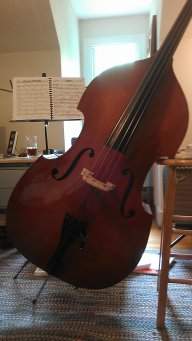
I bought in a small shop in Beijing from a luthier that owns a small factory. It's plywood, but a very competent instrument. It cost about $380 USD. Not much to report. It's very basic. The fingerboard is straight. The tone is okay, with a clear low E.
OK, thanks. At $380 in China that'll make it (depending on how well you haggled) around the $700-$800 mark in the west. Please don't get me wrong, I'm not passing judgement on the instrument. It is what it is, and for your purpose it is eminently suitable. You're not going to take a 200yo Italian master to the Oman-Yemen border. It will crack, or otherwise suffer, and that's a pointless loss. This instrument will do fine.

But instruments at this price-point normally require extensive after-care, normally done by the new owner. I say 'normally done by the new owner' because the price does not warrant to have it done by a luthier. And in your case, the nearest luthier might be in Turkey (or maybe RSA or India, who knows, at any rate: inaccessible). So you have to file down the notches in the bridge & nut yourself, as outlined by DM & in several other threads (like here, but there are many others). Go down slowly, because coming back up is more difficult. And there are differences in what people prefer (DM prefers the low side higher than I do), and it depends on the strings you use, and a few other things. Anyway, lets accept that in your situation it is not going to be done by a pro luthier, but by you.

Similarly, the upper limit of $100 you pose for the strings also seems sensible, wrt the acquisition price. I'd be reluctant to put $250 strings (including P&P) on a $380 bass. And what's your daily temperature variation? Something like 0 - 50°C? Even if it's a little less than that, I'd stick with steel strings. But a rope-core is an advantage, so for a competent 3/4 (about 105cm scale) instrument I would still recommend the Artino's I linked to earlier (costing you $60+$42 P&P), and if you want a little less tension the solid-core GEWA's will also do fine (at $44+$42). Or similar from another vendor, which might have cheaper shipping costs.

PS.: or of course 2nd hand strings; Spiro lights or detuned Solo's are light strings suitable for jazz, and can safely be bought if used for just a few years. Those are rope-core, similar to the Artino's.
 
Last edited:
  • Like
Reactions: Lee Moses
(2nd hand) Spiros are even a good choice if you know that they hold a lot longer (sound wise) than most other strings. They can be bright during the first time (up to a year, but the softer ones less), but can last 10 years easily. Others one to two years typically. So even if you can only get them new (I would either use Spiro Weich 4/4 or Spiro Solo 3/4 downtuned to orchestra tuning, maybe 3/4 Weich if you want a bit more tension), you can live a long time with one set of strings only. Maybe get used strings first, you can resell the, for almost the same price if the tension is not good for you and your instrument. If you got nice strings, you might want to get a new set if you ever think the used ones won't work as they should (which might be never). But then it's well invested money. Or get your next used set that you don't have to play in.

BTW, with Spiros you can get lower than 7 mm, but be prepared to work on the fingerboard to get rid of buzzes and do it slowly (the bump is always below your finger and the buzz gets away when you are on top of the bump).
5.5-7-8.5-10 mm would be the lowest I would put Spiros.
 
Remember, Spiros come in at least seven different sets that are used on conventional 3/4 double basses.

When most people talk about the difference between Weichs and Mitts or "Reds" (from the color of the silk at both top and bottom, not the "Red Mitchell Quint Tuning" set), they are talking about the 4/4 S42W and S42 sets.

Everybody forgets about the one in the middle: the 3885W 3/4 set: most of the tone heft of Red Mitts, but lighter on the fingers like the 4/4 Weichs. These, IMO, are the most forgotten about strings in the DB world for jazz pizz.