• TalkBass has been independent since 1998. Add your voice.
    Create a free account to reply to discussions, view embedded media, and browse with fewer display ads.
    Join freeLog in
    Want zero display ads or expanded classifieds tools? Compare plans.

Need advice on Ibanez EHB 1005SMS + shoulder injury

Hi everyone,

seems that I have the sufficient rights to post my question(s). So As I've mentioned in my intro post, I deal with a serious shoulder injury: supraspinous partial rupture.

Practicing bass as a righty, sitting or standing, is a nightmare but I've found only one posture that was ok: sitting as classical guitarist with the bass between my thighs, kinda Hadrien Feraud posture
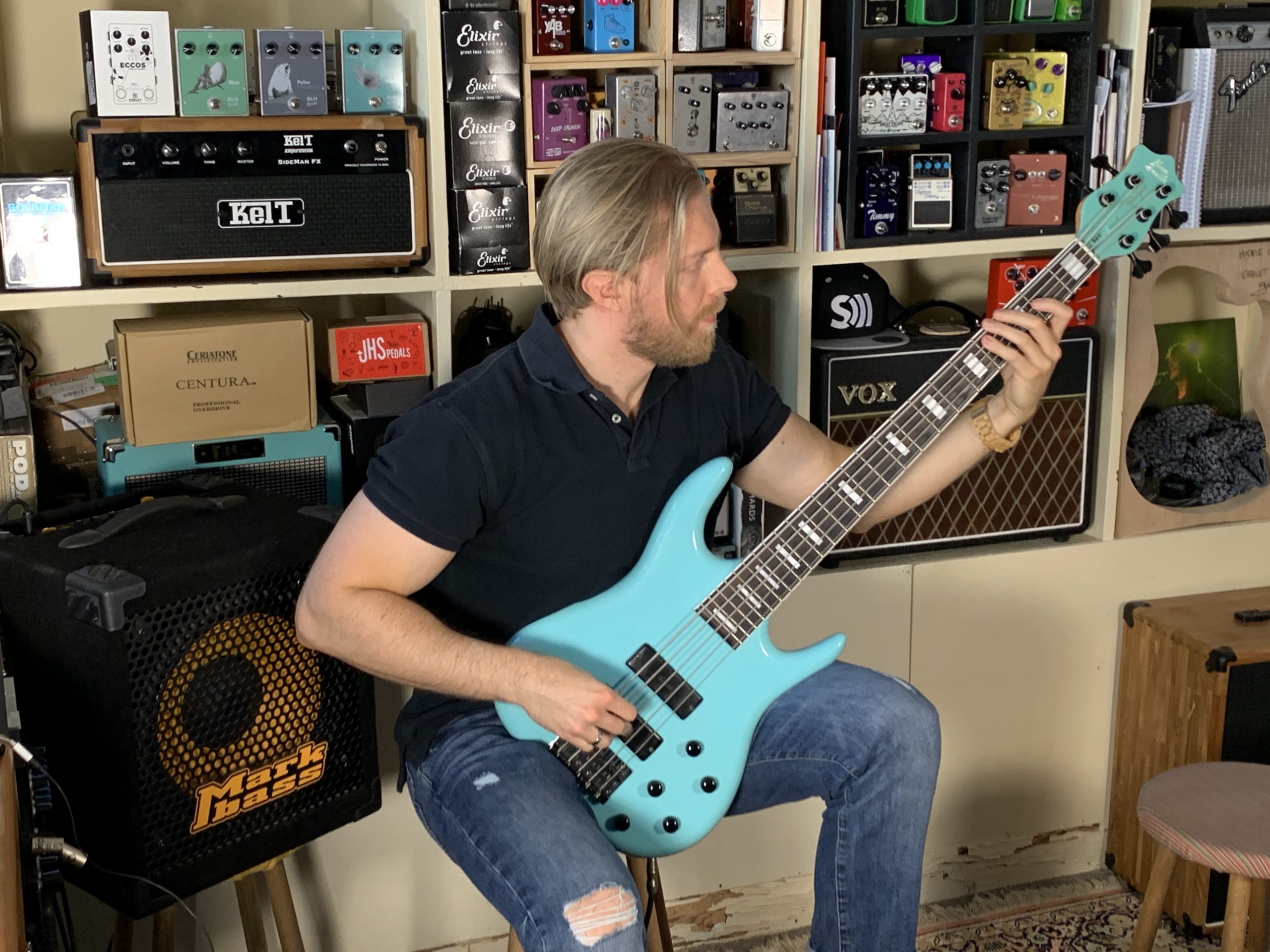
Hadrien-Feraud-showroom-9104-scaled.jpg


Slapping is a no-no, not that easy with this posture, and more of it all: my left arm struggles a bit being over extended, it's the downside of that posture. (I'm currently playing 4 and 5 strings fender-like basses, regular 34")

So I was thinking of getting an Ibanez EHB 1005 SMS, a medium/short scale bass then, and instead of keeping it tuned low B was thinking of doing a high C conversion, E to C so.

Have any of you already done that with that bass ? and have any of you already dealt with shoulder injury + bass practice ?
 
Last edited:
As I've mentioned in my intro post, I deal with a serious shoulder injury: supraspinous partial rupture....
The only medical advice that you get over the Internet that you should actually pay attention to is "don't listen to any medical advice you get over the Internet." :D

If you haven't done so already, take your bass to your physical therapist and work it out. A position that feels okay in the short term might turn out to weaken or damage your shoulder in the long term. You might also consider a guitar stand, so that you can position the instrument wherever you want. Or, you might have to stop completely for a few months.

Simulating a short-scale bass is pretty simple, just measure ~30" from the bridge and don't go below that fret. IIRC this is probably around the 5th fret.
 
Wow, it's escalating quickly without having any clue about who am I... is it the national sport here on that forum ?

I've already done my intro post, and if you took enough time to read it before replying disrespectfully, you'd have understood I'm french. Therefore, getting medical advice from a real doctor is easy and free compared to the US.

What is also free, is getting ultrasound to check what's going on (it's not for babies only...), and the ulstrasound I had 3 weeks ago showed that I had a partial rupture of the supraspinatus tendon right under the acromion hook, 3mm wide. It's a lso a stitching rupture, means that the tendon has been cut through by its thickness.

I'm not a doctor I KNOW, that's why I asked my doctor to get a surgeon advice + an MRI cos':
- the MRI is the best exam for the surgeon to get the real picture of what's going on
- only the surgeon will be able to tell if I really need to undergo surgery

I've had 1 cortisone injection already 1 month and a half ago, it's been ok for 2 weeks but then the pain and lack of mobility and force came back. Obviously, as I'm 50 years old, the doctor said it wasn't a good idea to get a second one. So he suspected something more serious, hence the ultrasound, hence... the partial rupture.

Seriously guys, you should stop talking like sh.t to people coming here for their first time. It's arrogant, and we all know that I, as a frenchman, know what arrogance is, right ? ;-)

What I need to avoid is the abduction movement, but as my doctor said, I also need to move my shoulder a bit still, to avoid any muscular atrophy. I've had this condition since an accident in mid January, it's stabilized for now, even if I'm on a sick leave cos' my boss doesn't want to see me back until I fully recover.
 
Last edited:
I've had bursitis in my shoulder. Only remedy was not playing bass at all for 6 months
Thanks for sharing your experience, in my case it's not a bursitis, and if it had been one the 1st cortisone injection would have solved it + some kinesitherapy as my doctor said. The physical therapist I'll start to see on next may already told me the same too, just by reading the ultrasound review.

What the doctor and the physical therapist want me to do is keeping some basic mobilization, without weight, cos' according to them it will benefit the surgery if it's needed. If not, the sooner I start mobilization, the sooner i'll be able to start a reinforcement schedule.
 
Thanks ;-)

Oh I forgot: I'm a righty, the injury is on the right shoulder, so it's my left arm that is over extended in that posture, the right arm falls down and in adduction movement the hand being on the middle of the belly, and it's pain free for instance. My arm is almost "glued" to my chest then, and that's also ideal to avoid any pain
 
Last edited:
  • Like
Reactions: el jeffe bass
Bonjour, hope things settle for you. As a shoulder surgeon, it is hard to make any decisions without seeing someone's shoulder and getting a full story. Happy to see you if you travel Down Under. Not uncommonly, there are MRI or imaging findings which are not relevant to a problem, and sometimes problems that I operate on which don't show up reliably on imaging...
The classical position keeps your right shoulder less abducted and puts your left arm further out - no harm trying a shorter scale bass, baritone, or normal guitar to see what works. Also no harm playing around with upright pizzicato playing - cheaper and less risky than jumping into surgery you may not need, and an excuse to buy another instrument.
 
  • Like
Reactions: BeMoreFrench
Hi everyone,

seems that I have the sufficient rights to post my question(s). So As I've mentioned in my intro post, I deal with a serious shoulder injury: supraspinous partial rupture.

Practicing bass as a righty, sitting or standing, is a nightmare but I've found only one posture that was ok: sitting as classical guitarist with the bass between my thighs, kinda Hadrien Feraud posture
Hadrien-Feraud-showroom-9104-scaled.jpg


Slapping is a no-no, not that easy with this posture, and more of it all: my left arm struggles a bit being over extended, it's the downside of that posture. (I'm currently playing 4 and 5 strings fender-like basses, regular 34")

So I was thinking of getting an Ibanez EHB 1005 SMS, a medium/short scale bass then, and instead of keeping it tuned low B was thinking of doing a high C conversion, E to C so.

Have any of you already done that with that bass ? and have any of you already dealt with shoulder injury + bass practice ?

Hi!

I just had very recently an injury on my right shoulder (calcifying tendinitis in the supraspinatus). So I am there with you. So I understand, making your elbow far from your torso hurts you. That's why this position feels better.
In this regard, I think a medium/short scale is a great idea! I think you can find posts in the forum of people converting B-G basses into E-C, quite successfully. As far as I understand, you will have to pay attention to string tension, neck relief, and action. Probably the limiting factor is the nut which is set to a different string gauge.

Ibanez is awesome. After playing Jazz bass for many years, I bought an Ibanez BTB845V, which is a 33" scale, E-C. It's just great! :)
 
  • Like
Reactions: BeMoreFrench
Wow, it's escalating quickly without having any clue about who am I... is it the national sport here on that forum ?

International sport, got it?

I've already done my intro post, and if you took enough time to read it before replying disrespectfully, you'd have understood I'm french. Therefore, getting medical advice from a real doctor is easy and free compared to the US.

Then why are you here asking for medical advice?
I'm French too, you're not special.


What is also free, is getting ultrasound to check what's going on (it's not for babies only...), and the ulstrasound I had 3 weeks ago showed that I had a partial rupture of the supraspinatus tendon right under the acromion hook, 3mm wide. It's a lso a stitching rupture, means that the tendon has been cut through by its thickness............BLAH, BLAH,BLAH.

Better start talking bass soon.
 
  • Like
Reactions: ColdEye
If you want to see if a short scale is for you, tune one of your long scale basses down one whole step to D standard then capo the 2nd fret. Voila!

You essentially have turned your long scale into a short scale (you can drop tune 1/2 step and capo the first fret for medium scale). Of course it takes a little getting used to, but it's an easy, inexpensive way to see if it's what you're looking for. If you find you like it, then you can move forward with a short scale bass purchase. Just a thought.
 
  • Like
Reactions: wintremute and JES
I'd recommend experimenting with the bass you have first with the tuning down/capo trick. Also, scale length is less important than body shape and position in terms of how far away the 1st fret feels.

Once you find a position you like, check with your PT.

Good luck with your recovery. I have a hand condition that transformed my bass playing so no relevant experience except to say that you can find a way that works for you.
 
I have moved to short scales and playing between the legs due to wrist issues. It has made a tremendous different for me. If you're not worried about the low B string, I would advise you try a cheaper 30" 4 string for a bit to see how it goes. I started on a MIM Mustang and eventually moved to a 5 string Maruszczyk.
 
  • Like
Reactions: ColdEye
I hope you feel better as soon and completely as possible. I have one of these basses and I'm not sure the tuners will let you sit with it between your legs. I'm headed home soon and I'll check it out - I will report what I find.
 
Hi everyone,

seems that I have the sufficient rights to post my question(s). So As I've mentioned in my intro post, I deal with a serious shoulder injury: supraspinous partial rupture.

Practicing bass as a righty, sitting or standing, is a nightmare but I've found only one posture that was ok: sitting as classical guitarist with the bass between my thighs, kinda Hadrien Feraud posture
Hadrien-Feraud-showroom-9104-scaled.jpg


Slapping is a no-no, not that easy with this posture, and more of it all: my left arm struggles a bit being over extended, it's the downside of that posture. (I'm currently playing 4 and 5 strings fender-like basses, regular 34")

So I was thinking of getting an Ibanez EHB 1005 SMS, a medium/short scale bass then, and instead of keeping it tuned low B was thinking of doing a high C conversion, E to C so.

Have any of you already done that with that bass ? and have any of you already dealt with shoulder injury + bass practice ?

I dont own one, but I've tried pretty much every bass in the Ibby EHB line. ALL of them are super comfortable, and light. I'd check one of the EHB threads on here to see if someone has done E-C. It wouldn't surprise me at all. I've also read (somewhere here on TB) that the B string is surprisingly good compared to what was expected for a 33" B. Standard suggestions for the EHB line apply afaik. I remember thinking the regular 4 string EHB was almost toylike it was so small... and I like short scales. If I was looking for a bass to play whilst injured, I'd go with the EHB, or a Kala Ubass with flatwound strings. My ubass is loads of fun.

I'm not sure exactly what your medical restraints are, but I can say, the EHB is possibly the most comfortable bass out there that is anywhere near affordable.