Hello, all.
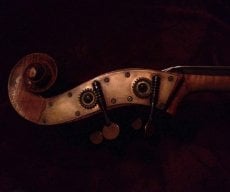
I bought the '38 or '39 Mortone that was in the classifieds last week. Long story short, the previous owner bought it in 1988 and never learned to play it, so as a result the bass sat on a stand collecting dust, tuned to pitch, for all of these years.
Despite being a builder of electric instruments, the previous owner did not seem to know much about the inner workings of violin family instruments, so the instrument's more serious problems were not disclosed. I would very much like to save it, as it is a gorgeous instrument, and am looking for advice from persons with more experience in these matters than I have.
Briefly (and I will go into more detail below for those who care to read it), Serious Problem A is the bass bar, which separated from the top roughly under the bridge to the bottom point of the bar, allowing the top to sag while still under string tension. Serious Problem B is the neck joint, where an old repair is failing.
It also has many less fatal problems (edge delamination, warped bridge, overly long soundpost, fingerboard falling off) but the way I see it my first priority should be restoring the structural integrity, if possible, before tacking the less critical problems.
The strings and fittings have been removed from the bass, which is presently on its' back on my basement work bench.
While it would be preferable to leave the dirty work to the professionals, the family budget does not presently allow for a professional restoration. If I have to prop it in a corner and leave it for a year or two until I can scrape together a few thousand to pay for a professional restoration, so be it, but I am mechanically adept enough to fix engines and houses so I may be up to the task. This will be my first major bass repair.
Frankly, it would be hard to make the bass much worse than it already is. Read on if you have the stomach. Pictures can be arranged to illustrate what I am talking about. Any advice the community could offer would be greatly appreciated.
Serious Problem A: bass bar.
Thankfully the glue joint holding the bar let go, so from what I can see the laminate is intact. However, the belly is sunken about a quarter of an inch under the E-side bridge foot and the bar, which appears to be the "sprung" type, is flapping in the breeze. The end of the bar is about one inch below the top.
The esteemed Arnold S. has advised me that the top will have to come off and a new bar will have to be fitted. Hooray. I started popping the top yesterday. The left (E side) was a breeze, as the seams of the upper and lower bouts were open and partially delaminated. An hour with a pot of boiling water and a thin knife blade did the trick. The right (G side) bouts, not so much. I'm thinking superglue was used at some point. Did I mention that whoever took the top off in the past put it back on crooked?
My next step, I think, will be to use a hot knife to finish popping the top, heat the belly using a heating pad or similar flexible heat source, and slowly clamp the bass bar back into place in hopes of restoring the arch. I have a sheet of 1/2" plywood roughly the size of the soundbox that I will clamp to the ribs to keep them still after I clean up the old glue joints.
If I can press the arch back into the top, my next step will be to source and fit a new bass bar. I read someplace that Metropolitan Music carries good quality bass bars for about $30. Is that correct? Can anyone suggest another reliable source?
While the top is off, I will have a better look at what is going on with the neck joint.
Serious Problem B: wobbly, doweled neck joint.
It appears that, at some point, this bass took a tumble and the neck heel suffered the common Kay-type fracture, breaking in two places along the neck heel. The heel fragments seem to have been glued and clamped fairly well. How the heel was placed back in the neck block seems to be the problem.
First, whoever fixed it the last time used carpenter's glue. A lot of it. There is a glue line at the neck joint, and the glue is gummy stuff you can pick out with a fingernail. Two cone-shaped dowels were used to reinforce the glue. Looking at the bottom of the neck block through the endpin hole, the dowels are about an inch wide down there, and taper to about 1/4" where their top ends are cut off flush with the neck heel. I could be wrong, but this seems to be what was done.
Here's the kicker: because so much glue was packed in between the neck block and the butt of the neck, the neck would not fit snugly back into place. In an effort to make things line up, the repair person sawed off the button and glued it back into its proper place. This left a matchstick-width gap below the button and another gap of equal width behind the neck heel.
The neck was tight under string tension, but once the strings were removed, a few degrees of lateral play in the neck joint was evident. If I understand how this works, the glue has failed and the mortise and tenon were bearing the full weight of string tension. This would seem like a recipe for eventual, catastrophic failure. I'm not sure what to do about this. If I can make the bass playable, it will be strung with weedwhackers or plain gut to put the least possible stress on the neck joint.
Bringing the bass to a pro for a neck graft seems like the best answer, but I don't see how that could be done for less than what the bass is worth, not to mention be done in a way that would allow the gorgeous original neck to be saved.
That's where I'm at, TBDB folks. Many thanks in advance for any wisdom you care to impart.
S
I bought the '38 or '39 Mortone that was in the classifieds last week. Long story short, the previous owner bought it in 1988 and never learned to play it, so as a result the bass sat on a stand collecting dust, tuned to pitch, for all of these years.
Despite being a builder of electric instruments, the previous owner did not seem to know much about the inner workings of violin family instruments, so the instrument's more serious problems were not disclosed. I would very much like to save it, as it is a gorgeous instrument, and am looking for advice from persons with more experience in these matters than I have.
Briefly (and I will go into more detail below for those who care to read it), Serious Problem A is the bass bar, which separated from the top roughly under the bridge to the bottom point of the bar, allowing the top to sag while still under string tension. Serious Problem B is the neck joint, where an old repair is failing.
It also has many less fatal problems (edge delamination, warped bridge, overly long soundpost, fingerboard falling off) but the way I see it my first priority should be restoring the structural integrity, if possible, before tacking the less critical problems.
The strings and fittings have been removed from the bass, which is presently on its' back on my basement work bench.
While it would be preferable to leave the dirty work to the professionals, the family budget does not presently allow for a professional restoration. If I have to prop it in a corner and leave it for a year or two until I can scrape together a few thousand to pay for a professional restoration, so be it, but I am mechanically adept enough to fix engines and houses so I may be up to the task. This will be my first major bass repair.
Frankly, it would be hard to make the bass much worse than it already is. Read on if you have the stomach. Pictures can be arranged to illustrate what I am talking about. Any advice the community could offer would be greatly appreciated.
Serious Problem A: bass bar.
Thankfully the glue joint holding the bar let go, so from what I can see the laminate is intact. However, the belly is sunken about a quarter of an inch under the E-side bridge foot and the bar, which appears to be the "sprung" type, is flapping in the breeze. The end of the bar is about one inch below the top.
The esteemed Arnold S. has advised me that the top will have to come off and a new bar will have to be fitted. Hooray. I started popping the top yesterday. The left (E side) was a breeze, as the seams of the upper and lower bouts were open and partially delaminated. An hour with a pot of boiling water and a thin knife blade did the trick. The right (G side) bouts, not so much. I'm thinking superglue was used at some point. Did I mention that whoever took the top off in the past put it back on crooked?
My next step, I think, will be to use a hot knife to finish popping the top, heat the belly using a heating pad or similar flexible heat source, and slowly clamp the bass bar back into place in hopes of restoring the arch. I have a sheet of 1/2" plywood roughly the size of the soundbox that I will clamp to the ribs to keep them still after I clean up the old glue joints.
If I can press the arch back into the top, my next step will be to source and fit a new bass bar. I read someplace that Metropolitan Music carries good quality bass bars for about $30. Is that correct? Can anyone suggest another reliable source?
While the top is off, I will have a better look at what is going on with the neck joint.
Serious Problem B: wobbly, doweled neck joint.
It appears that, at some point, this bass took a tumble and the neck heel suffered the common Kay-type fracture, breaking in two places along the neck heel. The heel fragments seem to have been glued and clamped fairly well. How the heel was placed back in the neck block seems to be the problem.
First, whoever fixed it the last time used carpenter's glue. A lot of it. There is a glue line at the neck joint, and the glue is gummy stuff you can pick out with a fingernail. Two cone-shaped dowels were used to reinforce the glue. Looking at the bottom of the neck block through the endpin hole, the dowels are about an inch wide down there, and taper to about 1/4" where their top ends are cut off flush with the neck heel. I could be wrong, but this seems to be what was done.
Here's the kicker: because so much glue was packed in between the neck block and the butt of the neck, the neck would not fit snugly back into place. In an effort to make things line up, the repair person sawed off the button and glued it back into its proper place. This left a matchstick-width gap below the button and another gap of equal width behind the neck heel.
The neck was tight under string tension, but once the strings were removed, a few degrees of lateral play in the neck joint was evident. If I understand how this works, the glue has failed and the mortise and tenon were bearing the full weight of string tension. This would seem like a recipe for eventual, catastrophic failure. I'm not sure what to do about this. If I can make the bass playable, it will be strung with weedwhackers or plain gut to put the least possible stress on the neck joint.
Bringing the bass to a pro for a neck graft seems like the best answer, but I don't see how that could be done for less than what the bass is worth, not to mention be done in a way that would allow the gorgeous original neck to be saved.
That's where I'm at, TBDB folks. Many thanks in advance for any wisdom you care to impart.
S