• TalkBass has been independent since 1998. Add your voice.
    Create a free account to reply to discussions, view embedded media, and browse with fewer display ads.
    Join freeLog in
    Want zero display ads or expanded classifieds tools? Compare plans.

Double Bass Need help bowing, slurs

Hi all,

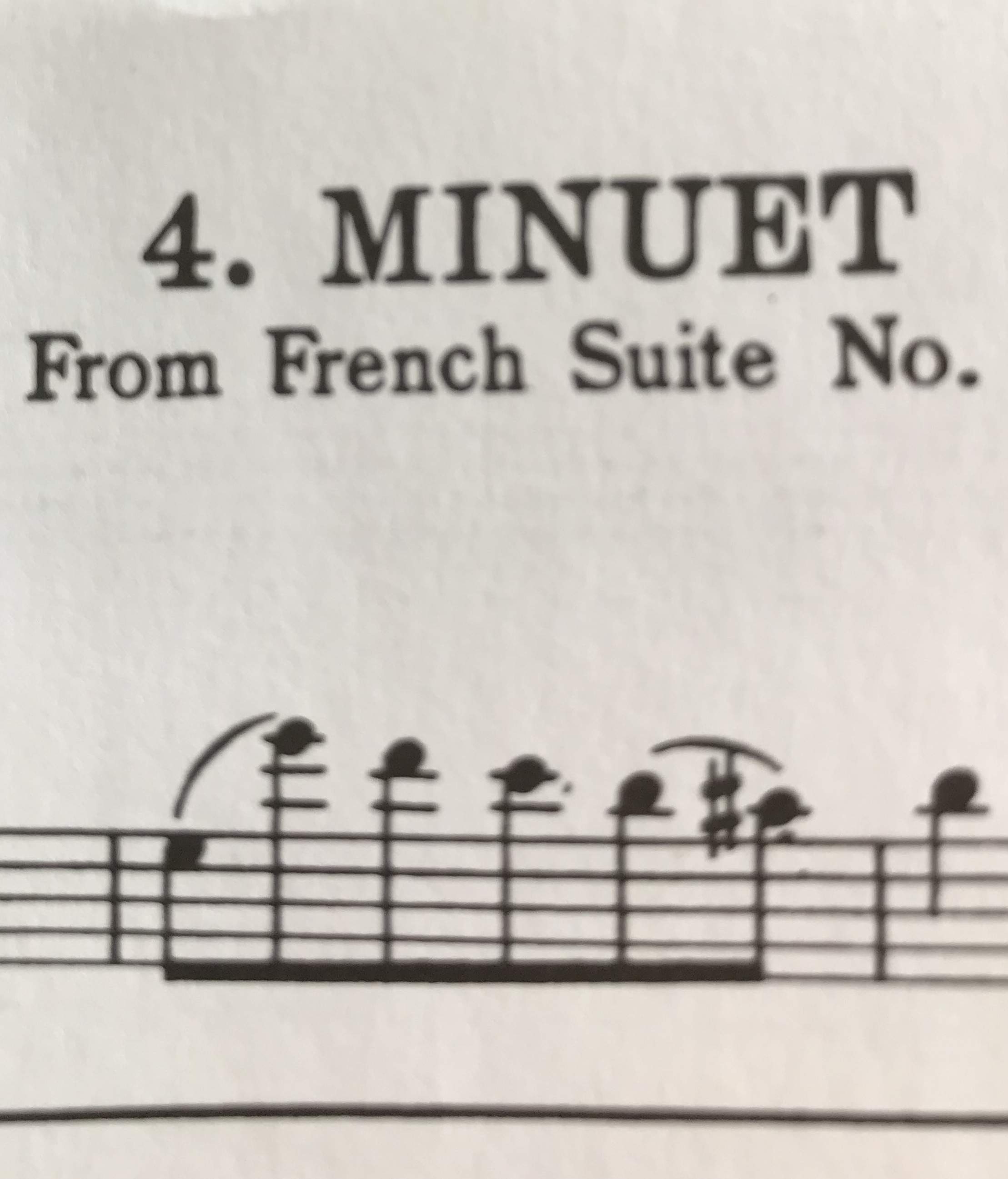
I’m about 8 years into double bass. Started out mostly working on jazz/pizz stuff but trying to get my arco chops together. Last summer I got about 60 pages through Simandl and then starting in September I began a jazz studies curriculum, but have been steadily working on arco technique. I’m currently working my way through the rather humiliatingly titled “Bach for the young bass player” and I’m discovering (I’m 47 btw) that I’m struggling with slurs. When there are a series of 8th or 16th notes, some of which are slurred, it scrambles my brain. I don’t recall Simandl spending much time on that. There were the odd up or down bow indications here and there but no exercises (that I recall) dedicated to this particular challenge. Anyone have any recs on books, methods, exercises for this? Maybe I just need to play the particular passages glacially slowly. But hoping there is some curriculum for this. I get the concept of slurs but still find it hard. Here’s an example of a measure I feel I’ve spent too much time on.
DDC69294-7E4F-40BB-A61E-2DB02A760F02.jpeg
 
Before heading into pages 68 and 69 of Simandl (as suggested by Don and good as they are) perhaps think about the following and do some preparatory work first -
(1) Think of how far you have come already and give yourself a pat on the back
(2) In pages 1 to 60 so far the separate sounds and their rythm and timing have made RH the master and LH the mechanical servant that stops the strings by shortening their vibrating lengths
(3) For clear articulation of separate notes the LH has to set up each note just before the RH sounds it
(4) Plucking the notes D E F G A up and down the D string demonstrates how natural this working relationship feels. Then use the bow instead of plucking the same notes and feel that suddenly you are into more complex territory.
(5) Slurring changes the relationship between the hands because the LH has to both create different notes and divide up their lengths according to the rythm and the length of the slur. This leads to even more complexity when mixed up with single notes and string crossings
(6) Which is why you may be having trouble with the Bach example that you gave.
(7) There is one very basic fact -

I see learning to play like building a pyramid upside down. To build technique and musicianship you add layers of information that rely on the strength of the first building blocks (where you are now?) Before taking on Simandl PP 68-69 I suggest trying the following approach to prepare-
(1) Play open Ds with alternate long bows at a steady slow-to-moderate tempo, in 4/4 with a metronome and using all but the last inch of hair at each end.
(2) Tie a piece of cotton/string around the stick at the middle of the hair length (or a clothes peg)
(3) Using the same bow speed and length with metronome then plant your LH finger firmly on E at the cotton marker in each direction without disturbing the smooth flow of the bow stroke (DE,DE,DE,DE...... Repeat this over and over until your brain says "I got it"
(4) The next step is to add in F and/or Fsharp (DE,FE,DE,FE. .......) with the same bow speed and length
(5) Now divide the bow hair into 4 with LH making DEDE,DEDE,DEDE..... and DEFE,DEFE,DEFE......(the notes will be twice as fast)
(6) Next try crossing strings with separate bows (E openG E G E and G E G E, the reverse) followed by slurring EG,EG then EF,GF,EF,GF....
(7) The logical development from here is to apply this to slurring easy scales like F, Bflat, G,C and D using "two notes per bow", 4 per bow, 8 per bow

Repeat each step until your brain accepts the new pattern and hands/shoulders relax. When you do take on the exercise on page 68 start with separate notes to learn the fingerings then apply Nos 3, 17 and 24, noting how the fingerings may have to change a little to accommodate the slurs. As a rough guide when slurring 2-to-bow try to shift between strokes and not in the middle of a slur if possible. This won't work with 4-to-, etc bow

You will become very aware of how to divide the length of the hair so that you never run out when mixing slurs with separate notes. There are two basic pieces of advice from me (1) look down at the bow and strings as you develop the above (2) if the bow hair does not move across the string there will be no sound. Simple.........

I will PM copies of my "Basic LH/RH Technique" notes that may also help develop LH confidence

Best Wishes and stay a safe distance from your bass - playing is infectious !!
 
Vv
Before heading into pages 68 and 69 of Simandl (as suggested by Don and good as they are) perhaps think about the following and do some preparatory work first -
(1) Think of how far you have come already and give yourself a pat on the back
(2) In pages 1 to 60 so far the separate sounds and their rythm and timing have made RH the master and LH the mechanical servant that stops the strings by shortening their vibrating lengths
(3) For clear articulation of separate notes the LH has to set up each note just before the RH sounds it
(4) Plucking the notes D E F G A up and down the D string demonstrates how natural this working relationship feels. Then use the bow instead of plucking the same notes and feel that suddenly you are into more complex territory.
(5) Slurring changes the relationship between the hands because the LH has to both create different notes and divide up their lengths according to the rythm and the length of the slur. This leads to even more complexity when mixed up with single notes and string crossings
(6) Which is why you may be having trouble with the Bach example that you gave.
(7) There is one very basic fact -

I see learning to play like building a pyramid upside down. To build technique and musicianship you add layers of information that rely on the strength of the first building blocks (where you are now?) Before taking on Simandl PP 68-69 I suggest trying the following approach to prepare-
(1) Play open Ds with alternate long bows at a steady slow-to-moderate tempo, in 4/4 with a metronome and using all but the last inch of hair at each end.
(2) Tie a piece of cotton/string around the stick at the middle of the hair length (or a clothes peg)
(3) Using the same bow speed and length with metronome then plant your LH finger firmly on E at the cotton marker in each direction without disturbing the smooth flow of the bow stroke (DE,DE,DE,DE...... Repeat this over and over until your brain says "I got it"
(4) The next step is to add in F and/or Fsharp (DE,FE,DE,FE. .......) with the same bow speed and length
(5) Now divide the bow hair into 4 with LH making DEDE,DEDE,DEDE..... and DEFE,DEFE,DEFE......(the notes will be twice as fast)
(6) Next try crossing strings with separate bows (E openG E G E and G E G E, the reverse) followed by slurring EG,EG then EF,GF,EF,GF....
(7) The logical development from here is to apply this to slurring easy scales like F, Bflat, G,C and D using "two notes per bow", 4 per bow, 8 per bow

Repeat each step until your brain accepts the new pattern and hands/shoulders relax. When you do take on the exercise on page 68 start with separate notes to learn the fingerings then apply Nos 3, 17 and 24, noting how the fingerings may have to change a little to accommodate the slurs. As a rough guide when slurring 2-to-bow try to shift between strokes and not in the middle of a slur if possible. This won't work with 4-to-, etc bow

You will become very aware of how to divide the length of the hair so that you never run out when mixing slurs with separate notes. There are two basic pieces of advice from me (1) look down at the bow and strings as you develop the above (2) if the bow hair does not move across the string there will be no sound. Simple.........

I will PM copies of my "Basic LH/RH Technique" notes that may also help develop LH confidence

Best Wishes and stay a safe distance from your bass - playing is infectious !!
This is beyond generous. Thank you David Potts!
 
But I think there may be other factors at play that influence how slurs are interpreted, so perhaps understanding what the issue specifically is that you are facing, will bring out the many helpful folks here (cue in David Potts :)
I think as David Potts points out, the fact that my LH is responsible for sounding some but not all of the notes in a slurred passage is confusing my brain, especially since I’m still primarily a pizz player and used to the RH being responsible for sounding most of the notes. It’s a process!
 
My biggest problem with slurs is that some are actually harder to practice slow...so when the fingerings are tricky, slowing it does not help!
Slurs over many (more than 8???) notes can get tricky, when slowing it down too much. Then you have to break up the slur.
Otherwise, there is no too slow in practicing.
 
I think as David Potts points out, the fact that my LH is responsible for sounding some but not all of the notes in a slurred passage is confusing my brain, especially since I’m still primarily a pizz player and used to the RH being responsible for sounding most of the notes. It’s a process!

Is the problem with slurs still there when you play the same passage pizz?
 
No, pizz is no problem. I try to learn anything difficult pizz first then switch to arco to get it sounding as intended.

ok, good. Then you know the problem is not the left hand but the bow. Sometimes when having many slurred noted the bow hand gets 'insecure'. Practice playing the same passage with adding slurred notes one by one. So start with two slurred notes, then three, and so on until 8 or more slurred notes. Practice the same starting with both down and up bows.