• TalkBass has been independent since 1998. Add your voice.
    Create a free account to reply to discussions, view embedded media, and browse with fewer display ads.
    Join freeLog in
    Want zero display ads or expanded classifieds tools? Compare plans.
Need help finding High Pass Filter Cap

Assume that each delta 10a has approx 30liters, cabinet is closed and you want a -6dB point at 200hz, then your crossover will look like this (only one speaker is drawn but actually there are two wired in parallel).


[Invalid or Expired Link Removed]

The capacitor in series should be at least an MKT type, the inductor can have a series impedance of approx 3ohm. The capacitor in the LCR can just be a bipolar electrolyt capacitor. The resistor should be 20 watts.
 
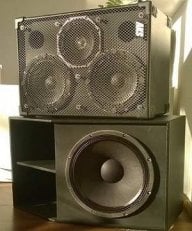
I'm currently designing a new cab based around the design of this one: Traynor Amps: Bass Extension Cabinets
The Traynor is a classic example of how not to build a bass cab. If your going to use a 15 for the lows all you need for the mids is one 6 or 8 for the mids. Look at the fEarful threads to see the right way to build a multi-way bass cab.

i cant find an impedance plot that shows where the peak is, or that particular speaker on the eminence website
At the point where he planned on filtering them it's moot anyway. There's neither an impedance peak nor is the rising impedance from the voice coil inductance anywhere near there.
 
At the point where he planned on filtering them it's moot anyway. There's neither an impedance peak nor is the rising impedance from the voice coil inductance anywhere near there.

The impedance peak (Fb) of the driver in the cab will be around 70hz, this will definitely mess up a 6db/oct network that is trying to achieve a highpass response.
If you want I can show you the response with and without the LCR network, it's a HUGE difference.
A single cap of say 100uf will surely not do the trick.
 
The impedance peak (Fb) of the driver in the cab will be around 70hz, this will definitely mess up a 6db/oct network that is trying to achieve a highpass response.
If you want I can show you the response with and without the LCR network, it's a HUGE difference.
A single cap of say 100uf will surely not do the trick.

Wouldn't it still at least "tame" the lows from the 210 a little? I think that's all he's trying to do, not have the 15 carry the entire bottom. Less than optimal design I know but make the best of it.
 
Considering the parts count, etc. of the lcr network, if he's getting that far into it, may be better to just ditch one of the 10's and do a crossover for a real 2way cab, could figure it for an 8ohm bottom half, 16 ohm top half. Keep it simple, 2nd ord. both ways with the leads flipped on the top half, 4 parts.
 
I'm obviously in over my head here.
No doubt. Designing speakers is not easy, and it doesn't help when commercial outfits produce cabs that they shouldn't, encouraging the uninformed to consider copying a design that they shouldn't.
If you want to spend a few months, or years, perusing the contents here you might come up with something worthwhile:

Invalid Link Removed

Otherwise take advantage of the fEarful thread, where the legwork has already been done for you.
 
Depends on how much topend extension you want. The delta will get you to about 3k, could try it that way first, if it's not high enough, add a tweeter later. You'd have to do a real crossover meaning lowpassing the 15 and highpassing the 10. Use an active crossover or biamp basshead or something first to find the "sweet spot", then start figuring out a passive for that frequency. 6" midranges play up to 5-6k and a lot of folks find they don't need the tweeter at that point. An alpha6 is only like $40 over here and matches sensitivity pretty well with your delta15lf. If it's expensive over there you can use one of your 10's and just play around with it and get it to sound it's best.