Hi there, i recently changed my bridge and i noticed that my E and G strings are not aligned in the middle of the poles of the pickups. This is really frustrating and i would like to know how i can fix this. Thank You.


Enjoy the benefits of a premium membership!
Upgrade Account
-
TalkBass has been independent since 1998. Add your voice.
Create a free account to reply to discussions, view embedded media, and browse with fewer display ads.
Join free Log in
Want zero display ads or expanded classifieds tools? Compare plans.
You are using an out of date browser. It may not display this or other websites correctly.
You should upgrade or use an alternative browser.
You should upgrade or use an alternative browser.
Need help with string alignment. PICTURES INCLUDED.
- Thread starter rhcpbassist
- Start date
More options
Who Replied?
In reality, with that bridge you can't fix it. This is a common problem with that type of bridge on a Jazz bass. Only a vintage Fender with threaded saddles, the new Fender multi groove, or any of the multitude of string spread adjustable bridges can fix it. Relax, my Squier jazz is the same and it really makes little sonic difference. It's doubtful anyone could actually hear a difference.
Ok, I will give you a quick little stab at analyzing this situation and what/where you might want to move. I will say that they are actually centered pretty good - good enough it isn't going to make any sonic difference.
For starters you will have to loosen the strings(duh). Now, remove the saddle from the G string and the E string - you may have noticed the intonation adjustment screw is offcenter on them. Remove the height adjustment screws from the G saddle and flip it over, put the height screws in from that side and put where the E saddle was - you now have a smooth surface to move your string around on once you give it a little tension to pull it straight from the nut to the ball at bridge end. If you are like - "wow, that is perfect" then all you have to do is file a notch where the string is resting and you can continue from there flipping the saddles and swapping left to right. Alternatively, you could file the original slot over toward the direction you feels it should go and take it a little deeper. However....
If you find that, "crap, the hole for the ball end is left/right of where it should be" your choices are "file the hole so ball can scoot over"(you'll still need to adjust the saddles slot one way or another) or move the entire bridge. Personally I don't like putting additional holes in the body so I would opt for adjusting the holes, making them into oblongs and letting the saddle slots do the real alignment. The saddles are usually easy to file - generally just plated brass. The bridge plate itself is probably steel on that style of bridge. YMMV.
Again, the alignment doesn't look like it would change you tone much - music is made by the total fluctuation of the magnetic field. But I understand those little things can be irksome.
Finally, before making any notches in the saddles, look at how the E and G string line up with the side of the neck. There is no point worrying about moving a string over 2mm if that is going to run it too close to the edge of the fingerboard. Your old bridge may have had the string in the same slight misalignment to the poles but after working on it you now are noticing it. Nice thing about the proposed work - saddles are totally replaceable, you really can't screw anything up beyond the cost of some replacement saddles.
BTW - just looked at your profile. Welcome to Talkbass, day 1. Sometimes these places get ugly but keep coming back for the parts you like.
For starters you will have to loosen the strings(duh). Now, remove the saddle from the G string and the E string - you may have noticed the intonation adjustment screw is offcenter on them. Remove the height adjustment screws from the G saddle and flip it over, put the height screws in from that side and put where the E saddle was - you now have a smooth surface to move your string around on once you give it a little tension to pull it straight from the nut to the ball at bridge end. If you are like - "wow, that is perfect" then all you have to do is file a notch where the string is resting and you can continue from there flipping the saddles and swapping left to right. Alternatively, you could file the original slot over toward the direction you feels it should go and take it a little deeper. However....
If you find that, "crap, the hole for the ball end is left/right of where it should be" your choices are "file the hole so ball can scoot over"(you'll still need to adjust the saddles slot one way or another) or move the entire bridge. Personally I don't like putting additional holes in the body so I would opt for adjusting the holes, making them into oblongs and letting the saddle slots do the real alignment. The saddles are usually easy to file - generally just plated brass. The bridge plate itself is probably steel on that style of bridge. YMMV.
Again, the alignment doesn't look like it would change you tone much - music is made by the total fluctuation of the magnetic field. But I understand those little things can be irksome.
Finally, before making any notches in the saddles, look at how the E and G string line up with the side of the neck. There is no point worrying about moving a string over 2mm if that is going to run it too close to the edge of the fingerboard. Your old bridge may have had the string in the same slight misalignment to the poles but after working on it you now are noticing it. Nice thing about the proposed work - saddles are totally replaceable, you really can't screw anything up beyond the cost of some replacement saddles.
BTW - just looked at your profile. Welcome to Talkbass, day 1. Sometimes these places get ugly but keep coming back for the parts you like.
Staring at your bridge pictures some more I'd say the holes in the bridge plate just need to be opened up on the outer side - they look to be closer together than the slots in the E & G are, causing them to have a slight crook to them. Few swipes with a small round/rat-tail file and you'd get that bow out. Hard to see if your saddle notches run all the way around - if so, no point in flipping them - filing over the direction you need is only choice. Ones with only a notch on top give you a second shot by flipping over.
I actually put a bridge like that on a bass that had a much thinner original bridge plate - oh crap, saddles wouldn't go down far enough! Then I started filing on the bottom of them and decided, "heck, I'll flatten these babies to get exactly the height i want and have some real steel2steel contact instead of just the two heigh screw tips. Killer sustain
I actually put a bridge like that on a bass that had a much thinner original bridge plate - oh crap, saddles wouldn't go down far enough! Then I started filing on the bottom of them and decided, "heck, I'll flatten these babies to get exactly the height i want and have some real steel2steel contact instead of just the two heigh screw tips. Killer sustain
^^Uh, the saddles already have notches. There is no smooth surface, just groove all the way around: flipping them will do nothing.
Moving the intonation screw holes over or widening will only increase the space between the saddles and they WILL slop around as he plays. Sorry man, you need to re think what you said.
Moving the intonation screw holes over or widening will only increase the space between the saddles and they WILL slop around as he plays. Sorry man, you need to re think what you said.
I agree.That small a deviation should make no diff sound wise.
If they'd only punch little oblong holes in the plate and let the saddles do the alignment work...
I already mentioned for that possiblity.^^Uh, the saddles already have notches. All the way around: flipping them will do nothing.
On this part you need to re-read brother - I said nothing about moving the intonation screw holes, he would have to drill and tap for that crap. And agreed, that would change nothing. But he can file one side of an individual saddle's notch(whether it goes around or not the string only rests at one point) and the string will center in that changed slot. He can then raise the height screws as needed. My other thought was he could oblong the holes in the end of the bridge plate(E string and G string) so the strings wouldn't have that nasty bend. I've done a lot of this work.Moving the intonation screw holes over or widening will only increase the space between the saddles and they WILL slop around as he plays. Sorry man, you need to re think what you said.
Ahh, other posts by member - this poor bass has already had other issues and tinkering.Go back to your first thread and read about aligning the neck.
You are quite right 96tbird, the issues go back to a time and place this thread cannot address adequately. Sorry I came off huffy with you. PEace.
I already mentioned for that possiblity.
On this part you need to re-read brother - I said nothing about moving the intonation screw holes, he would have to drill and tap for that crap. And agreed, that would change nothing. But he can file one side of an individual saddle's notch(whether it goes around or not the string only rests at one point) and the string will center in that changed slot. He can then raise the height screws as needed. I've done a lot of this work - I know exactly what I am talking about.
You are correct. You said the string holes. I was thinking the other holes in the plate that the screws pass through. My bad. Mini stroke possibly.

All good here - I fast-finger topics waaaay more than one man should.You are correct. You said the string holes. I was thinking the other holes in the plate that the screws pass through. My bad. Mini stroke possibly.

Sometimes this is like trying to help with watch repair via email(I'm a watchsmith) - very unredeeming.


My Squier is exactly the same as what you have pictured. I let it get to me alot when I first noticed it, but after letting go of my anal retentiveness, I realized that it really made no difference in sound, mainly a visual issue. Try to focus on the playing, not the appearance.
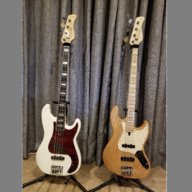
You can use a set of "vintage threaded saddles" with the bridge to give you more control of string positioning. But I agree with unclebass.
All the best,
Bob
All the best,
Bob
of course I'm going to play it, why do you think I'm fixing it and I have most of it fixed already anyways and don't give me an attitude like you know everything because I am just starting on bass repair, thank you.


- Aug 5, 2005
- 7,243
- 92
- Disclosures
- Endorsing Artist: J.C. Basses
I didn't see this in your other thread, but adjusting the neck (as I suggested over there) will not fix the issue because it's affecting both outer strings equally. Your replacement bridge appears to have a slightly smaller string spacing than the stock bridge.
What you could do (although it would be extremely cumbersome for no functional gain), is figure out where the saddles should be (they can be shifted slightly side-to-side) and file some grooves for the set screws, like you can see here:

You may also be able to replace the round saddles with another set that is slightly wider, but with minor variations in Fender replacement parts, that's a bit of a craps shoot.
What you could do (although it would be extremely cumbersome for no functional gain), is figure out where the saddles should be (they can be shifted slightly side-to-side) and file some grooves for the set screws, like you can see here:
You may also be able to replace the round saddles with another set that is slightly wider, but with minor variations in Fender replacement parts, that's a bit of a craps shoot.
I also doubt that is worth worrying about. Having said that, a Schaller roller bridge should solve the (perceived) problem nicely. It looks like you'd end up with a bit wider string spacing though (if that matters).
Or, as other have suggested, you could install Fender threaded-rod saddles on the bridge you currently have.


